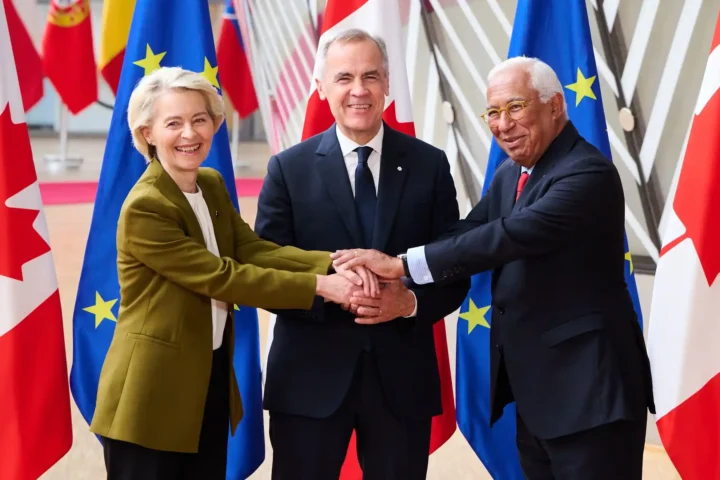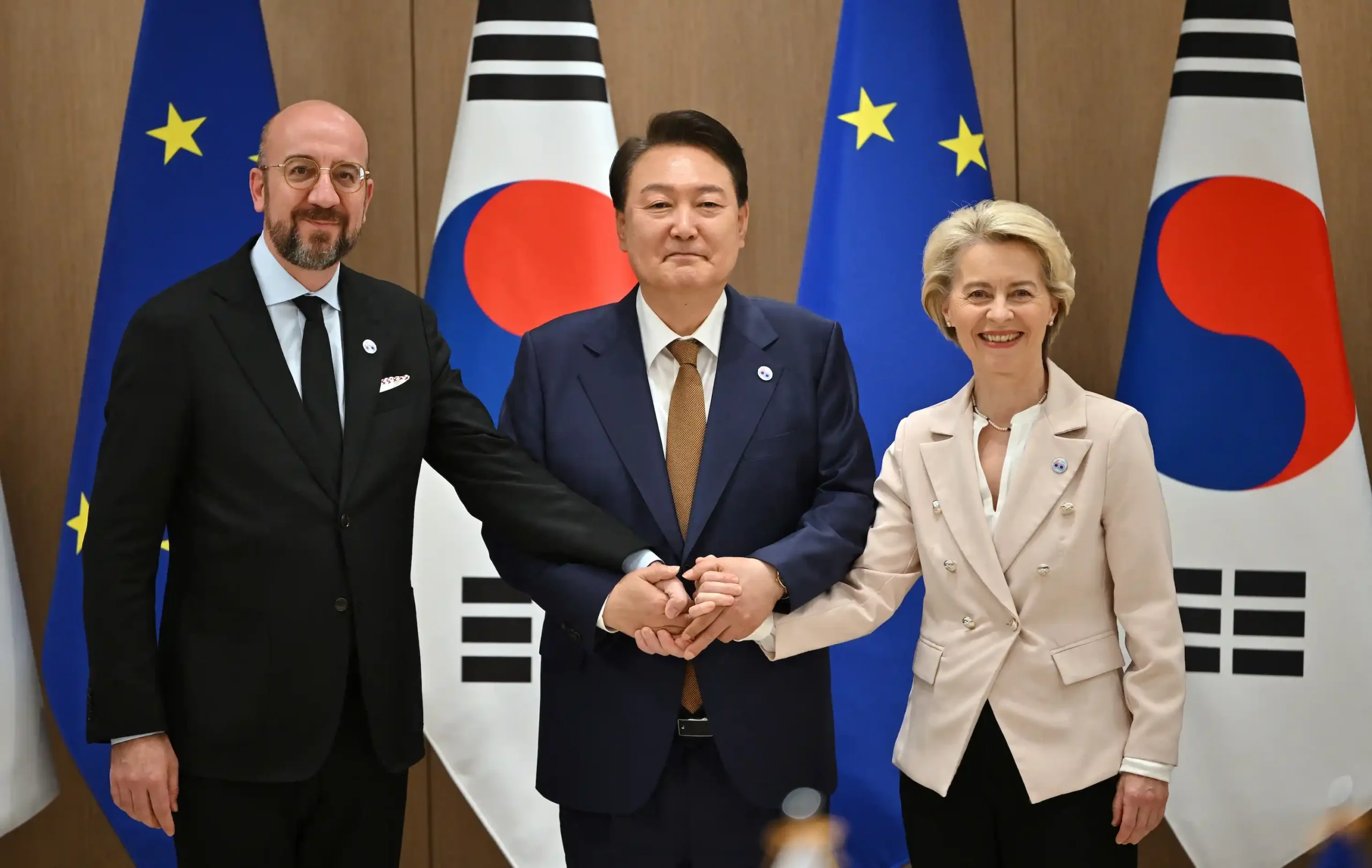
South Korean president arrives in Brussels with a soundtrack. K-pop — long one of Seoul’s most effective soft power tools — sets the tone for the first EU–South Korea summit in three years. But beneath the cultural choreography lies a far more strategic agenda: semiconductors, supply chains, defense cooperation, and the delicate question of China.
The symbolism matters. Europe is rediscovering Asia not just as a market, but as a geopolitical partner in an era of fractured globalization. South Korea, with its technological prowess and democratic credentials, is an obvious fit. Yet this visit also highlights a broader recalibration underway in Brussels — one that increasingly includes, and in some areas prioritizes, partners like India.
For Seoul, the stakes are immediate. The global semiconductor race has turned into a contest of resilience as much as innovation. South Korea’s chip giants, already central to global supply chains, are navigating mounting pressure to diversify away from China without severing ties completely. The European Union, eager to reduce its own strategic dependencies after pandemic-era shocks and the war in Ukraine, sees Korea as a natural collaborator in building a more secure and transparent chip ecosystem.
Trade is the second pillar. The EU–South Korea Free Trade Agreement, once a model of modern trade architecture, now needs updating for a world shaped by digital commerce, green transitions, and industrial policy. Brussels wants deeper alignment on standards and sustainability. Seoul, in turn, is seeking stable access to European markets as global demand patterns shift.
Defense, once a quieter aspect of the relationship, is moving to the foreground. Russia’s war in Ukraine has transformed Europe’s security outlook, and South Korea’s growing defense industry — from artillery to advanced systems — has found new relevance. The summit is expected to expand cooperation in defense technology and security frameworks, reflecting a shared concern about authoritarian assertiveness.
And then there is China — the unspoken constant in nearly every conversation. Both the EU and South Korea are trying to strike a careful balance: reducing strategic vulnerabilities without triggering outright confrontation. This shared ambiguity creates space for coordination, but also limits how far either side is willing to go.
It is in this context that India’s rising profile becomes harder to ignore. While South Korea offers technological depth and manufacturing strength, India brings scale, political alignment, and a growing role in global supply chain diversification. For the EU, India represents not just an alternative production base, but a long-term strategic partner with whom it can co-develop norms in digital governance, green energy, and infrastructure.
Recent momentum in EU–India trade negotiations, alongside expanding cooperation in critical technologies, reflects this shift. European policymakers increasingly view India as a stabilizing counterweight in the Indo-Pacific — one that complements relationships with countries like South Korea rather than competes with them. The contrast is subtle but significant: where Seoul is indispensable in specific high-tech sectors, India is becoming central to the EU’s broader geopolitical and economic strategy.
The Brussels summit, then, is not just about renewing ties with South Korea. It is part of a wider European effort to build a network of trusted partners across Asia, each serving a distinct role in a more fragmented world order.
K-pop may open the doors, but it is chips, trade routes, and strategic alignments that will define what comes next. And as Europe looks east, it is increasingly clear that its future partnerships will not hinge on a single country — but on a carefully balanced portfolio, in which both South Korea and India are set to play pivotal roles.