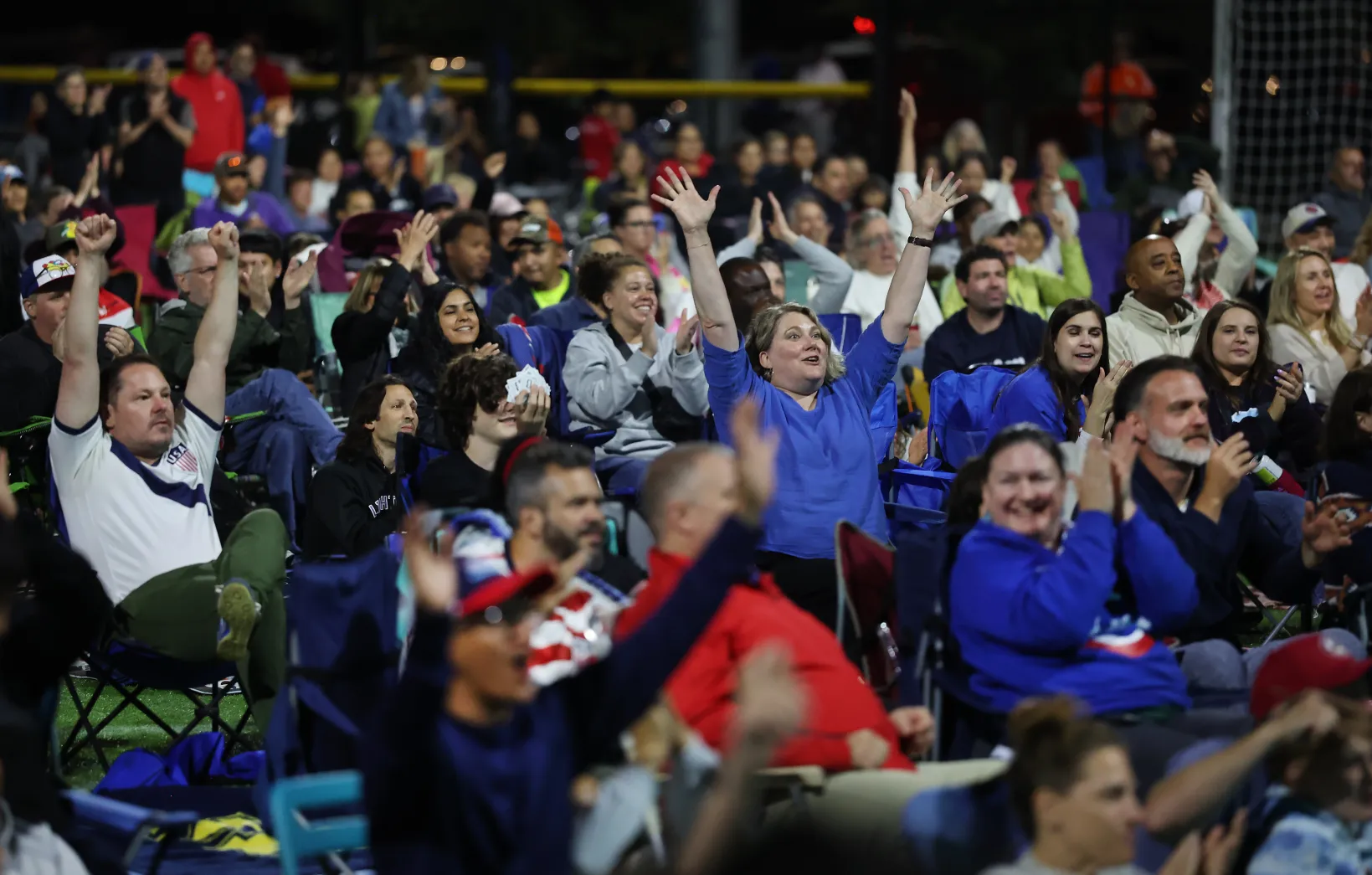
There is a moment in every big sporting event when a stadium, a bar, or a living room full of strangers becomes, briefly, a single organism. Everyone is watching the same ball, feeling the same dread or hope, and for a few minutes the usual social walls come down. It is exactly the kind of moment political organizers dream about, and it is exactly the moment the Democratic National Committee is trying to seize with its World Cup watch-party strategy.
The plan is simple to describe: set up shop at bars, restaurants, parks, and FIFA fan zones where people are already gathering to watch the World Cup, and use that captive, emotionally engaged crowd to register new voters. It is smart, modern retail politics. It is also, if the party is honest with itself, a tactic — not a substitute for the slower, harder work of building durable political relationships year-round.
Start with what the strategy gets right. The DNC’s broader initiative, called When We Count, is explicitly aimed at young people who are already in the workforce, not just the students on college campuses that voter-registration drives have traditionally targeted. That distinction matters more than it might sound. College campuses are easy to organize because they are dense, enclosed, and full of a captive audience with a lot of free time. But most young adults are not on campus. They are bartending, working retail, driving for a rideshare app, or clocking in at a warehouse. They do not have a campus green where a registration table can casually intercept them. They do have bars showing the match on a Saturday afternoon.
That is the insight driving this push: meet people where their attention already is, rather than trying to manufacture attention from scratch. A political scientist quoted in the reporting on this effort made the case plainly — the social energy generated by a mega-event like the World Cup can make turnout and registration work unusually effective, because people show up already primed to be social, engaged, and a little bit emotionally open. Nobody has to be talked into caring about something for the first time; they are already invested in the outcome on the screen, and that investment can be a bridge to a different kind of civic investment.
This is not a wild theory. It is the same logic that has made tailgates, block parties, and church picnics effective organizing venues for a century. What is new is the specific vehicle — a genuinely global, quadrennial event that pulls in casual fans, diaspora communities, and people who otherwise tune out domestic politics almost entirely.
Where It Is Likely to Work
The strategy is not being deployed everywhere with equal intensity, and that is a good sign of discipline rather than a scattershot approach. The effort is concentrated in battleground states — Arizona, Pennsylvania, Florida, and others — along with dense urban areas where organizers can reach large numbers of people quickly and target specific demographics with some precision. This is where retail politics tends to pay off: in places where the electoral margins are thin enough that a few thousand new registered voters can matter, and where the population density makes each hour of canvassing or tabling more efficient.
It also helps that this is not being staged as a one-off publicity stunt. The DNC says it is backing the watch-party push with a national training series for more than 1,500 organizers, staff, and volunteers. That is infrastructure, not improvisation. Voter registration drives that evaporate the day after the cameras leave tend to produce voters who never show up to the polls; registration drives backed by trained organizers who can follow up, answer questions, and build relationships tend to produce voters who actually turn out. The training series suggests the party understands that distinction, even if it does not always act on it.
Limits of a Crowd
But there is a structural problem with any strategy built around gathering places, and it is worth naming clearly: watch parties are crowded, but they are not representative. The people who show up to a bar or a fan zone to watch a match are, by definition, socially engaged, mobile, and already inclined toward public participation. They are not the disengaged, alienated, or distrustful voters that Democrats most need to reach if they want to expand the electorate rather than simply activate people who were already halfway there.
The party’s own framing acknowledges this. When We Count is explicitly built around young voters and voters of color, especially those without a college degree — a population that is harder to reach precisely because they are less likely to be embedded in the kinds of civic and institutional networks that traditional organizing relies on. A World Cup watch party in a battleground-state bar might catch some of these voters. It will not catch all of them, and it may disproportionately catch the ones who were already reachable through other means.
There is also a more delicate risk: the risk of looking opportunistic. A World Cup celebration is not a campaign rally, and sports fans — an audience famously resistant to having their leisure time politicized — can turn hostile fast if an event feels like a partisan intrusion rather than an organic part of the festivities. The strategy’s success depends heavily on tone. Done well, it feels like a friendly conversation with someone at the next table who happens to have a clipboard. Done poorly, it feels like a campaign booth dropped uninvited into someone else’s party. The difference between those two experiences is not a matter of message discipline in the traditional sense; it is a matter of restraint, local knowledge, and letting the event actually be about soccer first.
Visibility Is Not Persuasion
The largest risk, though, is conceptual rather than tactical. It would be easy for a party still bruised by recent electoral losses to mistake visibility for persuasion — to treat a viral clip of an organizer registering voters outside a fan zone as evidence of momentum, when in fact registration is only the opening move in a much longer game. Registering someone to vote at a World Cup watch party tells you almost nothing about whether that person will show up in a midterm election eighteen months later, whether they will trust the party enough to volunteer their time, or whether they will bring a friend along next cycle. That requires follow-up. It requires local trust built over months, not minutes. It requires message discipline that holds up long after the World Cup trophy has been handed out and the fan zones have been dismantled.
This is where the strategy’s placement inside the broader When We Count framework matters most. The initiative already includes organizing fellowships, sustained weeks of action, and targeted battleground-state investment — the scaffolding that is supposed to catch a newly registered voter and turn them into an engaged one. The World Cup push is not meant to be the whole strategy; it is meant to be an unusually efficient entry point into it.
If Democrats treat the World Cup as an opening act — a burst of energy that gets funneled immediately into the slower work of organizing, follow-up, and trust-building — this could be one of the more creative and effective registration efforts the party has run in years. If they treat it as the main event, a highlight reel to be proud of rather than a foundation to build on, it will be remembered as a clever summer stunt that generated a lot of goodwill and not much else. The difference will not be visible this July. It will be visible in November, long after the World Cup itself has been forgotten by everyone except the people who won.