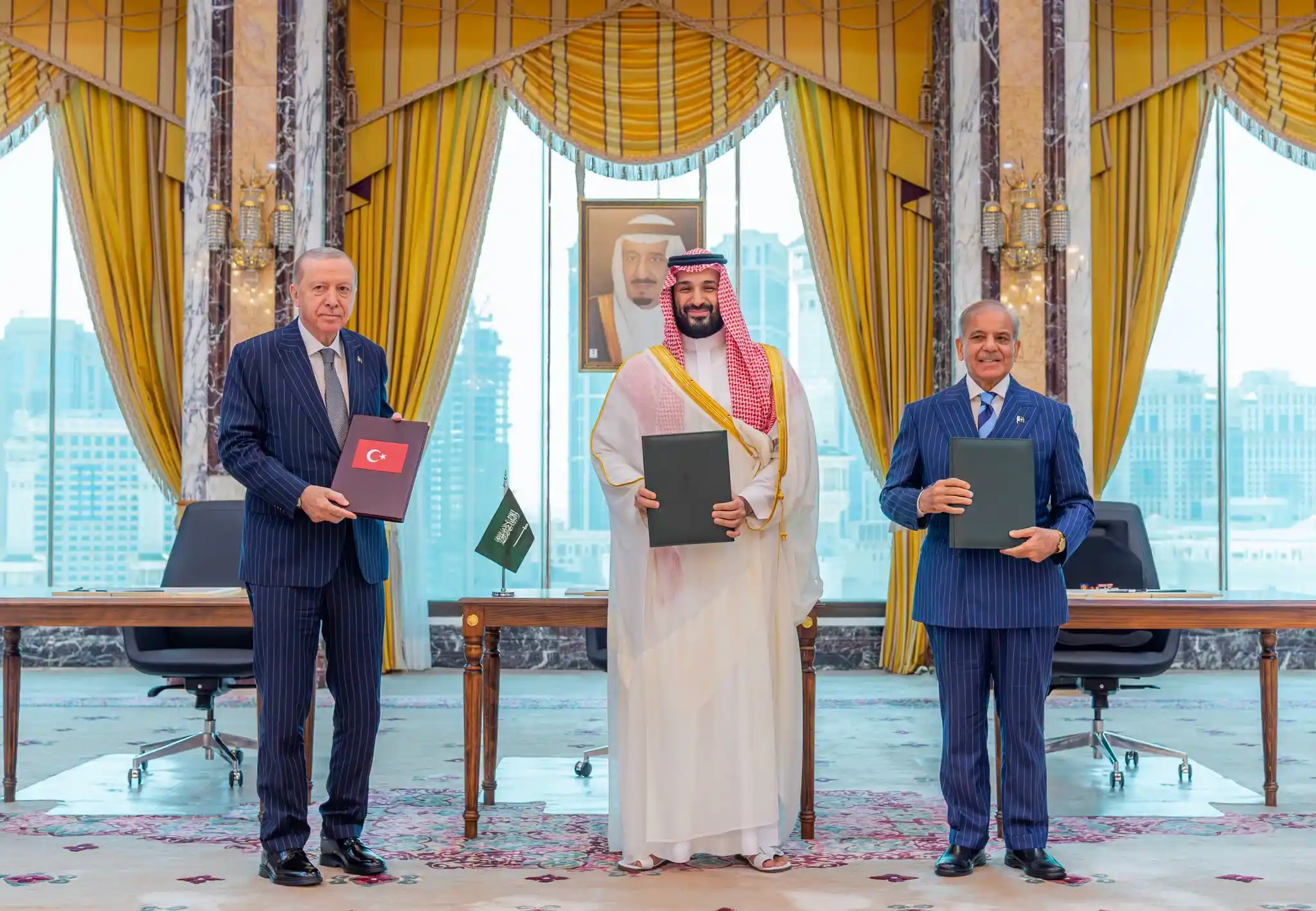
When Crown Prince Mohammed bin Salman, President Recep Tayyip Erdogan and Prime Minister Shehbaz Sharif stood together in Mecca to sign a mutual defense pact, the world’s headline writers reached instinctively for the easiest available shorthand: an “Islamic NATO” had been born. The language was almost irresistible. Here were three of the Muslim world’s most consequential military powers — one with bottomless oil wealth, one with a NATO-trained defense-industrial complex exporting drones across three continents, and one with a nuclear arsenal and the world’s sixth-largest army — pledging that an attack on one would be treated as an attack on all.
It is a seductive image. It is also a mirage.
The Mecca Joint Defence Agreement will not become a Middle Eastern equivalent of the alliance that anchored Western security for seventy-five years, and understanding why matters far more than celebrating or condemning the signing ceremony itself. NATO was never simply a promissory note. It was — and remains — a piece of institutional architecture: an integrated command structure at Supreme Headquarters Allied Powers Europe, standardized ammunition calibers, interoperable radar networks, standing multinational corps, and, most important of all, a single, unambiguous enemy that every member could point to on a map. The Mecca pact has none of this. It has a signing photograph, a shared podium, and three governments whose definitions of “threat” scarcely overlap at all.
A Pact With No Common Enemy
Start with the most basic requirement of any functioning alliance: agreement on who the adversary is. NATO’s genius was that West Germany, Norway, Turkey and the United States could all look eastward and see the same tanks massing on the same horizon. Riyadh, Ankara and Islamabad enjoy no such clarity.
Saudi Arabia’s strategic anxieties center on Iranian missile and drone capabilities and the constellation of proxy militias Tehran has cultivated from Yemen to Iraq — threats that bear directly on the kingdom’s oil infrastructure and on Crown Prince Mohammed’s signature Vision 2030 economic transformation. Turkey’s threat perception runs almost entirely in a different direction: Kurdish separatist movements along its southern border, maritime boundary disputes in the Eastern Mediterranean, and a broader ambition to project power into the Levant and North Africa through defense exports and expeditionary reach. Pakistan’s strategic universe, meanwhile, is dominated overwhelmingly by a single fixation — India — with more than four-fifths of its conventional military posture oriented toward its eastern border, alongside a grinding internal counterinsurgency and a fragile economy perpetually on the edge of default.
These are not variations on a theme. They are three separate strategic worlds that happen to share a religion and a signing table. When national interests diverge this sharply, the phrase “an attack on one is an attack on all” stops being a deterrent and becomes a diplomatic embarrassment waiting to happen. If Turkish forces clash with Kurdish militias or find themselves in a standoff over gas exploration rights in the Eastern Mediterranean, does anyone seriously expect Pakistani brigades to mobilize toward Europe’s edge? If skirmishes flare again along the Line of Control with India, will Saudi Arabia jeopardize a trade and technology partnership with New Delhi worth many multiples of its dealings with Islamabad in order to honor a treaty clause? History, and plain self-interest, both answer no.
The Fault Line Beneath the Handshake
The deeper problem is not merely that these three states lack a common enemy — it is that they do not entirely trust one another either, and for good reason. The most consequential fracture in any prospective Sunni security architecture does not run between the signatories and Iran. It runs between Ankara and the Gulf.
Saudi Arabia and Turkey have indeed achieved a tactical rapprochement in recent years, after a period of open hostility triggered by Turkey’s enthusiastic backing of Muslim Brotherhood movements in the wake of the 2011 Arab uprisings, the Gulf blockade of Qatar, and the diplomatic wreckage left by the murder of Jamal Khashoggi in the Saudi consulate in Istanbul. But a tactical thaw is not a durable alignment of worldview, and nowhere is that gap more visible than in the states’ relationship to political Islam and to Israel.
The United Arab Emirates — pointedly absent from the Mecca signing, and a useful bellwether for Gulf thinking even though it did not sign — regards the Muslim Brotherhood and its ideological offshoots as an existential threat to monarchical rule itself, not an abstract political dispute. That puts Abu Dhabi, and by extension much of Riyadh’s own establishment, in direct tension with President Erdogan, whose political movement has its roots precisely in that Brotherhood tradition. Layer onto this the fact that the UAE and Saudi Arabia have spent a decade quietly and then openly building commercial and security ties with Israel, formalized through the Abraham Accords, even as Turkey hosts Hamas political leadership and positions itself as the region’s loudest critic of Israeli policy. A defense pact cannot easily survive a condition in which one signatory’s chosen ally is another signatory’s ideological adversary. That is not a minor wrinkle to be papered over in a joint communiqué; it is a structural contradiction at the pact’s core.
The Pakistan Precedent
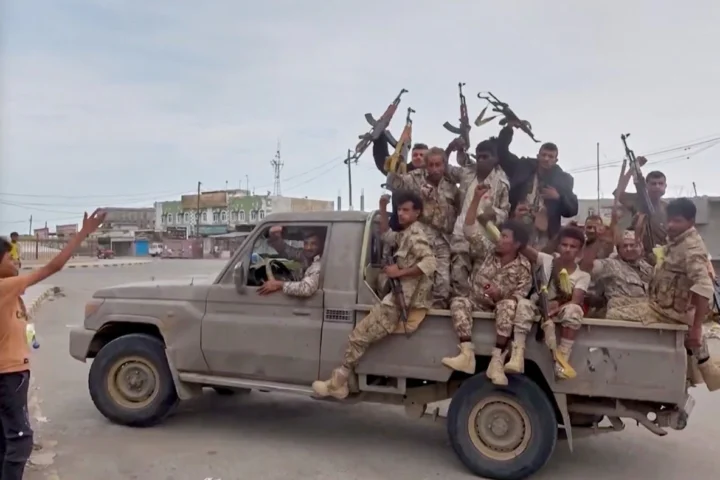
If Turkey supplies the ideological fault line, Pakistan supplies the cautionary case study — because this is not a hypothetical question of whether Islamabad would show up for a Gulf war. We already know the answer. In 2015, when Saudi Arabia asked Pakistan to contribute ground troops to the military coalition fighting Houthi forces in Yemen, Pakistan’s parliament voted unanimously to stay out. Lawmakers understood, correctly, that inserting Pakistani soldiers into a conflict with unmistakable sectarian overtones risked inflaming tensions with Pakistan’s own substantial Shia population and dragging the country into a war disconnected from its actual security needs.
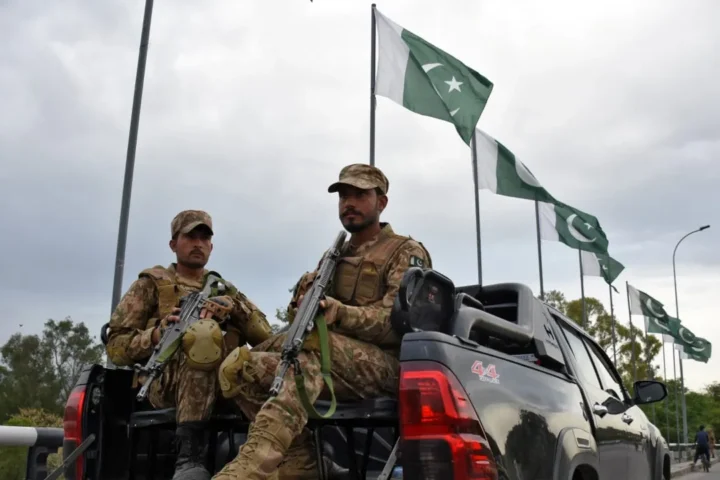
Nothing about Pakistan’s position has changed in the decade since. Its army remains oriented overwhelmingly toward India. Its treasury remains dependent on periodic bailouts from the very Gulf capitals it would theoretically be pledged to defend — and, in an irony that undercuts the entire premise of the pact, those same Gulf capitals have simultaneously poured investment into India through initiatives like the India-Middle East-Europe Economic Corridor. Neither Riyadh nor Abu Dhabi shows any appetite for jeopardizing its relationship with New Delhi to satisfy Pakistani grievances over Kashmir. Pakistan can lend Saudi Arabia nuclear prestige and military training missions. What it cannot credibly offer is combat divisions on a foreign battlefield, and everyone at the table in Mecca knows it.
A Long History of Paper Alliances
None of this should surprise anyone who has watched the Middle East attempt this experiment before, repeatedly, and watched it fail. The Baghdad Pact of 1955, engineered with heavy Western backing to contain Soviet influence, disintegrated within a few years under the weight of Arab nationalist backlash and collapsed outright after the 1958 coup in Iraq. The Arab League’s own Collective Security Pact, signed in 1950, never coordinated a meaningful joint response through any of the region’s major wars — it existed on paper and nowhere else. The Islamic Military Counter Terrorism Coalition, unveiled by Riyadh in 2015 with a headline-grabbing 41 member states, has spent a decade struggling to define its own operational mission. The Middle East Strategic Alliance, floated by the Trump administration in 2018 as an explicit “Arab NATO” aimed at containing Iran, fell apart before it ever assembled a single joint unit, undone when Egypt withdrew over fears about ceding sovereignty and provoking Tehran unnecessarily.
The pattern across seven decades is remarkably consistent. Middle Eastern governments, almost without exception, are autocracies or near-autocracies whose first priority is regime survival, and regime survival is best served by retaining total control over one’s own military. Ceding operational command to a multinational structure, or accepting the permanent presence of another state’s troops on one’s own soil, is treated not as a security enhancement but as a sovereignty risk — and, in the more paranoid corners of these capitals, as an invitation to future coercion or interference in domestic politics. That calculus has not changed, and nothing in the Mecca agreement’s text suggests it will change now.
What the Pact Actually Is
None of this means the Mecca signing was meaningless theater. It was not. It simply needs to be understood for what it actually is: a piece of transactional hedge diplomacy conducted by three governments each pursuing distinct, self-interested goals under a shared banner.
For Saudi Arabia, the agreement is a signal aimed less at Tehran than at Washington — a demonstration that Riyadh has alternatives to American security guarantees and American defense contracts if the relationship sours or the U.S. commitment to the Gulf continues to look uncertain. For Turkey, it is an opening into Gulf capital and an expanded customer base for a defense manufacturing sector, led by firms like Baykar, that has become one of Ankara’s most successful instruments of global influence. For Pakistan, it is a mechanism for extracting continued financial liquidity and energy concessions from Riyadh in exchange for military training and advisory relationships that cost Islamabad little and commit it to even less.
These are all rational, even shrewd, national strategies. What they are not is the foundation of a mutual-defense alliance capable of surviving contact with an actual crisis. When the next serious test arrives — a large-scale Iranian strike on Gulf infrastructure, a direct Turkish-Israeli confrontation, a flare-up on the Pakistan-India border — each of these governments will act according to its own immediate calculus of self-preservation, exactly as it always has. A signature in Mecca will not override decades of divergent threat perception, competing regional ambitions, and an unbroken institutional instinct to guard sovereign control over the use of force.
Commentators eager to declare a new pole of global power should resist the temptation. What was announced in Mecca is not the birth of an Islamic NATO. It is the latest entry in a long ledger of regional pacts that generated impressive headlines and modest substance — a dramatic photograph standing in for an alliance that, absent a shared enemy, a unified command and a common strategic vision, does not yet exist and, on present evidence, is unlikely to.