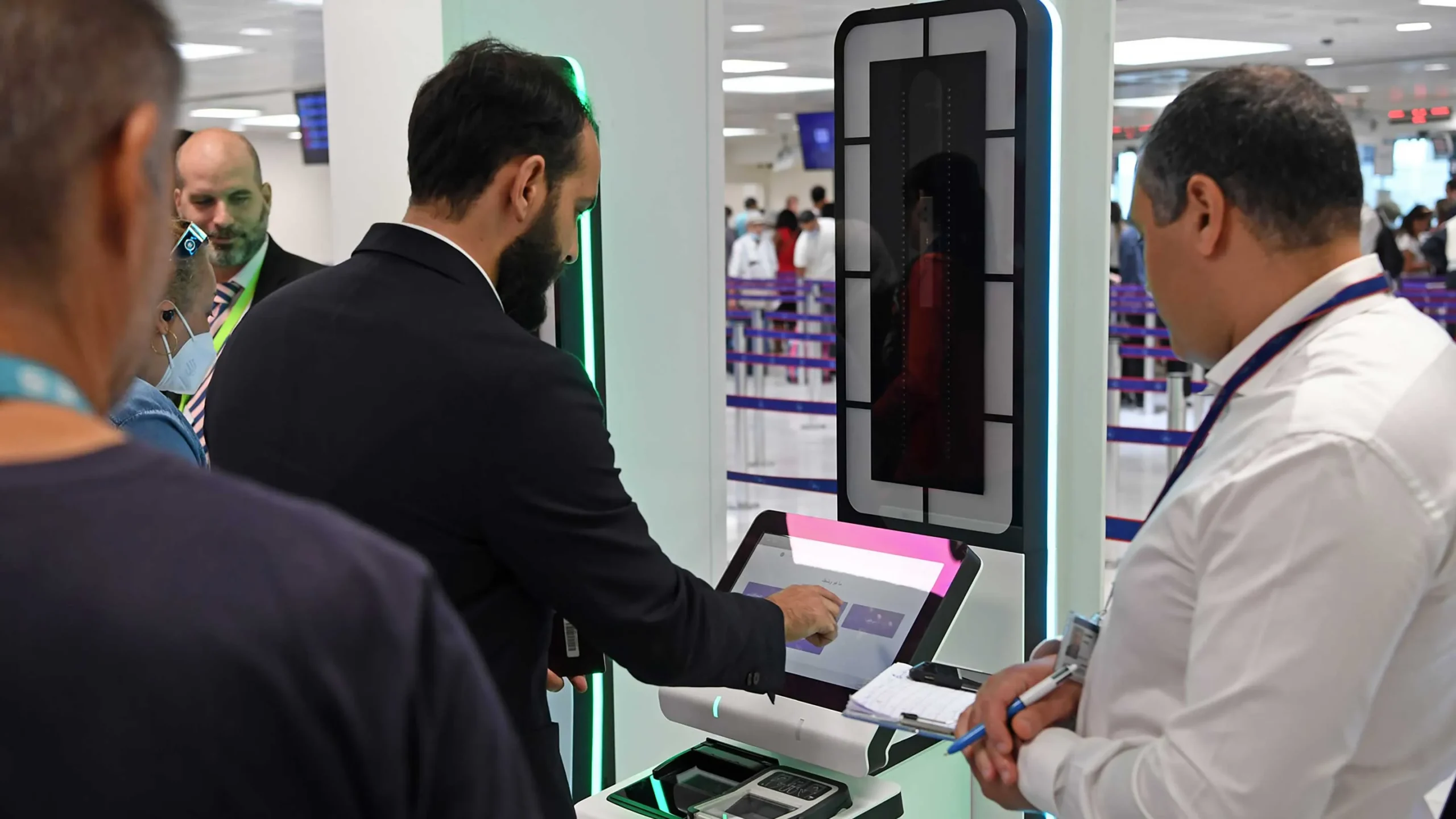
At Paris Charles de Gaulle Airport on a humid August morning, the future of European security sits bathed in an idle blue LED glow. Dozens of sleek, multi-million-euro biometric kiosks—designed to capture high-definition facial scans and ten-finger digital prints of every arriving non-EU national—stand completely turned off.
Beside them, border officers wave thousands of weary travelers through manual passport lanes with a flick of the wrist, reverting to the very paper-and-ink routines the new technology was built to destroy.
Similar scenes are playing out across Europe’s major gateways, from Amsterdam Schiphol and Frankfurt to Brussels, Milan, and Lisbon. Facing catastrophic terminal gridlock, missed connecting flights, and border queues that routinely stretch past two to four hours, airport directors and national border authorities have embraced a surprisingly low-tech solution to their high-tech nightmare: when overwhelmed, just flip the breaker.
This quick fix is not a rogue rebellion by overwhelmed airport staff; it is explicitly permitted under European Union regulations. Yet it highlights a profound structural failure at the heart of European policy. The EU’s ambitious Entry/Exit System (EES)—gradually phased in starting in October 2025 and fully enforced since April 10—was meant to herald a seamless, bulletproof digital era for the Schengen Area. Instead, the summer travel season has laid bare a farce: the world’s most sophisticated biometric border infrastructure only functions smoothly when almost nobody is using it.
The Technocratic Promise
To understand how Europe ended up in this bizarre predicament, one must look at the grand design behind the EES. For decades, tracking the short-stay movements of third-country nationals across the 29 Schengen member states relied on manual passport stamping—an analog relic prone to forgery, human error, and systemic evasion.
The EES was conceived as the definitive technological answer. By mandating biometric registration (facial image and four fingerprints) for every non-EU traveler staying up to 90 days, the database would automatically calculate allowed stays, track overstayers in real time, and instantly flag identity fraud. Coupled with the upcoming European Travel Information and Authorization System (ETIAS), Brussels promised a modernized “smart border” that would enhance security while accelerating transit for legitimate travelers.
However, there was always a fundamental flaw in the math.
Biometric enrollment is a high-touch, time-intensive process. Scanning a passport takes seconds; positioning an unfamiliar traveler in front of a biometric camera, prompting them to align their fingers correctly on a digital plate, and troubleshooting hardware read errors takes minutes. According to data from Airports Council International (ACI) Europe, first-time registration increases processing times per passenger by upwards of 70 percent.
When a single wide-body jet from London, New York, or Tokyo lands, it unleashes 300 to 400 travelers into the arrivals hall who simultaneously require first-time enrollment. When ten such flights land within an hour, the mathematical result is not a temporary delay; it is operational collapse.
The Reality of Summer Gridlock
The cracks began to show during the phased rollout late last year. Lisbon Airport offered a terrifying preview when severe software glitches and processing backlogs caused queues to swell to an unthinkable seven hours, forcing authorities to suspend the system entirely for three months. Similar meltdowns occurred in Spain and Portugal, where automated gates crashed under high load, leaving border guards scrambling to locate physical rubber stamps they had been told to phase out.
Industry trade bodies—including ACI Europe, Airlines for Europe (A4E), and the International Air Transport Association (IATA)—sent joint, urgent warnings to EU leadership. They cited a “complete disconnect” between the utopian visions engineered in Brussels conference rooms and the messy reality of airport terminal geometry, chronic police understaffing, and buggy vendor software.
When full enforcement arrived in April, those warnings proved prophetic. By the time peak summer vacation traffic hit in July and August, processing halls became pressure cookers. Passengers missed connection flights by hours, temperature levels inside crowded terminals soared, and security personnel expressed safety concerns regarding crowd control.
Faced with public outrage and potential safety hazards, border authorities exercised their legal right under Schengen rules: they invoked emergency flexibility clauses, turned off the kiosks, and opened manual lanes.
The “Turn It Off” Clause: Pragmatism or Policy Failure?
Proponents of the current system argue that turning off biometric checks is a feature, not a bug. The legal framework governing the EES contains explicit flexibility provisions allowing member states to temporarily ease or pause biometric checks during exceptional traffic peaks to prevent dangerous border congestion. Under these rules, national authorities can suspend full registration for up to 90 days post-rollout, with a potential 60-day extension.
From a purely operational perspective, this pragmatic safety valve is essential. No airport director can allow terminal concourses to overflow into dangerous conditions.
Yet from a policy perspective, this rationale collapses under its own irony. If a security system must be suspended precisely when passenger volume is highest, it fails at its primary objective. Peak summer travel is not an unforeseen black swan event; it is an annual, predictable reality of global commerce and tourism.
By routinely switching off biometric checks during heavy arrival waves, Europe creates an absurd security vacuum. It effectively signals that security checks are mandatory during quiet Tuesday afternoons, but optional on busy Friday mornings. Furthermore, toggling between digital logging and manual stamping dilutes the integrity of the central database, generating massive gaps in overstay tracking—the exact problem EES was created to solve.
Grand Tech, Fragile Ground
The EES debacle exposes a chronic ailment in modern European governance: the tendency to deploy complex technological solutions to complex political problems without investing in the underlying physical capacity needed to run them.
Brussels designed a centralized digital border architecture requiring state-of-the-art hardware, robust fiber networks, and synchronized databases across 29 sovereign nations. However, the actual execution was dumped onto national governments, local police forces, and private airport operators—many of whom lacked the capital, space, or personnel to adapt.
- Physical Spatial Constraints: Many older European terminals simply lack the floor square-footage to house dozens of additional registration kiosks alongside traditional queueing lanes.
- The Staffing Deficit: Automated kiosks do not eliminate human border officers; they require trained personnel to oversee biometric exceptions, assist confused travelers, and conduct manual secondary checks. Across Europe, border police forces face severe, ongoing recruitment shortages.
- Fragmented Software: A lack of standardized pre-registration apps across Schengen members meant that travelers arrived at the border cold, performing the entire initial data-entry process at physical airport gates rather than on their smartphones prior to departure.
Fixing the Fortress Before ETIAS Arrives
The current strategy of “turn it off and try again later” cannot become the permanent operational model for European travel. With the European Travel Information and Authorization System (ETIAS) set to layer additional digital pre-screening onto non-EU travelers in the near future, Europe risks compounding technological failure upon technological failure.
To escape this loop of summer meltdowns and emergency shutdowns, European policymakers must confront reality:
- Universal Mobile Pre-Enrollment: The EU must mandate and aggressively roll out a unified, user-friendly mobile application that allows travelers to upload passport data, take compliant facial photos, and answer standard border questions before boarding their flights. Capturing fingerprints at the gate is manageable; capturing basic personal data on-site is an unacceptable waste of throughput.
- Standardized Hardware and Infrastructure Grants: The EU must co-fund terminal expansions and standardized kiosk technology, ensuring that smaller gateways are not left relying on unstable hardware.
- Dedicated Border Staffing Mandates: Digital borders require more human intelligence, not less. Schengen states must tie border police funding directly to national airport throughput targets.
Technology should streamline human mobility, not paralyze it. Until European leaders bridge the gap between high-minded digital security directives and the physical reality of airport operations, the Schengen border will remain a digital fortress with a very prominent, embarrassing off switch.