Google’s massive data centre project in a small Austrian community is becoming a test of how far Europe is willing to stretch its energy and environmental systems in pursuit of the artificial intelligence boom.
A quiet corner of Upper Austria is emerging as an unlikely battleground over the future of Europe’s digital economy.
In Kronstorf, a small community near the foothills of the Alps, Google is developing Austria’s first hyperscale data centre — an enormous computing facility designed to support cloud services and the rapidly expanding infrastructure required for artificial intelligence.
The scale of the project is striking. If eventually developed to its planned maximum capacity, the facility could require around 4.4 terawatt-hours (TWh) of electricity annually. By comparison, Vienna’s roughly two million residents consume about 3.4 TWh through their households.
At full scale, the Kronstorf complex could therefore consume more electricity than all of Vienna’s homes combined and account for the equivalent of roughly 7 per cent of Austria’s present electricity demand.
For Austria, the project represents both an economic opportunity and a difficult question: how much energy should a country devote to the infrastructure behind the global AI race?
From farmland to digital infrastructure
Kronstorf offers many of the characteristics technology companies seek when choosing locations for large data centres. There is relatively flat land, access to water from the nearby River Enns for cooling and major electricity infrastructure close to the site.
Construction is already transforming the landscape.
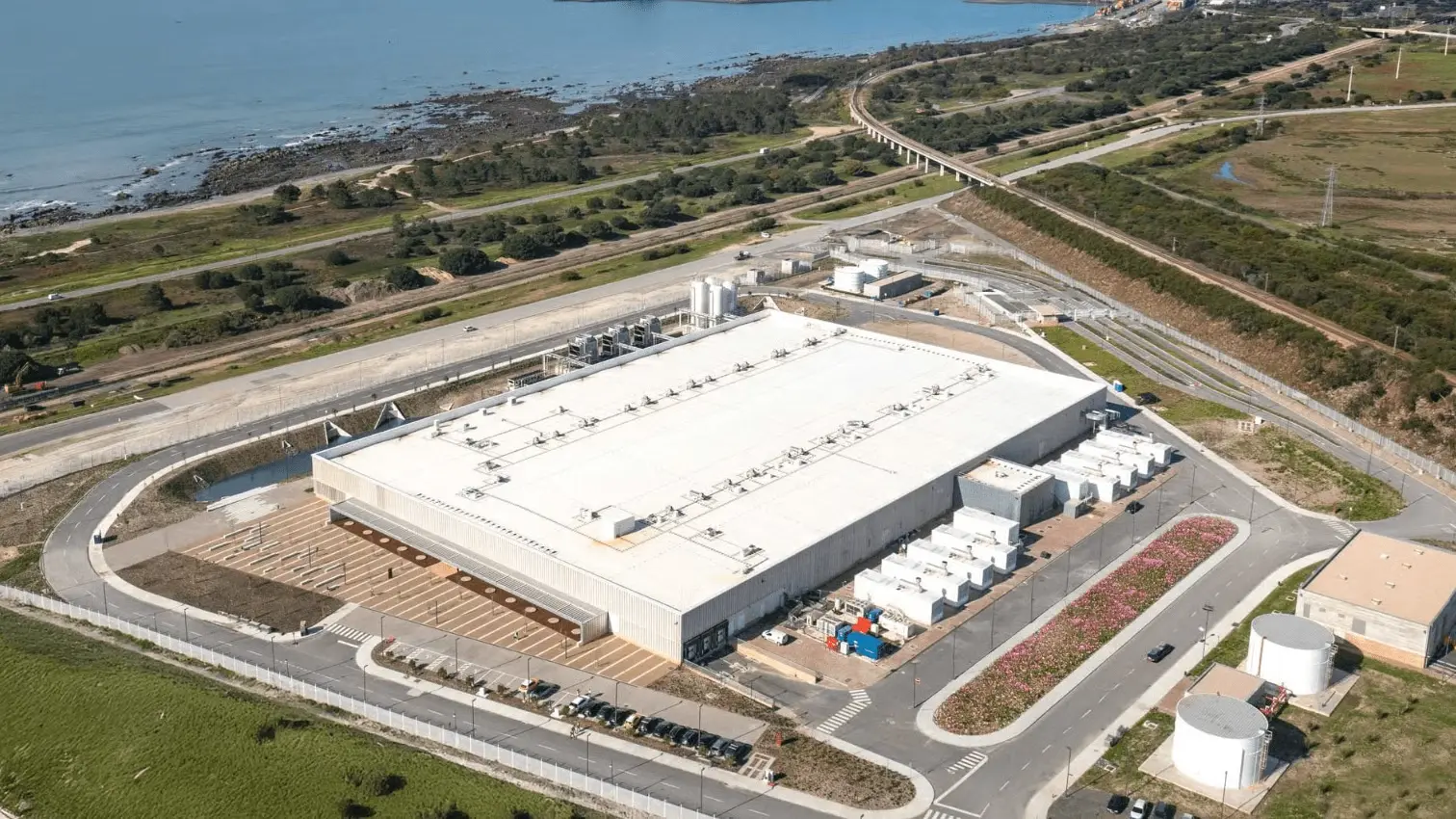
Server buildings are taking shape, while the electricity infrastructure required to supply the complex is being expanded. Pumping facilities near the Enns are intended to provide cooling water.
Google has also sought to reduce or compensate for the project’s environmental footprint. Plans include rooftop solar panels, support for improvements to the local river ecosystem and woodland planting near the development.
But those measures have done little to reassure a group of scientists, environmental campaigners and residents who have organised against further expansion.
Their campaign is not primarily focused on halting the first phase, which is already under construction. Instead, activists hope to prevent the project from growing into the much larger facility envisaged in later plans.
Freshwater ecologist Christina Gruber is among those questioning whether a project of this size can genuinely be considered sustainable.
Her concerns range from the conversion of agricultural land to water consumption and, above all, the enormous quantity of electricity the facility would require.
Local campaigner and IT specialist Harald Müllner has similarly argued that the development raises questions extending beyond one Austrian village: who should control strategically important digital infrastructure, who receives the economic benefits and who ultimately bears the environmental and energy costs?
The electricity question
The project’s energy requirements sit at the centre of the controversy.
Its initial phase is expected to have a power requirement of about 150 megawatts. Because hyperscale data centres operate continuously, that translates into annual electricity consumption of approximately 1.31 TWh.
A future expansion could increase capacity to around 500 MW and annual electricity consumption to approximately 4.4 TWh.
Austria appears, at first glance, particularly well suited to hosting such a facility. Almost 90 per cent of its electricity comes from renewable sources, with hydropower playing an especially important role.
That clean electricity supply is one reason Austria is attractive to Google, which has set a goal of operating its data centres with clean energy around the clock by 2030.
The problem is that renewable electricity is not unlimited.
Austria’s heavy dependence on hydropower also leaves generation vulnerable to changing rainfall and drought conditions. During particularly dry periods, hydroelectric production can fall significantly.
Critics fear that simultaneously increasing electricity demand through large data centres while climate change puts pressure on hydroelectric generation could eventually create strains elsewhere in the system.
Electricity prices are another concern.
Christoph Dolna-Gruber of the Austrian Energy Agency has warned that if substantial new electricity demand is not accompanied by additional generation, upward pressure on prices is possible. Austria’s participation in the interconnected European electricity market makes the eventual impact on household bills difficult to calculate precisely.
The Austrian government maintains that the electricity network is capable of accommodating the development. At the same time, officials acknowledge that future growth in data centres will have to be accompanied by investment in renewable generation, stronger electricity grids, energy storage and greater flexibility within the power system.
There is also a less visible fossil-fuel component to the project.
Google’s plans include large diesel generators capable of supplying emergency electricity during a blackout. Such backup systems are standard for data centres, where even brief interruptions can be costly. Although Austria experiences relatively few outages, backup generators still require periodic testing.
A fight over the River Enns
Electricity is only one environmental concern.
The nearby Enns will play an important role in cooling the servers. Water taken from the river system will eventually return warmer than before, prompting questions about the effect on aquatic ecosystems.
Environmental campaigners argue that even modest changes in water temperature can create additional stress for fish and other species, particularly as European waterways face increasing pressure from warmer summers.
Google disputes suggestions that the facility poses a significant threat to the river. The company says independent assessments conducted during the permitting process concluded that its effect on the Enns’ temperature would be negligible.
The disagreement has nevertheless exposed an unusual feature of Austrian environmental law.
Despite the project’s enormous scale, the data centre was not required to undergo the type of comprehensive environmental impact assessment imposed on some other infrastructure developments.
Campaigners point to what they regard as a regulatory contradiction: certain renewable-energy projects, including wind installations, can trigger extensive environmental assessment requirements while hyperscale data centres may fall outside the same framework.
The dispute has now reached national politics.
Austria’s centre-left Social Democrats have called for data centres to be brought within environmental impact assessment rules, a proposal supported by the opposition Greens. The centre-right People’s Party, which controls the energy portfolio, has resisted imposing additional regulatory barriers.
Google says the Kronstorf development has completed all legally required procedures and has pledged to operate as a transparent and responsible neighbour.
Europe’s larger AI dilemma
The debate in Kronstorf is part of a much bigger European struggle.
AI requires enormous amounts of computing capacity, and that capacity has to exist somewhere physically. Behind apparently weightless digital services are vast buildings containing thousands of servers, sophisticated cooling systems and electricity connections comparable in scale to those required by major industrial plants.
The European Union wants to triple its data-centre capacity by 2035 as it tries to narrow the technology gap with the United States and China.
That objective creates a fundamental tension.
Europe wants stronger environmental protections, lower carbon emissions and greater energy security. At the same time, it wants greater technological sovereignty and enough computing infrastructure to build competitive European AI companies.
Austria’s Energy State Secretary Elisabeth Zehetner has argued that Europe cannot demand greater independence in artificial intelligence while continuously creating new obstacles for the physical infrastructure necessary to achieve it.
Similar arguments are playing out elsewhere.
Data-centre developments have encountered opposition in France and Italy, while Ireland offers perhaps Europe’s clearest warning of what rapid expansion can mean for an electricity system. Irish data centres already account for around one-fifth of national electricity consumption, and attempts to block further developments have reached the courts.
The political backlash is also becoming visible in the United States, where the energy and water demands of data centres are increasingly becoming local and national political issues.
Who benefits from the AI boom?
In Kronstorf, the argument goes beyond environmental policy.
For some opponents, the nationality of the project’s owner matters.
Müllner argues that strategically valuable European locations — combining land, water and access to high-capacity electricity infrastructure — should not automatically be handed over to American technology corporations.
His concern reflects a contradiction increasingly confronting European policymakers. Governments speak frequently about “digital sovereignty,” yet much of the cloud and AI infrastructure underpinning Europe’s digital economy is owned by American companies.
Google expects its Kronstorf operation to create approximately 100 jobs.
Austria’s economy ministry argues that major technology investments can generate wider benefits through contracts for domestic businesses, infrastructure investment and improved access to high-performance cloud and AI services.
Critics are less convinced. They question whether the number of permanent jobs is proportionate to the land, water and electricity consumed, and argue that much of the financial value ultimately accrues to technology companies headquartered outside Europe.
Government officials reject a blanket opposition to data centres, arguing instead that environmental and energy consequences should be carefully evaluated alongside their economic and technological benefits.
That balancing act may become increasingly difficult.
Kronstorf could set a precedent
With the first stage already under construction, opponents acknowledge that stopping Google’s arrival in Kronstorf altogether is unlikely.
The real battle is now over what comes next.
Preventing the proposed second phase would keep the facility from expanding towards its potential 500 MW capacity and dramatically increasing its electricity requirements.
But even if campaigners fail, the political consequences of the dispute may extend well beyond this village.
AI infrastructure is spreading quickly across Europe. Every new hyperscale facility creates demand not merely for land, but for electricity generation, transmission networks, water and backup power. Governments will increasingly have to decide whether technology companies should simply purchase electricity from existing systems or be required to help finance the additional renewable generation and grid infrastructure their facilities make necessary.
That question will become more urgent as Europe simultaneously electrifies transport, heating and industry.
Kronstorf therefore represents something larger than a dispute between Google and a group of Austrian activists.
It is an early test of Europe’s attempt to reconcile three ambitions that do not always fit comfortably together: becoming a serious artificial-intelligence power, maintaining affordable and secure energy supplies, and meeting its environmental commitments.
The servers rising beside the River Enns may ultimately demonstrate whether Europe can achieve all three — or whether the physical demands of the AI revolution will force it to choose between them.