For more than three decades, North American economic integration has rested on a remarkably durable assumption: whatever political disagreements might arise between the United States, Canada and Mexico, the economic logic binding the three countries together would ultimately prevail. Governments could change, disputes could flare and tariffs could occasionally be threatened, but the underlying architecture of continental trade would remain intact.
That assumption can no longer be taken for granted.
The breakdown of trade negotiations between Washington and Ottawa in 2026 represents more than another disagreement between two countries that have periodically sparred over dairy, lumber, energy and market access. It points to something considerably more consequential: a widening disagreement over what North American economic integration is supposed to achieve in the first place.
The United States increasingly appears to view trade through the prism of national economic power, industrial sovereignty and strategic dependence. Canada, meanwhile, is confronting the uncomfortable reality that the economic interdependence it once considered an extraordinary national advantage can also become a source of vulnerability.
Caught between them is the North American production system itself.
From Integration to Transaction
When the United States-Mexico-Canada Agreement replaced NAFTA in 2020, the change was presented as modernization rather than abandonment. The USMCA tightened rules of origin, strengthened labor provisions and introduced disciplines covering areas such as digital commerce that barely existed when NAFTA was negotiated.
Its underlying philosophy, however, remained familiar: North America would prosper by functioning increasingly as an integrated economic platform.
A vehicle assembled in the United States might contain engines, electronics, metals and components that had crossed the Canadian and Mexican borders several times before reaching the showroom. Agricultural markets, energy systems and manufacturing supply chains became similarly intertwined.
The result was not simply greater trade among three neighboring countries. It was the creation of a continental production ecosystem.
The present dispute threatens that model because Washington’s objectives increasingly appear to extend beyond extracting concessions within the existing system. The ambition is to alter the system itself.
The Trump administration’s emphasis on reshoring manufacturing—particularly automobile production—and reducing reliance on imported goods reflects a fundamentally different understanding of economic security. Under this worldview, dependence can be dangerous even when the supplier is an ally.
That distinction matters enormously.
If economic integration itself is considered a strategic vulnerability, then concessions over individual tariffs will not resolve the underlying disagreement. Canada could compromise on one industry today only to encounter demands concerning another tomorrow.
The dispute therefore becomes less about negotiating the terms of integration than determining how much integration Washington still wants.
Canada Draws a Line
Mexico has powerful incentives to accommodate this changing American approach. Its manufacturing economy is deeply connected to the United States, and access to the American consumer market remains indispensable to its economic model.
Canada faces the same geographic reality but has chosen a more confrontational response.
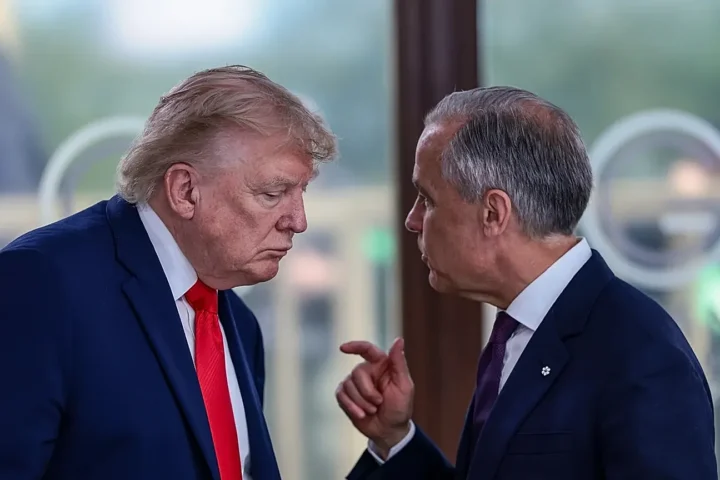
Prime Minister Mark Carney’s government has resisted demands it regards as incompatible with Canadian sovereignty and retaliated against American tariffs rather than simply absorbing them. The political appeal of that position is understandable. Public support for standing up to Washington has remained remarkably strong, with polling indicating broad backing for retaliation.
But Canada is making a dangerous calculation.
Economic patriotism may be politically popular, yet geography cannot be legislated away. The United States is not simply another destination for Canadian exports. Decades of infrastructure, investment and corporate strategy have been constructed around privileged access to the world’s largest advanced consumer market sitting immediately across Canada’s southern border.
That is precisely why the dispute has become intertwined with sovereignty.
American pressure concerning critical minerals, industrial policy and other strategically important sectors increasingly raises questions that extend beyond tariff schedules. If Washington expects preferential access or first-refusal rights to resources considered essential to future industries and national security, Ottawa must decide where economic cooperation ends and strategic subordination begins.
For Canadians, the distinction is profound.
A trade agreement can legitimately regulate commerce. It becomes politically explosive when one partner begins to believe that the agreement gives another country leverage over decisions that should remain sovereign.
This explains why the confrontation cannot simply be dismissed as another episode of tariff brinkmanship.
A 21st-Century Monroe Doctrine?
There is a broader strategic philosophy behind Washington’s economic posture.
For much of the post-Cold War period, American leadership was associated with building alliances and institutions that expanded U.S. influence partly by making cooperation attractive to other countries. The emerging model is considerably more transactional.
In its most expansive interpretation, it resembles an economic version of the Monroe Doctrine for the twenty-first century: the United States seeking overwhelming strategic and industrial primacy within the Western Hemisphere and expecting neighboring states to accommodate American security and economic priorities.
There is an undeniable logic behind parts of this strategy.
The pandemic exposed the vulnerability of extended global supply chains. China’s dominance of critical manufacturing sectors has created legitimate security concerns. Governments throughout the world are reconsidering whether efficiency alone should determine where strategically important goods are produced.
Yet there is an important difference between reducing dependence on geopolitical competitors and deliberately weakening economic integration with reliable allies.
If Washington treats Canada much as it treats an economic adversary, the long-term consequence may not be greater American security. It may instead encourage Canada to build precisely the alternative commercial relationships that reduce American influence.
Economic coercion can produce compliance. It can also produce diversification.
The Real Cost is Uncertainty
Tariffs dominate headlines because their effects are visible and measurable. The more damaging consequence of the present confrontation may be something less dramatic: uncertainty.
Modern manufacturing depends on extraordinarily long planning horizons. Companies decide where to build factories, locate suppliers and deploy billions of dollars in capital based on assumptions about market access that extend years or decades into the future.
The USMCA was supposed to provide that predictability.
If businesses begin to believe that its protections can be circumvented whenever political priorities change in Washington, the agreement loses value even if it remains legally intact.
The danger is therefore not necessarily the formal death of the USMCA. The agreement could survive until 2036 and still become progressively irrelevant.
It risks turning into a kind of “Swiss cheese” trade architecture: technically intact but increasingly punctured by tariffs, exemptions, sector-specific restrictions and national-security measures.
Companies do not need governments formally to abolish free trade before changing their behavior. They merely need to conclude that free trade can no longer be relied upon.
Once that conclusion becomes widespread, investment decisions change. Firms build redundant supply chains. Governments subsidize domestic production. Companies hold larger inventories. Capital becomes more cautious.
All of those responses make the continental economy less efficient.
Canada’s Diversification Imperative
For Ottawa, the crisis has already produced an important strategic realization.
Canada’s extraordinary economic dependence on the United States was historically regarded as an advantage. The country possessed privileged access to an enormous neighboring market without bearing many of the geopolitical risks associated with more distant trading relationships.
Today that same concentration increasingly looks like exposure.
Carney is therefore right to argue that Canada needs greater diversification. That does not mean replacing the United States—an economically unrealistic proposition—but reducing the consequences of American political volatility.
Energy illustrates both the opportunity and the difficulty.
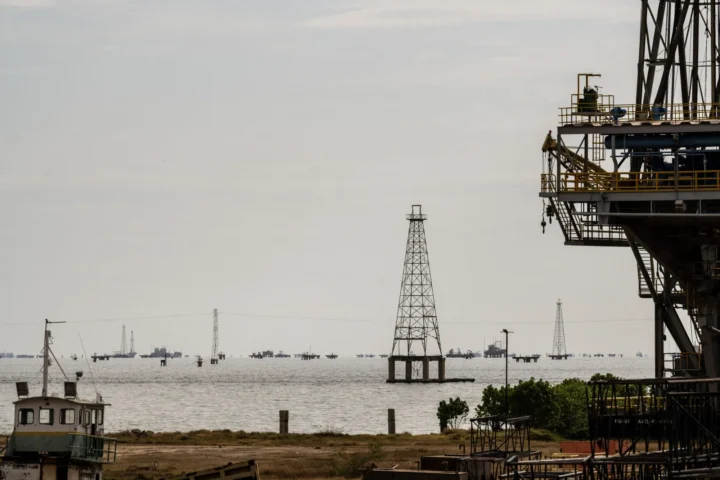
Infrastructure such as the Trans Mountain pipeline gives Canadian producers greater access to Pacific markets, reducing the degree to which Canadian resources are effectively captive to American buyers. Similar logic applies to critical minerals, technology, agriculture and advanced manufacturing.
Canada has trade agreements and political relationships that can support deeper commercial engagement with Europe and the Indo-Pacific.
But diversification requires more than diplomatic announcements.
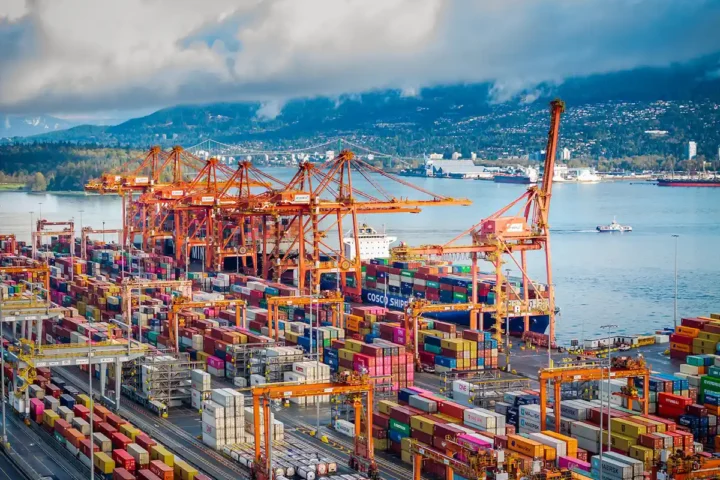
It requires ports, pipelines, rail capacity, processing facilities, investment incentives and regulatory systems capable of turning alternative markets into commercially viable ones. Decades of continental integration cannot be unwound simply by signing new trade agreements.
Canada is discovering that strategic autonomy is expensive.
America Also Has Something to Lose
It would nevertheless be a mistake to view this confrontation as a contest in which only Canada faces economic risk.
American consumers and manufacturers ultimately bear part of the cost of tariffs through higher prices and disrupted supply chains. Industries that depend upon Canadian energy, minerals and intermediate goods cannot instantaneously recreate those inputs domestically.
That becomes particularly important as the United States approaches its midterm elections.
Economic nationalism is politically powerful when described in terms of factories returning home and foreign countries finally paying their “fair share.” It becomes considerably more complicated when households experience higher prices or American businesses discover that supposedly protective tariffs have increased their production costs.
The administration is therefore attempting a difficult balancing act: using economic pressure aggressively enough to demonstrate political strength without generating enough inflation or industrial disruption to erode domestic support.
Whether that balance can be maintained may ultimately determine how far Washington is willing to push its confrontation with Ottawa.
The End of an Assumption
The most consequential development of 2026 may therefore not be any particular tariff rate or negotiating demand.
It is the destruction of an assumption.
For generations, Canada could organize much of its economic strategy around the belief that whatever disagreements emerged, the United States would ultimately remain a predictable partner committed to preserving the broader North American economic relationship.
That confidence has been damaged.
Even if Washington and Ottawa eventually reach another compromise—and economic reality gives both governments powerful incentives to do so—the memory of this confrontation will influence Canadian policy for years.
Governments will diversify. Companies will hedge. Strategic industries will seek alternative markets. Policymakers will think twice before allowing critical infrastructure to depend overwhelmingly upon a single country.
The same process may occur elsewhere as American allies reconsider what economic dependence on the United States means in an era when trade itself has become an instrument of strategic pressure.
North American free trade is unlikely to disappear overnight. The economic connections binding the United States, Canada and Mexico are simply too deep.
But institutions rarely collapse in a single dramatic moment. More often, they are gradually hollowed out as trust disappears and exceptions become normal.
That is the danger confronting the USMCA today.
The question is no longer merely whether the three countries can negotiate another compromise. It is whether the political philosophy that made North American economic integration possible still exists.
If the answer is no, the continent may be entering a very different era—one in which proximity no longer guarantees partnership, integration no longer guarantees stability, and even the closest of allies must prepare for the possibility that economic dependence can become geopolitical leverage.
The foundation of North American trade has not yet collapsed.
But for the first time in decades, its cracks are becoming impossible to ignore.