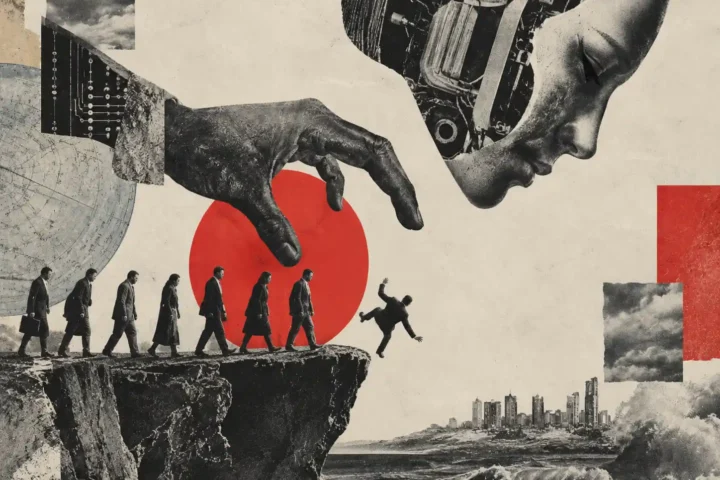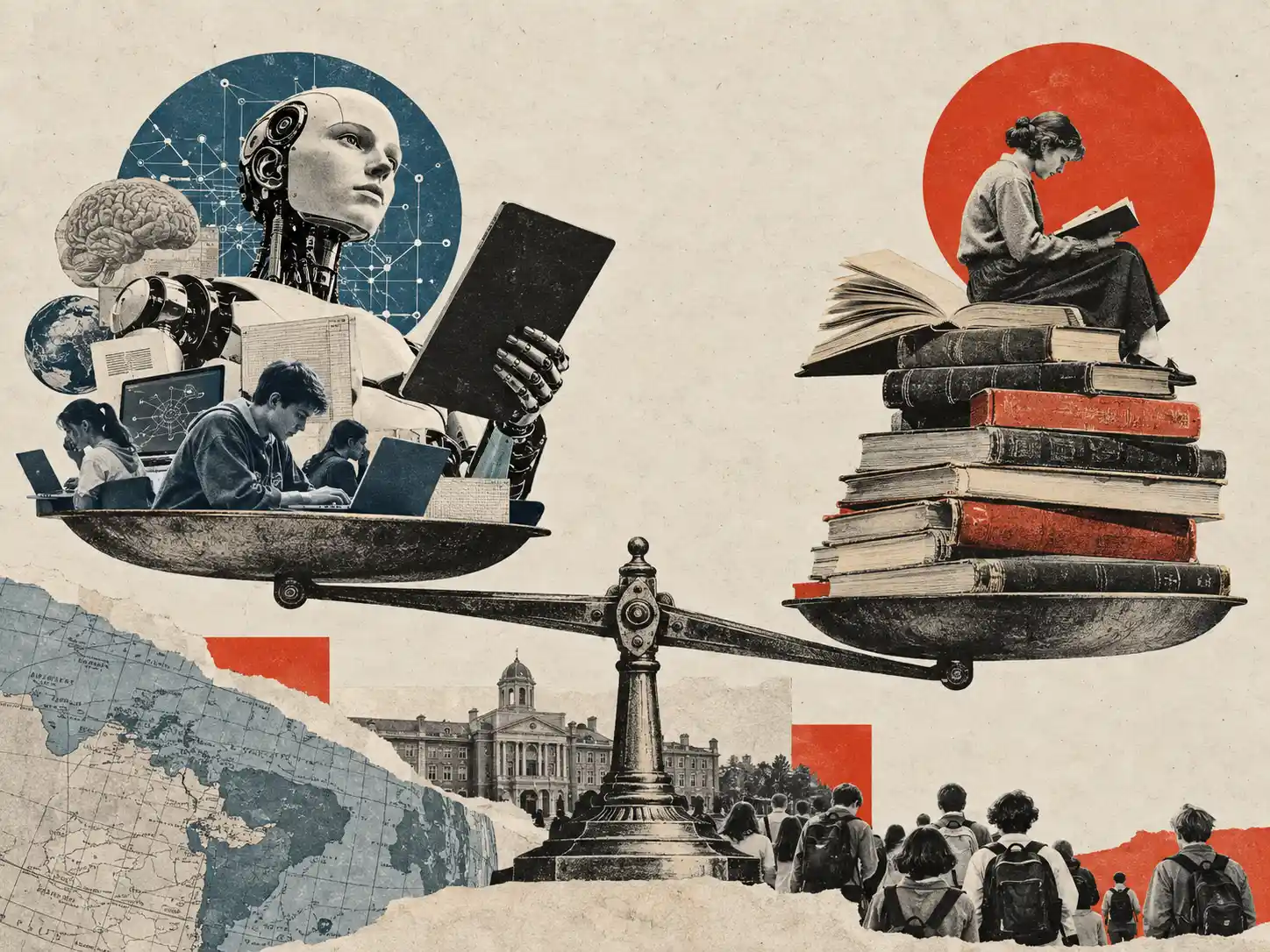
As reading proficiency declines across the world, governments are moving to restrict artificial intelligence in classrooms. But the deeper challenge may not be technology itself. It may be that education systems are struggling to adapt to a fundamental transformation in how knowledge is acquired, communicated and understood.
For generations, the ability to read, comprehend and interpret written information has been regarded as one of the essential foundations of education. Schools have been organised around textbooks, written examinations and the expectation that sustained engagement with the written word produces intellectual development. Yet that longstanding relationship between literacy and learning is facing an unprecedented challenge.
The latest findings from the Programme for International Student Assessment (PISA) have intensified concerns about declining reading proficiency among students. Education policymakers across Europe have responded with warnings about the consequences of excessive screen exposure, social media and artificial intelligence. French Education Minister Édouard Geffray has described the situation in terms of generational cognitive deterioration, while Spain’s Education Minister Milagros Tolón has emphasised the need to strengthen reading skills as a fundamental educational priority.
The debate reflects a growing anxiety: at a time when artificial intelligence systems can process enormous quantities of information, generate sophisticated arguments and produce written material almost instantaneously, young people appear to be struggling with some of the very cognitive skills traditionally associated with academic achievement.
But attributing declining reading performance primarily to technological distraction may overlook a more consequential development. The problem may not simply be that digital technologies are interfering with established methods of learning. It may be that technology is fundamentally changing the cultural environment in which those methods developed.
The growing resistance to AI in classrooms
Governments and educational institutions are increasingly experimenting with restrictions on digital technology, particularly for younger students.
In New York City, Mayor Zohran Mamdani announced on September 2 a policy restricting student-facing generative AI tools in public schools from pre-kindergarten through eighth grade. The proposed approach also includes age-appropriate screen-time limits, AI-related critical-thinking instruction for high-school students and limited classroom trials of the technology among older learners.
The reasoning behind such measures is understandable. Children need opportunities to develop concentration, independent reasoning and intellectual confidence without relying excessively on automated systems. Generative AI can produce essays, summarise textbooks and answer questions with minimal effort from students, potentially reducing opportunities to practise essential skills.
However, restrictions alone cannot resolve the larger educational dilemma.
Students do not encounter technology exclusively within classrooms. Their communication, entertainment, social relationships and access to information are increasingly shaped by digital platforms. Even when schools prohibit certain tools, the expectations and habits created by those technologies remain influential.
Consequently, the central question is not merely whether artificial intelligence should be permitted in schools. It is whether educational institutions are adequately preparing students for a world in which the production and circulation of knowledge operate differently from the systems on which conventional schooling was built.
When knowledge moved from memory to manuscripts
History offers a useful perspective on this transformation.
Long before literacy became widespread, human societies developed sophisticated methods of preserving and transmitting knowledge through speech, storytelling, poetry and collective memory.
Ancient Greek civilisation provides a particularly revealing example. Homer’s Iliad and Odyssey, among the foundational works of Western literature, emerged from an oral tradition in which elaborate narratives were composed and transmitted across generations without depending on written manuscripts.
The ability to preserve complex information, communicate philosophical ideas and sustain cultural traditions therefore existed long before reading became central to education.
In his influential 1963 work Preface to Plato, classical scholar Eric Havelock examined how the emergence of writing transformed ancient Greek intellectual life. As written records gradually replaced oral memory as a principal means of preserving knowledge, societies developed new approaches to instruction, reasoning and philosophical inquiry.
Writing made information more durable and accessible beyond the immediate circumstances of a conversation. Ideas could be revisited, compared and examined independently of the person who originally expressed them.
This technological development helped create conditions for systematic analysis and abstract philosophical thought.
The transition also transformed the meaning of education itself.
Walter J. Ong, the scholar and Jesuit priest whose 1982 book Orality and Literacy explored the relationship between communication technologies and human consciousness, argued that writing encouraged forms of reflection different from those prevalent in oral cultures.
Where oral societies relied extensively on listening, participation, apprenticeship and collective interaction, literate societies increasingly valued solitary study and sustained examination of fixed texts.
The familiar image of a student sitting quietly with a book is therefore not an eternal model of learning. It is a product of particular historical and technological circumstances.
From the printed page to the interactive screen
For approximately five centuries following the spread of Gutenberg’s printing technology, printed material occupied a privileged position in the organisation of knowledge.
Books, newspapers, academic journals and official documents became central instruments through which societies established authority, circulated ideas and preserved information.
Danish literary scholar Lars Ole Sauerberg has described this period through the concept of the “Gutenberg Parenthesis”, suggesting that the dominance of print may represent a relatively brief chapter in the much longer history of human communication.
The emergence of radio, television and electronic communications began changing this arrangement well before the arrival of the internet.
Ong anticipated aspects of this transformation through his concept of “secondary orality”, a communication culture shaped by electronic technologies that restores some characteristics of oral interaction while remaining dependent on literacy.
Digital platforms have accelerated this development.
Today, information increasingly travels through podcasts, short videos, livestreams, voice messages, interactive discussions and rapidly evolving online conversations. Communication often prioritises immediacy, participation and responsiveness over the permanence traditionally associated with printed material.
Artificial intelligence introduces another dimension to this shift.
Unlike a conventional textbook, an AI chatbot can respond to questions, reformulate explanations, adjust its language and simulate a continuing conversation. Information is no longer necessarily presented as a fixed body of text that readers must interpret independently. It can be generated and reorganised according to individual requests.
This makes knowledge appear more conversational and accessible, although it also creates serious questions about reliability, accuracy and intellectual dependence.
An AI-generated explanation may sound authoritative while containing factual errors or fabricated references. Its responsiveness should not be mistaken for understanding, nor should the convenience of obtaining an answer be confused with acquiring knowledge.
Nevertheless, the technology changes the experience of engaging with written information.
For students accustomed to interactive digital environments, the traditional expectation of silently reading an extended, unchanging text may feel increasingly disconnected from their everyday encounters with information.
That difference does not establish that reading has become obsolete. It does suggest that schools must confront a widening gap between established educational practices and contemporary communication habits.
Are schools measuring yesterday’s skills?
The PISA assessment programme was introduced in 2000, when the internet was becoming an increasingly important feature of everyday life but before smartphones, social media platforms and generative AI had reshaped information consumption.
Its assessments of reading, mathematics and science remain valuable tools for understanding student proficiency and comparing educational outcomes across participating systems.
Yet the technological environment surrounding students has changed dramatically since the programme began.
Traditional reading assessments emphasise the ability to understand, interpret and evaluate written material. These remain essential capabilities, particularly in an information environment saturated with misleading claims and automatically generated content.
However, students increasingly need additional competencies: verifying sources, identifying manipulated information, evaluating AI-generated explanations, comparing conflicting claims and understanding the limitations of automated systems.
The challenge is therefore not necessarily to replace conventional literacy with digital proficiency. It is to reconsider what comprehensive literacy should mean in an environment where information can be produced almost without limit.
Declining reading scores should not be dismissed as evidence that students have simply developed different strengths. Weaknesses in comprehension can have substantial consequences for learning, employment and civic participation.
At the same time, falling performance cannot automatically be explained by artificial intelligence, particularly when changes in reading achievement predate the widespread public availability of generative AI.
Educational outcomes are influenced by numerous factors, including instructional quality, socioeconomic circumstances, reading habits, access to learning resources and the disruptions associated with the COVID-19 pandemic.
A serious response must therefore distinguish between the measurable decline in particular skills and broader theories about its causes.
Why banning technology is not enough
Restrictions on AI may serve a useful purpose, especially during the early years of education when children are developing foundational reading, writing and reasoning abilities.
Learning to construct an argument, work through difficult material and solve problems independently requires practice. If automated systems consistently perform these tasks on behalf of students, important opportunities for intellectual development may be lost.
But treating technology exclusively as an external threat risks overlooking its deeper influence.
The ancient philosopher Plato captured a similar anxiety in Phaedrus, where Socrates recounts a story about the Egyptian ruler Thamus, who questioned whether writing would weaken human memory by encouraging people to depend on external records.
The concern was not entirely unreasonable. Writing did change how societies remembered and transmitted information. Yet it also enabled extraordinary developments in philosophy, science, law and education.
The historical lesson is not that every technological innovation inevitably improves human learning. Rather, new communication technologies often alter both the skills societies rely upon and the institutions responsible for developing them.
Artificial intelligence presents a comparable challenge.
Schools may need protected environments where younger children learn without constant digital assistance. They may also need carefully designed opportunities for older students to examine AI systems, test their reliability and understand when their use supports or undermines learning.
Teacher training, assessment reform and age-appropriate digital literacy are likely to be as important as restrictions on particular tools.
Written examinations may need to place greater emphasis on demonstrating reasoning rather than merely producing polished answers. Classroom activities may need to combine sustained reading with discussion, oral explanation and critical evaluation of digital material.
Crucially, educational policy should be informed by evidence about how students actually learn, rather than assumptions that technological familiarity necessarily indicates either intellectual advancement or decline.
Education beyond the age of the printed word
The debate over reading proficiency ultimately raises a question larger than artificial intelligence.
For centuries, educational institutions developed around the relative scarcity and permanence of written information. Students were expected to acquire knowledge by locating, reading, retaining and reproducing material.
Today, the difficulty is increasingly different. Information is abundant, instantly accessible and often generated on demand. The challenge is to determine what deserves attention, which claims are trustworthy and how available information can be transformed into genuine understanding.
In such circumstances, reading may become more important rather than less. Deep comprehension provides the foundation for evaluating complex arguments, recognising contradictions and resisting manipulation, whether information appears in a printed book, a social media post or an AI-generated response.
But preserving those abilities will require more than attempting to recreate the technological conditions of an earlier era.
Schools must find ways to cultivate sustained attention and independent thought while acknowledging that the forms through which knowledge circulates are changing.
Students themselves should have a meaningful role in that discussion. Their experiences can help educators understand how digital communication influences motivation, concentration and learning, although those experiences must be considered alongside research and measurable educational outcomes.
The central task is neither to surrender education to technology nor to isolate classrooms from it entirely.
It is to determine which intellectual capacities remain indispensable, which new competencies are emerging and how both can be developed together.
The future of education will depend not simply on whether children continue to read, but on whether schools can teach them to think critically in a world where producing words has become easier than establishing their meaning.