France’s political turmoil is often explained through public debt, economic stagnation and the rise of the far right. Yet beneath these crises lies another question that successive governments have struggled to confront: whether decades of large-scale immigration, inadequate integration and mounting pressure on public institutions have fundamentally altered the relationship between the French state and its citizens.
France has a phrase for a crisis that feeds upon itself: un engrenage, a vicious spiral. It is an apt description of a republic increasingly trapped between political paralysis, fiscal deterioration, social discontent and an electorate losing confidence in the institutions meant to represent it.
For years, the French political establishment has treated these challenges as separate problems. Public debt is a matter for economists. Street protests are a matter for the police. The rise of the National Rally is a matter for political strategists. Immigration, meanwhile, is frequently discussed either as an economic necessity or as a question of humanitarian obligation.
But these issues cannot be understood entirely in isolation.
At the centre of France’s political transformation is an increasingly contentious debate over mass immigration: its scale, its management, its consequences for housing and public services, and the failure of successive governments to build a convincing framework for integration.
To argue that immigration is a major driver of French political discontent is not to suggest that immigrants are responsible for every problem confronting France. Nor is it to deny the economic, cultural and demographic contributions made by generations of newcomers.
It is, rather, to acknowledge an uncomfortable political reality: when citizens believe that immigration is occurring faster than institutions can accommodate it, and that their concerns are dismissed rather than addressed, public trust begins to fracture.
That fracture is now reshaping French politics.
A Republic Divided Over Immigration
France has long been a country of immigration. Its industrial expansion, post-war reconstruction and economic development drew workers from across Europe, North Africa and beyond. Many settled permanently, raised families and became part of French society.
Yet the political environment surrounding immigration has changed dramatically.
What was once primarily a debate about labour and economic opportunity has become a much broader confrontation over national identity, secularism, security, social cohesion and the responsibilities of the state.
The distinction matters.
For many French voters, opposition to mass immigration is not necessarily opposition to immigrants as individuals. It is opposition to what they perceive as an immigration system operating without sufficient democratic consent, effective border management or credible expectations of integration.
The rise of Marine Le Pen’s National Rally reflects this shift. Immigration has become one of the defining issues around which the party has built its appeal, alongside purchasing power, public security and dissatisfaction with the political establishment.
The party’s growing support cannot be attributed exclusively to immigration. But neither can its success be understood without recognising the importance of the issue to its political identity.
France’s traditional parties have struggled to articulate a response that satisfies voters concerned about migration while preserving the republic’s commitments to equality and individual rights.
The resulting vacuum has allowed the political extremes to frame the debate.
When Immigration Meets Institutional Failure
The consequences of immigration depend not simply on how many people enter a country, but on whether its institutions can accommodate them.
Housing, schools, healthcare, transportation and employment markets all require investment, planning and administrative capacity. Population growth can strengthen an economy when matched by productivity, infrastructure and successful integration. It can also intensify existing pressures when public systems are already overstretched.
France is confronting precisely such institutional weaknesses.
Public services have faced persistent financial and organisational challenges. Schools struggle with staffing and educational inequality. Affordable housing remains scarce in many urban areas. Public finances are burdened by decades of deficits and rising debt-servicing costs.
In poorer suburbs, where immigrant-origin populations are often concentrated, these problems can become especially visible.
Yet it would be misleading to attribute overcrowded classrooms or deteriorating public facilities directly to immigration without examining funding decisions, population distribution, administrative failures and the wider economy.
The political significance lies in perception as well as measurable impact.
When families struggle to secure housing, obtain medical appointments or access adequately resourced schools, they look for explanations. Immigration becomes a powerful political symbol when governments cannot demonstrate that population change is being matched by investment.
The result is a growing sense of competition over public resources, even where the underlying causes are considerably more complex.
That perception can be politically explosive.
The Scale of Change Cannot Be Ignored
Official statistics illustrate the magnitude of France’s demographic transformation.
According to the French national statistics institute, INSEE, approximately eight million immigrants lived in France in 2025, representing 11.6 percent of the population. In 1999, the corresponding share was 7.3 percent. The statistical agency cautions that methodological changes complicate direct comparisons across some recent years, but the longer-term increase is unmistakable.
These figures do not include everyone descended from immigrant families. Nor do they establish that immigration has been economically harmful.
Nevertheless, demographic change on this scale raises legitimate questions about integration, infrastructure and the capacity of public institutions.
The challenge becomes especially acute when communities experience rapid population change alongside economic stagnation.
France’s republican model traditionally emphasises a common civic identity rather than the formal recognition of separate ethnic communities. Its promise is that citizenship, secular institutions and equality before the law can unite people of different origins.
But that promise requires more than legal declarations.
It requires schools capable of teaching a shared language and civic culture, labour markets capable of providing opportunity, and neighbourhoods where social separation does not become permanent.
Where those conditions are absent, integration can falter, resentment can deepen and political movements can exploit the resulting divisions.
The Protests Reveal a Deeper Crisis of Confidence
The demonstrations that began in French high schools in September offer a striking illustration of the country’s institutional discontent.
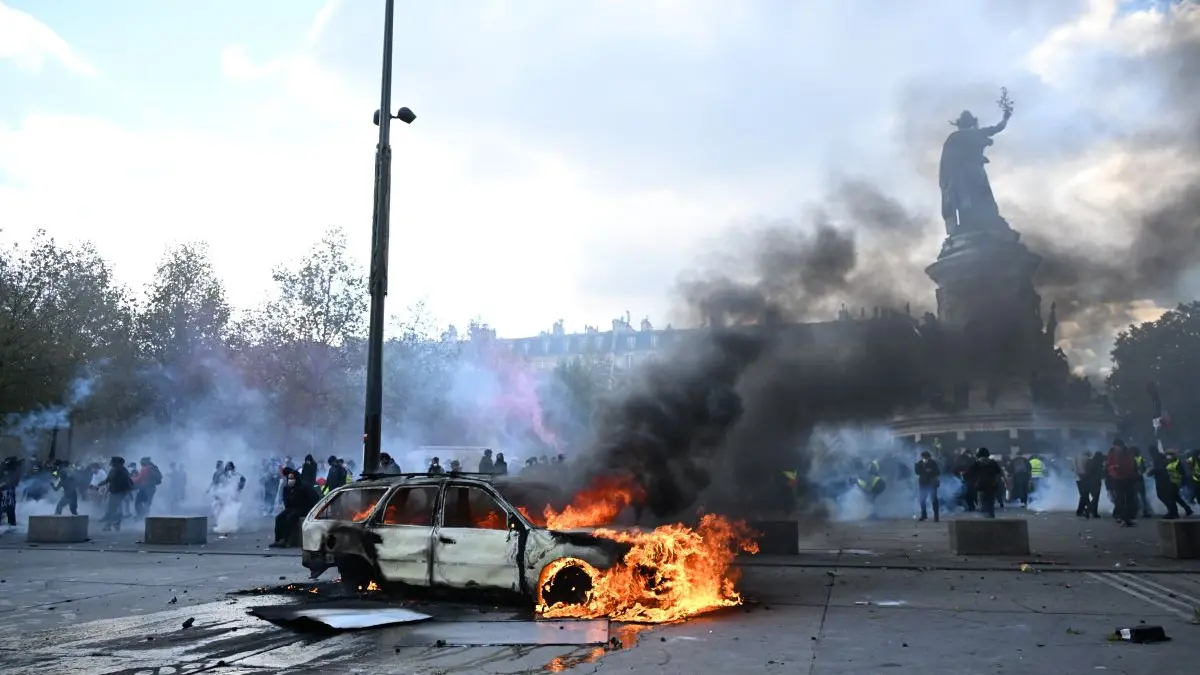
Students have protested teacher shortages, overcrowded classrooms, deteriorating buildings and uncertain economic prospects. Their movement has expanded into wider demonstrations over public spending and the cost of living. By October 17, nationwide protests had escalated into serious violence, with extensive arrests and damage to public buildings.
It would be inaccurate to describe these student protests as primarily anti-immigration demonstrations. Their publicly articulated demands concern education and economic opportunity.
Yet they unfold within a broader political environment in which immigration has become a central explanation offered by some voters and political parties for France’s perceived decline.
That distinction is essential.
The immediate causes of a protest are not always identical to the deeper forces shaping the country’s political mood.
France is witnessing several forms of dissatisfaction converging: students demanding investment, workers demanding economic security, taxpayers questioning government spending and voters demanding greater control over immigration.
The danger arises when these grievances become mutually reinforcing.
A Fiscal Crisis That Makes Everything Worse
France’s financial predicament sharply limits its ability to respond.
Decades of deficit spending, the enormous cost of the pandemic, energy subsidies and a politically contentious pension system have placed extraordinary pressure on the public finances.
The government’s difficulties in passing reforms have been compounded by a fragmented parliament and successive political confrontations.
Immigration is neither the principal established cause of France’s sovereign debt nor a straightforward solution to it.
Working-age immigrants can contribute taxes, support businesses and help sustain pension systems in ageing societies. Their net fiscal impact depends on employment, earnings, age, household composition and access to public services.
But the fiscal argument for immigration becomes less persuasive to voters when governments cannot demonstrate successful labour-market integration or explain how expanding populations will be accommodated.
France must therefore confront two difficult questions simultaneously: how to restore fiscal discipline and how to ensure immigration policy remains consistent with the country’s economic and institutional capacity.
Ignoring either problem will make the other harder to resolve.
The Political Establishment’s Greatest Mistake
Perhaps the most consequential failure of French leadership has been its inability to sustain a credible, democratic conversation about immigration.
For too long, the debate has oscillated between sweeping denunciations and reassuring abstractions.
Neither is adequate.
Citizens have a legitimate interest in knowing how many people their country admits, on what grounds, with what expectations and at what cost. Equally, immigrants and their descendants have a right to be treated as individuals rather than collectively blamed for failures of public policy.
A serious national strategy would distinguish legal immigration, asylum obligations and irregular migration. It would establish transparent migration objectives, strengthen administrative enforcement, invest in language acquisition and employment, and direct infrastructure funding towards communities experiencing the greatest pressures.
It would also confront discrimination and residential segregation, which undermine integration and prevent France from benefiting fully from the people already living within its borders.
Above all, the government must demonstrate that immigration policy is subject to democratic accountability rather than political evasion.
France’s Warning to Europe
France’s predicament is not uniquely French.
Across Europe, immigration has become intertwined with concerns about economic security, cultural continuity, public services and political representation.
The lesson is not that immigration inevitably produces instability. Countries differ considerably in their migration systems, economic circumstances and integration outcomes.
The lesson is that governments cannot indefinitely separate demographic decisions from their social and political consequences.
France’s protests are a warning about failing institutions. Its fiscal crisis is a warning about unsustainable promises. The rise of the National Rally is a warning about what happens when large sections of the electorate conclude that established parties no longer represent their concerns.
Mass immigration has become one of the most powerful issues connecting these anxieties, even where it is not their direct cause.
As France approaches the 2027 presidential election, the question is no longer whether immigration will shape its political future. It undoubtedly will.
The question is whether mainstream democratic institutions can restore confidence through credible border management, effective integration, stronger public services and economic reform—or whether continued paralysis will allow political resentment to deepen.
France does not face an inevitable collapse. But it does face a profound test of democratic legitimacy.
A republic that cannot reconcile the aspirations of its citizens, the obligations of its state and the realities of demographic change risks becoming trapped in precisely the vicious spiral the French call un engrenage.
And the longer its leaders avoid confronting that challenge, the more difficult escaping it will become.