Executive Summary
While the European Union has launched an ambitious agenda to foster climate resilience across its domestic policies, climate risks remain inherently systemic and transboundary. Many EU neighbour partner countries that are facing climate tragedies, lack the financial resources, technologies and institutional capacities to enable an effective adaptation.
Closing this gap is a direct strategic interest for the EU, as climate-induced instability abroad fuels humanitarian crises, supply chain disruption, undermines security and people’s safety, and slows down global progress envisioned by the Paris Agreement. The interconnectedness feature of climate change cannot be neglected.
To shift European external action from reactive disaster relief to preventive adaptation, this policy brief intends to propose four core recommendations addressed to the European External Action Service (EEAS) and the Directorate-General for International Partnerships (DG INTPA):
- Scale up climate finance and financial de-risking through the Global Gateway strategy to mobilise private capital for resilient infrastructure in vulnerable partner countries under NDICI-Global Europe.
- Launch a Demand-Driven “Space Data Diplomacy” to expand access to EU space and forecasting capabilities (Copernicus, Galileo, EGNOS) and to pair data provision with targeted technology transfer and local capacity-building.
- Systematically embed Climate Resilience By Design into bilateral agreements, regional studies (such as the Pact for the Mediterranean) and the enlargement process.
- Operationalise the Humanitarian-Development-Peace (HDP) Nexus: Align DG ECHO, DG INTPA and EEAS programming in fragile states so emergency relief reinforces long-term climate resilience and conflict prevention.
INTRODUCTION: Policy context and problem definition
The New EU Framework for Climate Resilience: The European Commission’s Communication (COM(2026) 720, October 27, 2026) establishes “climate resilience by design” as a cross-cutting standard across all EU policies. It introduces common reference global warming trajectory, clarifies risk ownership and strengthens anticipatory risk management through initiatives such as the European Preparedness Union Strategy.
The framework primarily aims to support and safeguard infrastructure, energy grids, transport networks and food systems within the EU, however the Commission recognises that domestic resilience cannot exist in isolation: climate shocks create consequences that cross European borders.
The EU’s neighbourhood (the Arctic, Eastern and South-Eastern Europe and the Mediterranean and Black Sea basins) as well as developing countries are highly exposed to droughts, floods, and heatwaves, yet they dispose of lower adaptive capacity. As reflected by the persistent negotiation deadlocks at COP31 in Antalya over extending the Mitigation Work Programme (MWP) to 2040, global mitigation efforts continue to fall short of the Paris Agreement temperature threshold.
Since delayed climate action increases long-term risks, strengthening preventive adaptation in partner countries is essential to reduce the impact of climate shocks on fragile societies, food security and conflict.
The policy problem: although the EU provides development aid, diplomatic support and humanitarian aid to countries facing climate challenges, these tools remain insufficiently coordinated. They often work separately in silos and the EU is usually responding after a disaster has already happened instead of building long-term partnerships that enable partner countries to anticipate and withstand climate shocks before crises occur.
POLICY ANALYSIS
Vulnerable partner countries face a serious adaptation finance gap, worsened by high borrowing costs and elevated risk perceptions among private investors. The Global Gateway strategy offers an essential vehicle for mobilising private and insurance-sector capital through guarantees and blended finance, however multilateral climate negotiations demonstrate that developing countries are increasingly wary of approaches that rely solely on private sector matchmaking or emphasise domestic “structural barriers” without clear public financial commitments (Paris Agreement Art. 9.1), a concern raised forcefully by the Arab Group during the COP31 consultations. In addition, partner economies frequently highlight the spillover pressures of EU unilateral trade and transition measures, such as the EU Carbon Border Adjustment Mechanism (CBAM), on their economic diversification (Art. 4.7 and 4.15). To preserve diplomatic trust, EU external resilience finance must pair Global Gateway de-risking tools with accessible, subsidy-based adaptation support that avoids worsening debt distress.
Reliable climate data and early warning systems are prerequisites for effective prevention. Here, the EU holds a distinct comparative advantage through its space infrastructure: specifically Copernicus (including the Copernicus Climate Change Service, C3S, for monitoring and projections), Galileo and EGNOS for positioning, navigation, and emergency response, and GOVSATCOM/IRIS² for secure crisis communications.
Nonetheless, partner administrations frequently lack the institutional capability to translate this data into urban planning, resilient agriculture or civil protection protocols. Moreover, developing countries tend to consider the external technical mechanisms as top-down conditionalities disconnected from their Nationally Determined Contributions (NDCs).
Technology sharing must therefore be built around local co-ownership.
Finally, in our fragmented geopolitical context, climate resilience works as a vital instrument of preventive diplomacy and peacebuilding. Embedding adaptation objectives into bilateral agreements, regional frameworks and the enlargement process enables the EU to improve regional stability, diversify critical supply chains, and present itself as a reliable partner while addressing the causes of humanitarian crises.
POLICY RECOMMENDATIONS
Pair Global Gateway De-Risking with Adaptation Finance (DG INTPA)
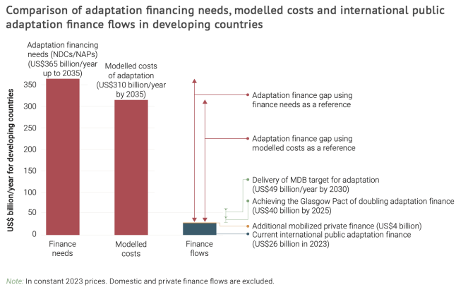
To ensure “smart, clean, and secure infrastructure”, as stated within the responsibilities of the DG INTPA, all EU-backed external investment in energy, water, transport and digital networks must undergo a climate risk assessment before they are approved and throughout their lifecycle. As illustrated in Figure 1, international public adaptation finance flows remain far below developing countries’ adaptation needs of US$ 310-365 billion per year by 2035. Bridging this gap requires a differentiated financial approach:
- Scale up guarantees in middle-income markets to expand the adaptation de-risking window under the European Fund for Sustainable Development Plus (EFSD+) to absorb early-stage risk and attract private institutional capital
- Ring-fence grants for Least Developed Countries (LDCs) to protect a share of grant funding within the NDICI-Global Europe for indebted and climate-vulnerable nations. In this way, those who contributed less to historical emissions are not forced to face unsustainable debt to protect their populations.
Launch a Demand-Driven “Space Data Diplomacy” and Technical Twinning Programme (DG INTPA & EEAS, with DG DEFIS and the EEA)
The EU should expand the operational access to Copernicus, Galileo and marine observation tools such as OceanEye and the European Digital Twin of the Ocean, so that they are available for national and regional authorities in partner countries. Rather than imposing top-down approaches, DG INTPA and the European Environment Agency should fund technical twinning partnerships between European meteorological and civil protection agencies and partner institutions. In this way, a new framework to co-design national early warning systems and protocols can be created aligned to the countries’ existing NDCs.
Mainstream climate resilience into enlargement and neighbourhood frameworks (EEAS & DG NEAR/DG ENEST)
The EU should use both its enlargement and neighbourhood policies to strengthen regional preparedness and support green economic diversification:
- Enlargement process: integrate candidate countries into the European Preparedness Union Strategy, adopt common climate risk indicators, and include climate resilience standards among EU accession benchmarks (Art.49 TEU) backed by IPA III funding.
- Regional Neighbourhood Frameworks: operationalise joint water security and disaster preparedness priorities within the Pact for the Mediterranean and use the EU Arctic Strategy to support Arctic communities in adapting to rapid environmental changes and diversifying to not be dependent on climate-vulnerable sectors.
Operationalise the Humanitarian-Development-Peace (HDP) Nexus in fragile countries (DG ECHO, DG INTPA & EEAS)
To break down institutional silos between emergency response and long-term development, the EU should implement joint multi-year programming frameworks in climate-fragile regions. This would allow immediate link between food and civil protection with investments in climate-resilient agriculture and local resource-conflict mediation, so that solutions for droughts or floods are not treated simply as short-term humanitarian aid.
CONCLUSIONS
Transboundary partnerships and assistance are a key ingredient to ensure that climate adaptation operates in a truly systemic, anticipatory and equitable way beyond the Union’s frontiers. As multilateral negotiations continue to struggle over the modalities of global mitigation, the EU has a decisive opportunity to be the leader partner embedding Climate Resilience by Design across its external action. Ensuring accessible finance, co-owned space and forecasting technologies, and non-prescriptive diplomacy, is no longer simply an act of international solidarity but it represents Europe’s core engagement to reach long-term competitiveness, security and strategic autonomy.
References and Further Reading
European Commission. (2026, October 27). Communication from the Commission to the European Parliament, the Council, the European Economic and Social Committee and the Committee of the Regions: New EU Framework for Climate Resilience (COM(2026) 720 final).
European Commission. (n.d.). Directorate-General for International Partnerships (DG INTPA). https://commission.europa.eu/about/departments-and-executive-agencies/international-partnerships_en
European Commission. (n.d.). Neighbourhood, Development and International Cooperation Instrument – Global Europe (NDICI – Global Europe). https://commission.europa.eu/funding-and-tenders/find-funding/eu-funding-programmes/global-europe-neighbourhood-development-and-international-cooperation-instrument_en
Italia Clima. (2026). Mitigation Work Programme: Scontro su durata e finanza climatica [Analysis of COP31 negotiations in Antalya]. https://www.italiaclima.org/mitigation-work-programme-scontro-su-durata-e-finanza-climatica/
United Nations Environment Programme (UNEP). (2025). Adaptation Gap Report 2025