
Migration in East Africa is frequently interpreted through the geopolitical priorities of European destination countries, particularly irregular migration, border security and asylum management. Such interpretations obscure the region's more extensive systems of internal displacement, cross-border labour mobility, circular migration and movement towards the Arabian Peninsula. Drawing on United Nations migration statistics, International Organization for Migration (IOM) monitoring, World Bank economic data and regional policy frameworks, this paper examines the structural characteristics of East African migration and their implications for development governance. It argues that mobility is not merely a consequence of economic deprivation or political instability but also a mechanism of labour-market adjustment, household resilience and regional economic integration. The analysis identifies significant discrepancies between dominant migration narratives and empirical realities, particularly regarding destinations, motivations and the relationship between migration and development. It concludes that effective migration governance requires a shift from externally driven containment strategies towards rights-based regional mobility systems, expanded legal migration channels, economic inclusion and evidence-led institutional coordination.
1. Introduction: The Geography of a Misunderstood Phenomenon
International migration occupies a central position in contemporary debates concerning economic development, national sovereignty and global inequality. Yet the geographical framing of migration often reflects the political concerns of wealthy destination countries rather than the actual distribution of migratory movements.
East Africa illustrates this disconnect particularly clearly. International attention frequently focuses on Africans attempting to reach Europe through Mediterranean crossings. However, demographic evidence reveals a substantially different regional migration system, characterised by movements between neighbouring African states, substantial refugee populations, extensive domestic mobility and labour migration towards the Gulf.
According to United Nations estimates, the worldwide international migrant population reached approximately 304 million in 2024. Within this global system, migration involving sub-Saharan Africa remains strongly shaped by regional economic relationships and geographical proximity.
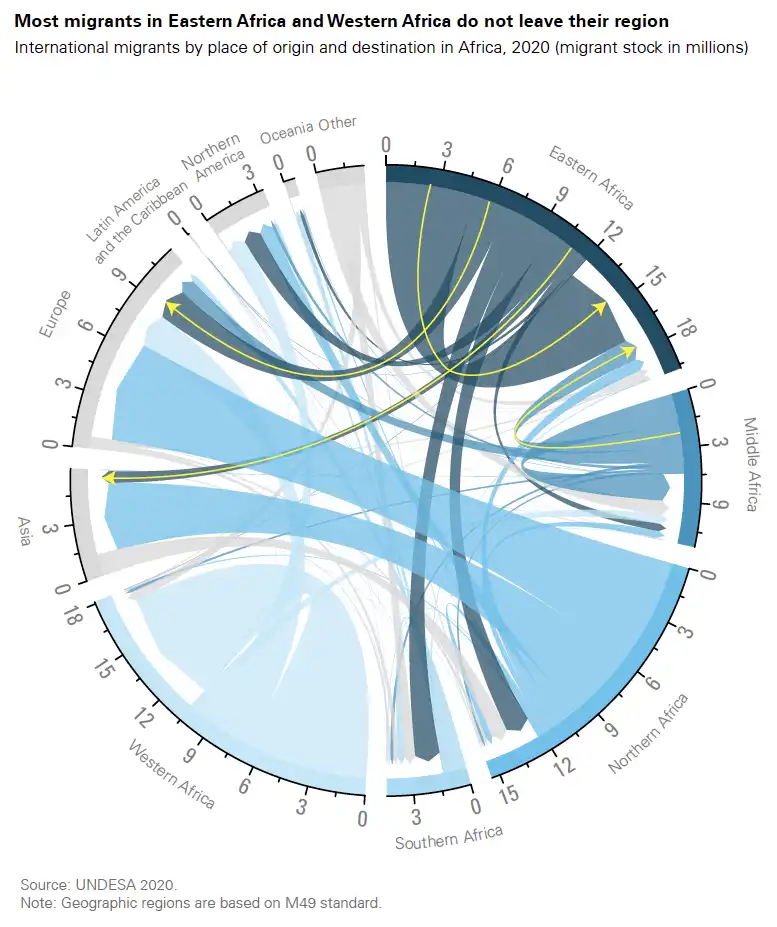
More specifically, analysis of UN migration data indicates that Eastern Africa hosted approximately 8.8 million international migrants in 2024. About 95% were African-born, while approximately 74% originated within Eastern Africa itself. These proportions challenge the assumption that migration from the region is principally directed towards Europe.
Understanding this distinction is essential. Policies designed primarily to prevent movement towards Europe may fail to address the economic and humanitarian realities affecting millions of migrants who never intend to travel there.
The central argument of this piece is that East African migration must be understood as an interconnected system of economic opportunity, human security, environmental adaptation and regional integration rather than predominantly as an external border-management challenge.
2. Regional Migration as the Dominant Structural Pattern
Migration within East Africa has historical foundations extending well beyond contemporary international borders. Commercial networks across the Horn of Africa, pastoral movements between ecological zones and population exchanges around the Great Lakes have long connected communities through trade, kinship and seasonal employment.
Modern political boundaries have not eliminated these relationships.
Today, movements between Kenya, Uganda, Tanzania, Rwanda, Burundi, Ethiopia, Somalia and South Sudan reflect diverse motivations. These include agricultural employment, commerce, education, family reunification, urban employment and displacement caused by conflict.
The predominance of regional migration is consistent with economic theories emphasising distance, transport costs, social networks and information asymmetries in destination selection. Neighbouring countries generally offer lower migration costs, greater familiarity and more accessible social connections than distant overseas destinations.
Nevertheless, conventional migration statistics capture only part of this reality.
United Nations international migrant-stock estimates principally measure people living outside their country of birth or citizenship at a particular date. They do not comprehensively capture temporary cross-border traders, short-term agricultural workers, repeated seasonal movements or internal migration.
Consequently, the full economic significance of regional mobility may exceed what international migrant-stock figures suggest.
This statistical limitation has substantial policy implications. Governments relying narrowly on permanent migration statistics may underestimate the importance of temporary mobility in sustaining regional markets.
A more accurate approach must distinguish between migration stocks, annual movements, internal displacement and circular labour migration rather than treating them as interchangeable measures.
3. The Gulf Corridor and the Changing Geography of Labour Migration
One of East Africa's most significant migration systems connects Ethiopia and Somalia with Yemen, Saudi Arabia and other Arabian Peninsula economies.
This Eastern Route demonstrates why Europe-centred migration frameworks are geographically incomplete.
Migrants frequently travel through Djibouti or Somalia before undertaking dangerous maritime crossings to Yemen. For many, Yemen is not their intended destination but a transit territory towards employment in Saudi Arabia.
IOM recorded approximately 60,897 migrant arrivals in Yemen during 2024, compared with 97,210 in 2023. This decrease was partly associated with enforcement measures affecting established arrival routes.
By contrast, monitoring of the broader corridor recorded renewed movement during 2025. Approximately 351,000 movements towards the Gulf were registered between January and September, although movement counts cannot be interpreted as numbers of unique migrants.
These patterns reflect a combination of labour demand, employment inequalities, migration networks and limited regular entry opportunities.
For Ethiopian migrants in particular, employment in Gulf economies can offer earnings substantially exceeding available domestic wages. Yet dependence on irregular routes frequently exposes migrants to exploitation, detention and violence.
The consequences have been severe.
IOM recorded 922 deaths and disappearances along the Eastern Route during 2025, compared with 558 in 2024. These are documented incidents rather than an exhaustive mortality estimate.
Meanwhile, approximately 95,100 forced returns from Saudi Arabia to Ethiopia were reported in 2025, bringing the cumulative number since 2017 to roughly 750,400.
The corridor therefore represents a transregional labour market constrained by restrictive migration governance.
Its persistence suggests that enforcement alone cannot eliminate mobility where substantial employment incentives remain. Instead, restrictions may redirect migrants towards more dangerous routes and increase their dependence on intermediaries.
4. Forced Displacement and the Burden on Neighbouring States
Economic migration constitutes only one dimension of East African mobility. The region also experiences some of the world's most extensive forced displacement.
Armed conflict, political instability and communal violence have displaced millions across Sudan, South Sudan, Somalia and neighbouring territories.
The Sudan conflict, which began in April 2023, has generated an extraordinary humanitarian emergency. UNHCR estimated that approximately 12.6 million Sudanese people remained displaced internally or internationally by mid-2026.
These movements place substantial pressures on neighbouring countries, frequently those with limited fiscal capacity.
Uganda offers an instructive example.
By March 2026, Uganda hosted approximately 2 million refugees and asylum seekers, making it Africa's largest refugee-hosting country. Most originated from South Sudan and the Democratic Republic of the Congo.
Uganda's refugee framework has been internationally recognised for permitting relatively extensive socioeconomic participation, supported by its Refugees Act of 2006 and implementing regulations.
However, the effectiveness of such policies depends on access to productive land, education, healthcare, employment and sustained financial support.
Refugee-hosting communities also confront pressure on infrastructure, public services and environmental resources.
Crucially, displacement should not automatically be interpreted as a precursor to migration towards Europe. Refugees frequently remain in neighbouring countries because proximity supports family connections, cultural continuity and the possibility of eventual return.
The appropriate policy response must therefore prioritise regional protection capacity rather than treating refugees primarily as potential onward migrants.
5. Migration, Development and the Economics of Mobility
A persistent assumption in international development policy is that poverty reduction will automatically reduce emigration.
The empirical relationship is considerably more complex.
Migration requires resources, information and networks. Extremely poor households may lack the financial capacity to migrate even when economic incentives are strong.
The migration-transition hypothesis suggests that emigration can initially increase as societies develop, although empirical research cautions against interpreting this relationship as universal or strictly causal.
Economic development can expand educational attainment, access to information, financial resources and aspirations.
As a result, rising incomes may initially increase people's capacity to move.
Migration also contributes to development through remittances, skills acquisition, commercial connections and household diversification.
World Bank estimates place officially recorded remittance inflows to sub-Saharan Africa at approximately US$54 billion in 2023. These resources support household consumption, education, healthcare and investment, although their developmental impact varies according to economic conditions and household characteristics.
Yet the cost of transferring money remains a significant barrier.
In the first quarter of 2025, the average cost of sending remittances to sub-Saharan Africa reached approximately 8.78%, making it the world's most expensive receiving region.
Reducing transfer costs through interoperable digital payment systems, stronger financial competition and improved cross-border banking infrastructure could increase the proportion of migrant earnings reaching recipient households.
The broader implication is that migration should not be evaluated exclusively through the number of departures. Its effects on productivity, welfare, employment and regional capital flows are equally important.
6. Climate Change, Mobility and Adaptation
Environmental change is increasingly influencing migration decisions across East Africa.
Drought, flooding, water scarcity and declining agricultural productivity affect rural livelihoods, particularly in pastoral and rain-fed farming communities.
However, the relationship between climate change and migration is rarely linear.
Environmental shocks interact with land tenure, political insecurity, household wealth, infrastructure and labour-market conditions.
Some households relocate temporarily. Others diversify income through seasonal employment. The poorest may become unable to move despite deteriorating environmental conditions.
World Bank modelling suggests that climate-related pressures could generate as many as 38.5 million internal climate migrants across the Lake Victoria Basin countries by 2050 under a pessimistic scenario. This is a conditional projection, not a forecast of inevitable displacement.
Importantly, these projected movements occur primarily within national boundaries.
Climate adaptation policy must therefore incorporate mobility into urban planning, agricultural investment, infrastructure development and social protection.
Treating all environmentally influenced movement as a security threat risks undermining adaptation strategies that have historically enabled communities to manage ecological variability.
Conversely, insufficient investment in climate resilience can increase involuntary displacement and reduce households' capacity to remain safely in their communities.
7. Regional Integration and Institutional Constraints
The East African Community (EAC) provides an institutional framework through which migration can be incorporated into regional economic development.
Its Common Market Protocol, operational since 2010, establishes commitments concerning the movement of persons, workers, services and capital, alongside rights of establishment and residence.
Nevertheless, legal commitments do not necessarily translate into unrestricted practical mobility.
Research by the International Monetary Fund has identified obstacles including complex work-permit procedures, incomplete recognition of professional qualifications, language differences and domestic concerns about labour-market competition.
These barriers disproportionately affect workers whose livelihoods depend on short-term employment and cross-border economic activity.
At the continental level, implementation has also been limited.
As of September 2026, the African Union's Free Movement Protocol had secured 32 signatures but only four ratifications, considerably below the 15 required for entry into force.
This gap between institutional ambition and implementation reveals a central contradiction: African governments increasingly recognise economic integration as a development priority while frequently maintaining restrictive systems governing labour mobility.
More effective integration requires cooperation on identity documentation, employment standards, social security portability, qualifications recognition and migrant protection.
Regional mobility governance must also extend beyond formal employment categories to account for informal commerce and livelihood strategies that remain central to East African economies.
8. Towards an Evidence-Based Migration Policy Framework
The evidence indicates that East African migration governance requires fundamental recalibration.
First, migration policy must distinguish labour mobility from forced displacement while recognising that individual motivations can overlap.
Second, regional labour agreements should expand accessible, regulated employment pathways. Such arrangements can reduce dependence on irregular intermediaries without assuming that mobility itself is undesirable.
Third, humanitarian protection must be integrated into economic planning. Refugee-hosting areas require sustained investment in public services, infrastructure and local employment rather than short-term emergency responses alone.
Fourth, migration statistics must become more comprehensive.
National census data, household surveys, border monitoring and administrative records should be integrated to distinguish permanent settlement, temporary movement, repeated crossings and involuntary displacement.
Finally, international cooperation should move beyond narrowly defined migration-containment objectives.
External funding mechanisms that reward reductions in outward mobility may overlook the developmental value of safe movement and the humanitarian consequences of restrictive enforcement.
A more appropriate performance framework would assess migrant safety, labour protections, remittance efficiency, refugee integration and regional economic participation.
Such an approach would align migration governance more closely with the African Union's regional integration objectives and the broader Sustainable Development Goals.
9. Conclusion
East African migration cannot be adequately understood through the singular lens of movement towards Europe.
The empirical record instead reveals a complex regional system shaped by neighbouring labour markets, historical mobility networks, forced displacement, environmental pressures and economic connections with the Arabian Peninsula.
International migration statistics demonstrate the importance of intraregional settlement, while humanitarian monitoring illustrates the vulnerability of migrants navigating irregular routes and protracted displacement.
The policy challenge is therefore not simply to reduce migration but to distinguish between its different forms, address the conditions that make movement dangerous and expand opportunities for mobility to contribute positively to development.
Economic growth, regional integration and climate adaptation may transform migration patterns without necessarily eliminating the incentive or aspiration to move.
Ultimately, an effective East African migration framework must recognise mobility as an enduring feature of economic and social transformation.
Replacing externally dominated security narratives with regionally grounded, empirically informed governance offers a more credible foundation for human security, sustainable development and long-term regional stability.