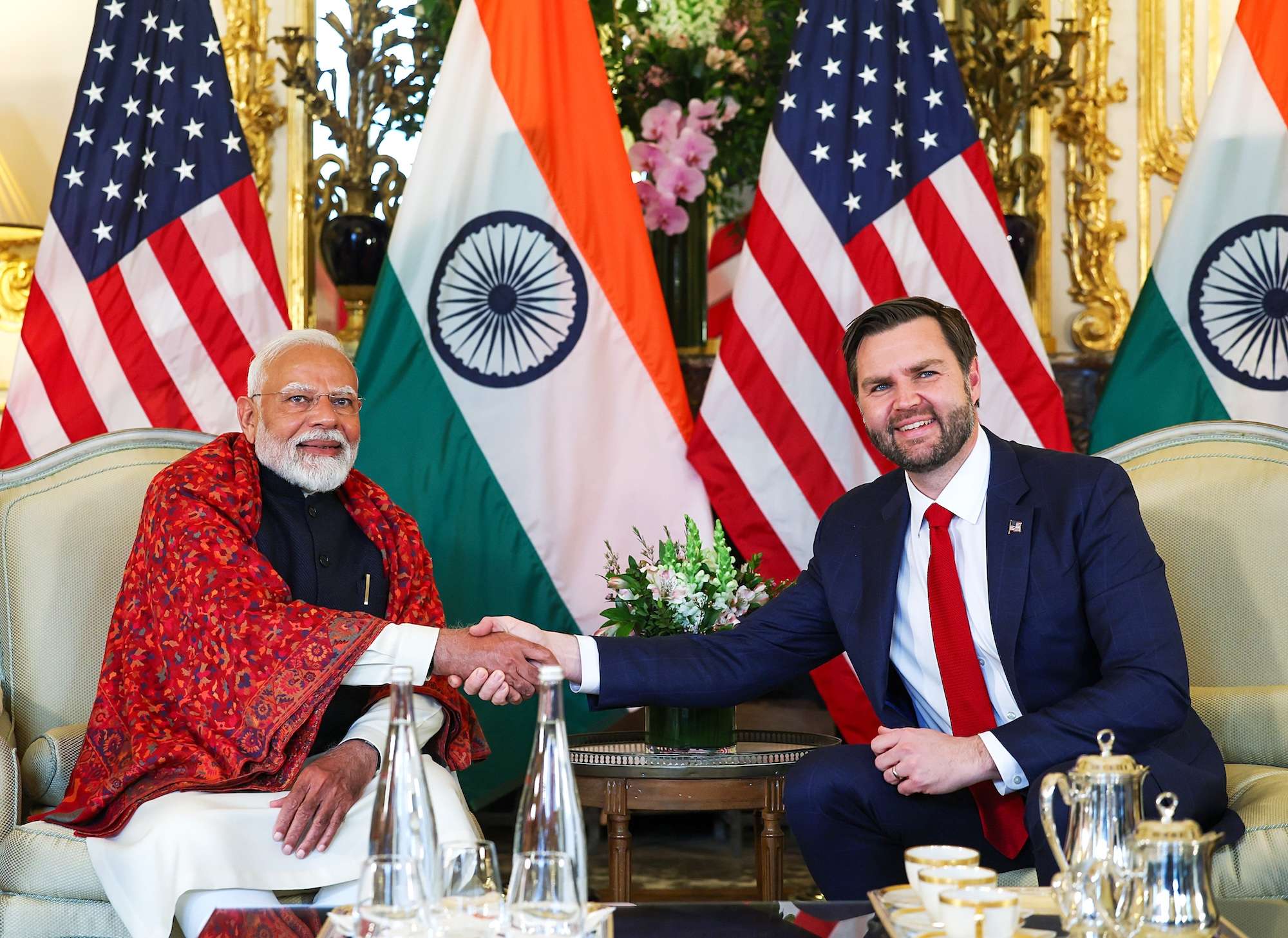
We’re no stranger to skepticism when it comes to foreign visits by our elected officials. Most trips abroad get reduced to photo ops or empty platitudes. But Vice President JD Vance’s ongoing visit to India is different. It is, in many ways, a reflection of the tectonic shift taking place in the 21st-century global order. And it’s time more Americans realized just how much this alliance with India matters—not just for global diplomacy, but for our economy, our security, and the future we’re all going to share.
India is no longer the sleeping giant of decades past. With a population of 1.4 billion and the world’s fastest-growing major economy, India is stepping onto the global stage not just as a partner, but as a peer. In this pivotal moment, the U.S.-India relationship is maturing into something far more meaningful: a strategic, values-based partnership built not on short-term interests, but on long-term vision.
The $500 Billion Bet: Trade That Builds Futures
Let’s start with the money. Trade isn’t just about numbers—it’s about jobs, innovation, and economic resilience. The current U.S.-India bilateral trade stands at $191 billion, a respectable number, but both nations have set their sights much higher. “Mission 500,” an ambitious goal to more than double trade to $500 billion by 2030, is not some starry-eyed slogan. It’s a structured, aggressive strategy backed by serious negotiation.
We’re talking about a comprehensive Bilateral Trade Agreement (BTA) that dives deep—19 chapters deep, to be exact. These cover everything from customs and investment rules to market access and tariff reductions. On the American side, we’re pushing to expand exports of electric vehicles, agricultural products, wines, and industrial goods. For India, it’s about boosting textiles, chemicals, and seafood—industries tied closely to its workforce and economy.
India is already our ninth-largest trading partner and our largest in South Asia. More importantly, it’s our biggest export market for pharmaceuticals and a rising consumer base for American technology, clean energy, and food products. A successful BTA will mean more American-made goods in Indian homes and more Indian innovation in our markets. It’s a two-way street, paved with mutual benefit.
And let’s not forget the strategic edge. Diversifying our trade partnerships, especially as we work to reduce overreliance on China, is no longer a luxury—it’s a necessity. India’s growing middle class and democratic framework make it a natural partner for the U.S. supply chain resilience strategy.
This isn’t just economic theory. This is about protecting American jobs and ensuring that our industries have stable, democratic partners for the long haul.
Defense: From Buyer to Builder
Economic ties are just the tip of the spear. The real transformation is unfolding in defense.
Historically, the U.S.-India defense relationship was a buyer-seller affair. We sold, India bought. But those days are over. Today, we are co-producing weapons, co-developing technology, and aligning our military doctrines in ways that would have been unthinkable even a decade ago.
A new 10-year defense framework is in the works, encompassing everything from arms transfers to technology co-development. India now fields U.S.-origin platforms such as the C-130J Super Hercules, C-17 Globemaster III, P-8I Poseidon, and AH-64E Apache helicopters. New plans include joint production of Javelin missiles and Stryker infantry vehicles—projects that would not only support jobs in both nations but ensure interoperability between our forces.
Let’s be clear: this is not just about hardware. It’s about readiness. Through joint military exercises and intelligence sharing, both nations are preparing to counter threats across the Indo-Pacific and beyond. Whether it’s deterring aggression in the South China Sea or responding to humanitarian disasters, the U.S.-India defense partnership is rapidly becoming the backbone of regional security.
Security Partnership: From Coordination to Action
Security cooperation isn’t limited to battlefields. It’s also about justice, and here the progress is just as striking.
Earlier this month, the United States extradited Tahawwur Rana—a Pakistani-origin Canadian national—to India for his role in the 2008 Mumbai terrorist attacks. This marks the first time we have extradited a terror suspect to India under our 1997 treaty. It was a complex legal process, involving years of litigation and appeals all the way to the Supreme Court. And yet, justice prevailed.
This wasn’t a political stunt—it was a commitment to principle. Six Americans were among the 166 people killed in the Mumbai attacks. Rana’s extradition sends a crystal-clear message: if you orchestrate terror, there is no hiding behind borders or bureaucracy. We will find you, and you will face justice.
And there’s more. Just weeks ago, the FBI arrested Harpreet Singh, a key figure in the Khalistan-linked terror group Babbar Khalsa International, right here in Sacramento, California. Singh is accused of orchestrating over a dozen grenade and IED attacks in India, often with help from Pakistan’s ISI. Thanks to joint operations and real-time intelligence sharing between U.S. and Indian agencies, Singh was tracked despite using burner phones and encrypted messaging apps.
His arrest and the ongoing extradition process again demonstrate the potency of this partnership. These are not isolated wins—they’re the fruits of sustained cooperation, trust, and a shared zero-tolerance policy toward terrorism.
Values That Bind, Not Just Interests That Align
For decades, American foreign policy has been a chessboard of compromises—balancing our values with “strategic necessities.” But the U.S.-India relationship offers a rare opportunity where values and interests actually align. Both nations are multiethnic, pluralistic democracies. Both are committed to the rule of law, a free press, and the protection of civil liberties.
We don’t always agree. But unlike authoritarian regimes that trade in censorship and coercion, India engages us openly, democratically, and in good faith.
This is a partnership of equals—not a dependency, not an alliance of convenience.
And as the world faces new challenges—from cyber warfare and artificial intelligence to climate change and pandemics—our ability to tackle them will depend on the kind of alliances we build today. Do we want to face tomorrow’s threats with China or Russia at our flank? Or would we rather stand with India—a fellow democracy, an economic powerhouse, and a cultural partner with shared convictions?
A Defining Moment
JD Vance’s trip to India comes at a defining moment. It’s a recognition that American interests are best served by forging deep, enduring partnerships—not just across the Atlantic, but across the Pacific. His presence signals that this relationship isn’t partisan, and it isn’t performative. It’s foundational.
Americans are often told to look inward—to focus on Main Street, not Mumbai. But the truth is, what happens in Mumbai, in New Delhi, in Bangalore, increasingly shapes what happens in Cleveland, Omaha, and Los Angeles. Trade deals mean jobs. Defense ties mean security. Counterterrorism cooperation means fewer families burying loved ones.
The U.S. is proud to be walking alongside India, not just as a friend but as a force for good. This is what real leadership looks like: principled, proactive, and prepared for the future.
We should all be paying attention. Because this isn’t just a story about diplomacy—it’s a story about who we are, and who we want to become.
And with India by our side, the answer looks a lot more promising.
Further Reading
- The New York Times: U.S. Pursues Defense Partnership With India to Deter China1
- CNN: The India-US trade relationship explained in 4 charts2
- White House: United States-India Joint Leaders’ Statement (2025)3
- BBC News: US officials begin trade talks in Delhi as tariff deadline nears4
- Foreign Policy: The Quad’s Malabar Exercises Point the Way to an Asian NATO5
- ExecutiveGov: US, Indian Officials Discuss Strategic Tech Collaborations6
- CNN: New US-backed India-Middle East trade route to challenge China’s Belt and Road7
- U.S. Department of State: U.S.-India Relations Fact Sheet
(Authoritative overview of diplomatic, economic, and security ties) - Council on Foreign Relations: The U.S.-India Relationship
(Backgrounder on the evolution of the partnership and strategic context) - Brookings Institution: The U.S.-India strategic partnership
(Analysis of the defense and economic dimensions of the alliance) - Carnegie Endowment for International Peace: U.S.-India Defense Cooperation
(Deep dive into defense technology and co-production agreements) - Atlantic Council: U.S.-India partnership for the 21st century
(Report on the future trajectory and challenges of the alliance)