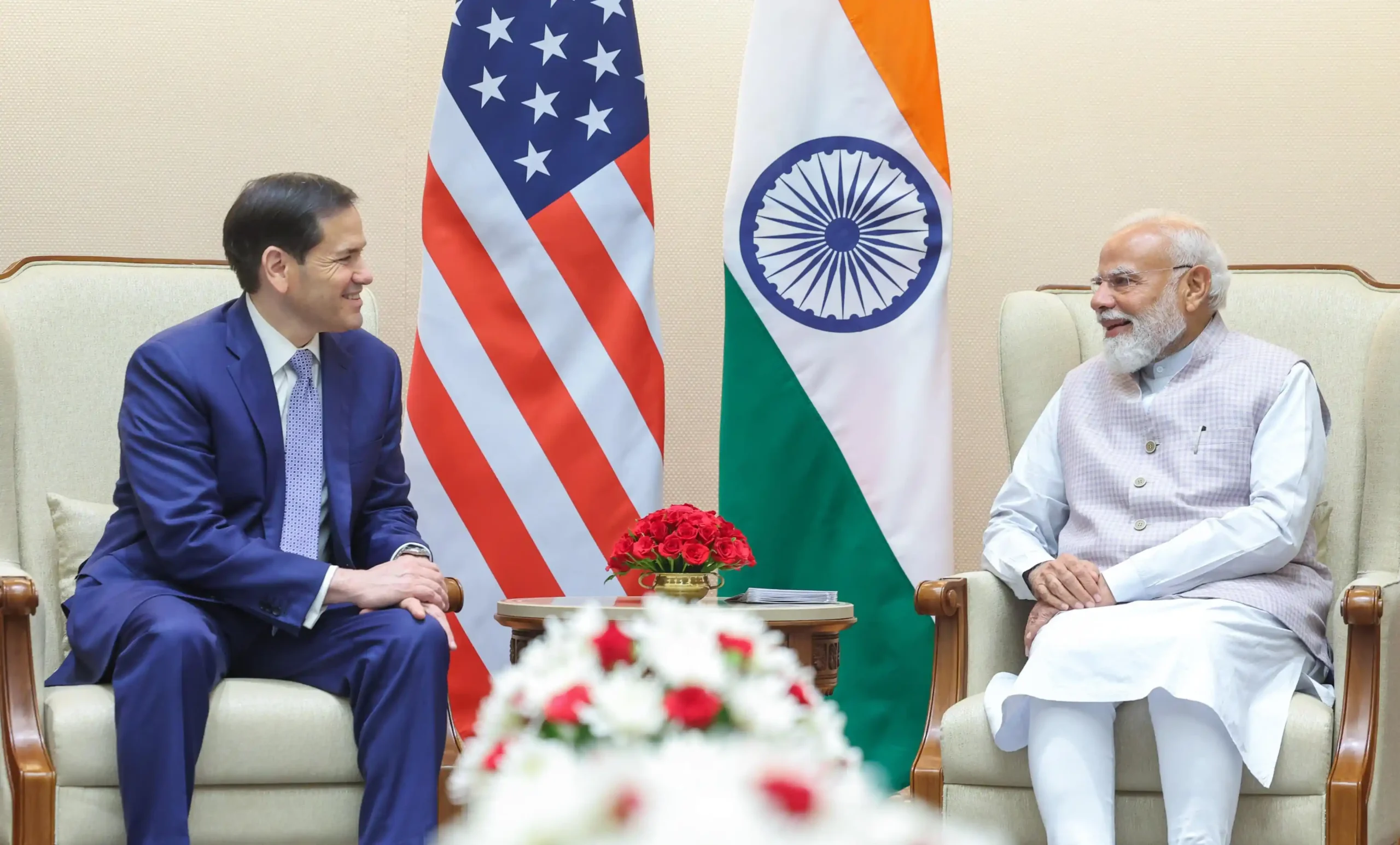
Marco Rubio’s May 2026 visit to India is not diplomatic pageantry; it is an attempt to re-anchor a relationship whose economic and security stakes are now systemic for both countries and for the wider Indo-Pacific order. It comes at a moment when bilateral goods and services trade has climbed above 200 billion USD annually, defense trade has risen from near-zero two decades ago to roughly 20 billion USD cumulatively, and technology, climate, and human-capital linkages increasingly bind the two economies into a shared production and innovation ecosystem.
By situating his trip around Quad consultations, energy security, trade, and defense industrial cooperation, Rubio is effectively treating India less as a “partner of convenience” and more as a structural co-anchor of U.S. economic security and technological resilience. The question is not whether this visit can “reset” personalities in Washington and New Delhi, but whether it can translate existing architectures—iCET, INDUS‑X, climate and clean energy partnerships, the four “foundational” defense agreements—into a more predictable, rules‑based framework for trade, technology sharing, and mobility.
The scale and composition of U.S.–India trade already look like those of a macro‑critical relationship, not a niche emerging‑market play. In 2024, two‑way U.S. goods and services trade with India reached an estimated 212.3 billion USD, an 8.3 percent increase over 2023. Preliminary data suggest that total goods and services flows rose further to around 241.5 billion USD in 2025, with 152.3 billion USD in U.S. imports from India and 89.2 billion USD in U.S. exports, generating a bilateral U.S. trade deficit of 63.1 billion USD.
India has simultaneously become the United States’ largest goods‑and‑services trading partner on New Delhi’s books, with India’s own data showing bilateral trade of 132.2 billion USD in FY 2024–25 and a sizable Indian surplus of 40.82 billion USD. These numbers do not perfectly align because of differences in coverage and methodology, but the direction is unambiguous: India has moved into the top tier of U.S. trading partners, while the United States has become India’s largest single market.
From symbolism to supply chains
The composition of trade underscores why Rubio’s visit is being framed around energy security, critical minerals, and advanced manufacturing rather than only services offshoring. In 2025, consumer goods accounted for roughly 57.9 billion USD, or about 38 percent, of U.S. imports from India, while industrial supplies and materials, capital goods, and business and telecom services together made up the backbone of exports to India. On India’s side, exports to the United States in FY 2024–25—86.51 billion USD—were led by electrical machinery and equipment (15.89 billion USD), gems and jewelry (9.97 billion USD), pharmaceuticals (9.78 billion USD), and machinery and mechanical appliances (6.69 billion USD).
This structure—India exporting labor‑ and skill‑intensive manufactures and pharmaceuticals while importing energy, capital goods, and high‑end services—maps neatly onto U.S. “friend‑shoring” efforts to diversify supply chains away from over‑concentration in China. Rubio’s emphasis on commercial ties and energy security during his India swing is therefore not rhetorical; it reflects a view that greater Indian integration into U.S. supply chains for consumer goods, APIs, electronics, and potentially green technologies can mitigate price and geopolitical risk for American firms and consumers.
Investment, FDI, and the political economy of interdependence
Trade flows are being reinforced by steadily rising investment stocks. U.S. foreign direct investment (FDI) in India has reached roughly 58.5 billion USD in 2024–25, with cumulative U.S. FDI stock around 70.65 billion USD, making the United States India’s third‑largest investor. Indian FDI in the United States, while smaller, has grown to about 16.4 billion USD in stock terms and supports more than 70,800 jobs in the U.S. economy, particularly in IT services, pharmaceuticals, and manufacturing.
Rubio himself has highlighted “more than 20 billion” USD in investments from Indian companies in the United States in just the past year, underscoring how corporate India increasingly sees the U.S. market as a platform for global scale rather than merely an export destination. These figures matter politically: they create U.S. constituencies—local governments, workers, and firms—whose economic fortunes are tied to the continuity of an open, rules‑based bilateral economic regime. By using his visit to spotlight these investments and launch a new “America‑first” business visa scheduling tool to prioritize professionals who deepen bilateral ties, Rubio is explicitly linking mobility and investment to domestic employment narratives in the United States.
Defense and the hard infrastructure of trust
On the security side, Rubio is operating within a defense relationship that has been structurally transformed over the last decade. Since 2008, U.S.–India defense trade has risen from “near zero” to roughly 15–20 billion USD in cumulative arms sales, including transport aircraft, maritime patrol planes, artillery, and helicopters. The Defense Security Cooperation Agency approved an additional 5.611 billion USD in sales to India in 2024–25 alone, including 31 MQ‑9B remotely piloted aircraft, MH‑60R multi‑mission helicopter support, MK 54 lightweight torpedoes, sonobuoys, and precision munitions.
These flows have been enabled by India’s designation as a “Major Defense Partner” in 2016, a status unique to India that allows defense trade and technology sharing “at par” with the United States’ closest allies and removes many export hurdles for high‑end hardware and dual‑use technologies. They are further underpinned by the so‑called “foundational agreements”—LEMOA (2016), COMCASA (2018), and BECA (2020)—which provide logistics access, secure communications interoperability, and geospatial intelligence sharing, respectively.
Rubio’s focus on defense collaboration and joint exercises in the Indo‑Pacific during this trip thus builds on an already dense architecture that makes Indian maritime and air capabilities more interoperable with U.S. forces and more dependent on U.S. technology ecosystems. From a geopolitical economist’s perspective, this is not merely about balancing China; it is about embedding India in a network of U.S.‑aligned defense supply chains, maintenance hubs, and standards regimes that increase the opportunity cost of strategic divergence.
iCET, INDUS‑X, and the technology compact
The United States–India Initiative on Critical and Emerging Technology (iCET), launched in 2022–23 and reviewed at high level in New Delhi in June 2024, provides the civilian‑military innovation backbone for Rubio’s agenda. Under iCET, the two countries have prioritized cooperation in semiconductors, quantum computing, artificial intelligence, space, advanced telecommunications, and biotechnology, and have set up an Indo‑U.S. quantum coordination mechanism that brings together industry, academia, and government.
On the defense‑industrial side, the INDUS‑X initiative—launched in June 2023 by the U.S. Department of Defense and India’s Ministry of Defence as a “defense acceleration ecosystem”—aims to build an “innovation bridge” between American and Indian defense startups, investors, and research institutions under the iCET umbrella. INDUS‑X’s early achievements include joint innovation challenges, plans for a bilateral innovation fund with private capital participation, and efforts to standardize certification for jointly developed technologies so that they can be rapidly absorbed into both militaries.
Rubio’s visit, coming just as the third INDUS‑X summit is being prepared with a focus on mobilizing private capital in Silicon Valley, offers an opportunity to lock in deeper Treasury and Commerce Department involvement and to treat defense‑tech co‑production as part of a broader industrial policy for both economies. In effect, it can move U.S.–India technology cooperation from a pilot‑project model to a portfolio‑level framework with clearer timelines, financing structures, and export control carve‑outs.
Clean energy, climate finance, and critical minerals
Energy security is formally on Rubio’s agenda, but the economic content extends beyond oil flows and sanctions management. Under the U.S.–India Climate and Clean Energy Agenda 2030 Partnership, launched in 2021, India has set a target of installing 450 gigawatts of renewable energy capacity by 2030, while the United States has committed to economy‑wide emission reductions of 50–52 percent below 2005 levels by that date. Analysts at UC Davis estimate that renewed U.S. commitments could generate more than 2 billion USD in public climate finance to India between 2021 and 2025, with an ambition to crowd in at least 4 billion USD in private climate finance over the same period.
For a U.S. administration under Donald Trump that has otherwise been skeptical of multilateral climate regimes, Rubio’s willingness to foreground energy security and clean energy cooperation in India is notable. It suggests that climate and critical mineral supply chains—lithium, cobalt, rare earths, and solar‑grade polysilicon—are being reframed primarily through an energy security and industrial policy lens. In such a framing, Indian deployment targets and U.S. climate finance commitments are less about moral leadership than about building diversified, democracy‑aligned supply chains for the green transition.
People, visas, and the mobility dividend
Perhaps the most under‑appreciated macroeconomic variable in the U.S.–India relationship is human capital mobility. According to the latest Open Doors 2025 data, 363,019 Indian students were studying in the United States in academic year 2024–25, a 9.5 percent increase over the previous year; Indians now account for roughly 30–31 percent of all international students in the U.S., having overtaken China as the top source country. A parallel report from U.S. immigration authorities indicates that Indian students made up about 27 percent of all active F‑1 and M‑1 records in 2024—around 420,000 individuals—reflecting double‑digit year‑on‑year growth.
Beyond students, an estimated 5.1 million people of Indian origin reside in the United States, and Indian visitors are now the third‑largest group of overseas travelers to the U.S., with 1.76 million Indians visiting in 2023 and at least 1.55 million traveling between January and August 2024 alone. This demand is straining consular capacity: wait times for interview‑required visitor visas in mid‑2025 ranged from roughly 312 days in Mumbai to 477 days in Kolkata. Rubio’s unveiling of a new visa scheduling tool in New Delhi, explicitly marketed as an “America‑first” mechanism that prioritizes business professionals and others who deepen economic ties, is therefore not just consular housekeeping; it is a productivity intervention aimed at reducing frictions in a labor and knowledge market that contributes tens of billions of dollars annually to U.S. GDP.
Managing friction while locking in convergence
Rubio’s visit is also taking place against a backdrop of notable bilateral friction: disputes over tariffs and digital trade rules, tensions after a brief India–Pakistan conflict and subsequent crisis diplomacy, and disagreements over third‑country issues such as Russia and Iran. Reports suggest that U.S.–India ties “started to fray” following the Kashmir crisis and that last year’s planned Quad leaders’ summit in India was postponed amid broader turbulence in the relationship. Meanwhile, U.S. arms sales to India—such as the 92.8 million USD in Javelin anti‑tank missiles and Excalibur artillery shells approved in 2025—have been interpreted both as a hedge against Russia’s declining defense reliability and as a source of congressional scrutiny over technology transfer.
It is in this context that analysts at the Council on Foreign Relations and elsewhere have described Rubio’s trip as one conducted in “repair mode,” aimed at restoring momentum after a year of strain between Trump and Modi. By tying the visit to the Quad foreign ministers’ meeting in New Delhi and explicitly signaling “new announcements ahead” to strengthen the partnership, Rubio is attempting to use multilateral choreography and forward‑guidance to reassure markets and bureaucracies that, despite episodic disputes, the strategic trajectory remains upward.
Why this visit is a positive inflection
From a geopolitical‑economic standpoint, the positivity of Rubio’s visit lies less in any single memorandum announced in New Delhi than in its potential to consolidate four distinct but interlocking equilibria. First, on trade and investment, by spotlighting the 200‑plus‑billion‑USD trade relationship, the tens of billions in two‑way FDI, and Indian investments supporting U.S. jobs, Rubio can help expand the domestic coalition in both countries that benefits from openness and regulatory predictability.
Second, on defense and technology, his engagement with India comes at a time when foundational agreements, Major Defense Partner status, iCET, and INDUS‑X have already lowered the institutional costs of cooperation; what is needed now is political direction to translate these frameworks into scalable co‑production programs in aerospace, maritime systems, cyber, and semiconductors. Third, on climate and energy, reaffirming and possibly expanding U.S. climate finance and critical mineral cooperation with India would dovetail with Rubio’s stated focus on energy security and with India’s 450‑gigawatt renewable target, giving both sides a shared industrial‑policy project for the 2030s.
Finally, on human capital, by linking consular reforms and new visa tools to the economic value generated by the 360,000‑plus Indian students and over a million Indian visitors in a single year, Rubio is implicitly acknowledging that U.S.–India ties are now as much about people and data flows as about goods and weapons systems. If the visit results in even incremental reductions in uncertainty and friction across these four domains, it will have advanced a structural agenda: moving the relationship from episodic strategic convergence to embedded economic interdependence that is harder to reverse, regardless of who occupies the White House or Race Course Road.