A Canada–India trade agreement may seem modest in aggregate volume, but it is disproportionately important for Canada’s diversification strategy and North American supply‑chain resilience, especially in critical minerals, clean energy, and knowledge‑intensive services. For Canadian and U.S. policymakers, the central economic case rests less on headline trade totals and more on how an eventual Early Progress Trade Agreement (EPTA) and Comprehensive Economic Partnership Agreement (CEPA) rewire upstream resource flows, midstream processing, and downstream manufacturing across the wider USMCA production system.
Of late, bilateral commerce has grown into a mid‑sized but still underexploited relationship. In fiscal year 2023–24, India–Canada merchandise trade reached about 8.4 billion USD, up slightly from 8.3 billion USD in 2022–23. In calendar‑year terms, bilateral trade in goods and services stood at 18.38 billion USD in 2023 and rose to roughly 23 billion USD in 2024, implying that services now account for a significant share of the relationship.
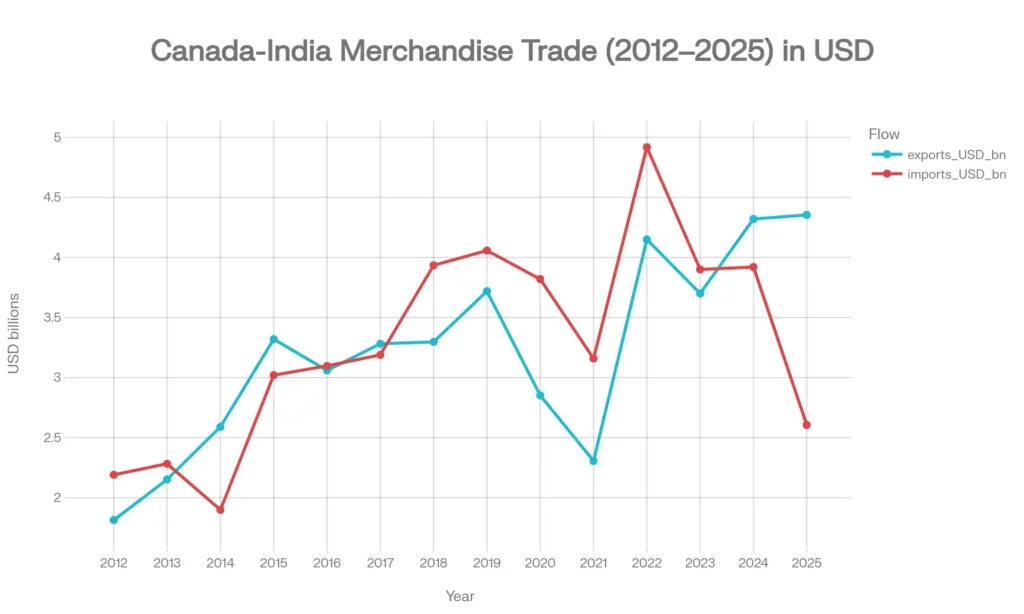
Recent trade flows (USD billions)
In structural terms, India and Canada remain peripheral in each other’s overall trade portfolios. Canada’s goods and services trade with all partners was nearly 1.9 trillion in 2022—very likely in Canadian dollars—which translates to roughly 1.46 trillion USD at the Bank of Canada’s 2022 average rate of 1 USD = 1.3013 CAD, so India’s 2023 goods‑and‑services trade of 18–23 billion USD represents barely over 1% of that total. Conversely, Canada accounts for only about 0.6% of India’s merchandise imports and around 1% of India’s merchandise exports, underscoring how much headroom remains.
The merchandise basket is narrow and heavily resource‑linked, which is economically manageable but strategically fragile. India imports pulses, fertilisers, newsprint, wood pulp, and industrial chemicals from Canada, creating concentrated dependencies in specific food‑security and input‑intensive sectors. On the export side, India ships gems and jewellery, pharmaceutical products, ready‑made garments, organic chemicals, and light engineering goods to Canada, reflecting India’s role as a diversified manufacturing and processing hub rather than a simple commodity supplier.
Services are where the bilateral relationship has grown most dynamically and where an EPTA/CEPA could deliver the highest value‑added gains for Canada and the United States. Canada’s services exports to India rose to about 6.2 billion Canadian dollars in 2022—roughly 4.8 billion USD at the 2022 average exchange rate—while services imports from India reached 2.9 billion Canadian dollars, or about 2.2 billion USD. Even so, Canada’s services exports to India account for only about 1% of its total services exports, whereas services imports from India have climbed to an estimated 3.5% of Canada’s total services imports, implying rising Canadian reliance on Indian IT, professional, and back‑office capabilities.
Historical data show a slow but steady deepening of ties, especially after 2010, but without the step‑change one associates with a major free‑trade agreement. Canadian merchandise exports to India grew from 2.36 billion Canadian dollars in 2012 to 5.4 billion in 2022—about 1.8 to 4.15 billion USD—while imports from India rose from 2.85 to 6.4 billion Canadian dollars, or roughly 2.16 to 4.9 billion USD over the same period. The persistence of a modest Canadian deficit in goods, alongside Canada’s surplus in services, suggests that a comprehensive agreement would need to manage sectoral sensitivities while recognizing that two‑way trade remains small relative to each economy’s scale.
For Ottawa, the strategic value of an India deal lies less in raw volume and more in diversification away from an overwhelming dependence on the United States and a fraught but still sizable relationship with China. Global Affairs Canada has explicitly identified India as a priority partner within its Indo‑Pacific strategy, with an ambition to double two‑way trade with India to about 70 billion annually—likely in Canadian dollars—by 2030, which would correspond to roughly the mid‑50‑billion‑USD range at recent exchange rates. The federal government has also committed to doubling total exports to non‑U.S. markets by 2035, and senior ministers now link Canada–India energy and critical‑minerals cooperation directly to that diversification goal.
On the Indian side, sustained high growth and surging energy demand anchor the economic rationale for deeper engagement. Canada’s natural resources ministry explicitly notes that India is expected to account for the largest growth in global energy demand through 2030, positioning it as a key long‑term market for Canadian liquefied natural gas (LNG), crude, and other fuels. India’s rapid electrification, ambitious renewable‑energy targets, and expanding middle class also create demand for critical minerals, advanced manufacturing inputs, and aerospace technology that Canada can competitively supply.
Institutionally, New Delhi and Ottawa have converged on a two‑step architecture: a limited EPTA followed by a comprehensive CEPA. In March 2022, ministers formally agreed to re‑launch CEPA negotiations while pursuing an interim Early Progress Trade Agreement covering goods, services, investment, rules of origin, sanitary and phytosanitary (SPS) measures, technical barriers to trade (TBT), and dispute settlement. By May 2023, the sixth Ministerial Dialogue on Trade and Investment (MDTI) had recorded seven negotiating rounds on the EPTA, signalling substantial technical progress despite later political shocks.
Diplomatic relations deteriorated sharply in 2023 following public allegations by Canada’s then government concerning the killing of Hardeep Singh Nijjar, prompting Ottawa to pause FTA talks. Notwithstanding this political rupture, bilateral merchandise trade actually edged up from 8.3 billion USD in 2022–23 to 8.4 billion USD in 2023–24, and 2024 goods‑and‑services trade rose to about 23 billion USD, underscoring a surprising resilience of commercial flows to political turbulence. For negotiators in Washington and Ottawa, this disconnect between politics and trade suggests that properly institutionalized economic ties—anchored in rules rather than personalities—can withstand cyclical diplomatic crises.
By late 2025, both governments had moved to restore momentum, recalibrating the negotiation as an instrument of economic security rather than simple tariff reduction. India’s commerce minister announced that talks would resume on a “high‑ambition” CEPA with a shared goal of increasing two‑way trade to 50 billion USD by 2030, essentially more than doubling current levels. This target is economically plausible given the recent jump from 18.38 to 23 billion USD in total trade between 2023 and 2024, but achieving it will require concentrated liberalisation and project‑level execution rather than incrementalism.
The most compelling economic logic for a Canada–India deal lies in critical minerals, where Canada has resource endowments and India has scale in processing and manufacturing. Canadian and Indian ministers have committed to annual dialogues on critical‑mineral supply chain resiliency, initially tied to the Prospectors and Developers Association of Canada (PDAC) conference, to coordinate exploration, investment, and offtake. Track‑1.5 dialogues hosted by the Asia Pacific Foundation of Canada and Indian partners have stressed the need to move from broad frameworks to a small number of commercially viable pilot projects in minerals such as lithium, nickel, copper, and select rare earths.
Beyond minerals, energy trade offers a classic upstream‑downstream partnership. Canada is positioning itself as an “energy superpower” in both conventional and clean energy, with emerging LNG export facilities and expanded crude shipments aimed at Asian markets, including India. India, facing sharp growth in energy demand and seeking diversification away from single‑supplier risks, has signalled interest in long‑term LNG, LPG, and crude offtake from Canada, while also exploring Indian investment in Canadian terminals and energy infrastructure.
Agriculture and food are already central to the relationship and would be directly shaped by any agreement. India depends on Canada for a significant share of its imported pulses and fertilisers, making tariff stability and SPS predictability in these categories a matter of food‑price and rural‑income stability for New Delhi. In turn, Canadian farmers gain from a large and growing market for lentils, peas, and other agricultural products, especially if an EPTA locks in lower tariffs and science‑based SPS rules, reducing exposure to abrupt, politically driven policy shifts.
The services relationship is increasingly defined by human capital and digital networks. Canada’s services imports from India—rising to an estimated 2.9 billion Canadian dollars in 2022—reflect the integration of Indian firms into Canadian IT, business‑process outsourcing, and professional‑services supply chains, which in turn support Canadian firms serving North American clients. Meanwhile, Canada’s services exports to India, at about 6.2 billion Canadian dollars in 2022, embody education, tourism, and financial services that are sensitive to visa policy, regulatory recognition, and digital‑trade rules, all of which can be disciplined within a modern FTA.
Investment flows, especially through Canadian pension funds, are already large enough to matter for both economies and for global asset allocation. According to India‑focused credit analysis, Canadian pension funds have cumulatively invested around 55 billion USD in India, making the country the fifth‑largest foreign investment destination for the Canada Pension Plan Investment Board and its peers. This is occurring against a backdrop in which global foreign direct investment fell by 12% to 1.3 trillion USD in 2022, implying that Canada’s pension‑fund exposure to India is significant in global context and could expand further under a robust investment chapter with credible dispute‑settlement provisions.
For U.S. audiences, the Canada–India deal matters chiefly through its interaction with North American value chains. Canada’s effort to leverage its energy and mineral strengths to build “reliable supply chains and strategic stability” explicitly targets partnerships with major Asian economies such as India, which would then feed into manufacturing in the USMCA area. A well‑structured CEPA could encourage Canadian upstream production and Indian midstream processing in ways that complement, rather than compete with, U.S. downstream manufacturing in sectors such as electric vehicles, batteries, and aerospace.
The geography of benefits within Canada is likely to be uneven but politically salient. Resource‑rich provinces like Saskatchewan, Alberta, and British Columbia stand to gain from expanded exports of pulses, potash, LNG, and critical minerals, while Ontario and Quebec would benefit more from services, aerospace, and advanced‑manufacturing linkages with India. Given that India currently accounts for only a small fraction of Canada’s total trade, even a few billion dollars of additional, high‑value‑added exports could have outsized employment and fiscal impacts in these regions, especially when combined with new investment inflows.
The 2023 diplomatic crisis illustrates that political risk is not an abstraction but a structural variable that must be built into the agreement’s institutional design. The EPTA framework already envisages binding chapters on SPS, TBT, and dispute settlement, which can reduce the scope for arbitrary policy reversals in sensitive sectors like agriculture and energy. For investors and U.S. supply‑chain planners, credible state‑to‑state and, where appropriate, investor–state dispute‑settlement mechanisms are essential to translating political declarations into bankable projects.
Regulatory cooperation offers another channel through which a Canada–India agreement can generate value that exceeds its tariff cuts. The MDTI process has already discussed recognition of Canada’s systems approach to pest‑risk management in pulses and potential Conformity Verification Body status for India’s agricultural export authority, both of which would streamline trade in agri‑food products. Extending this logic to digital trade, data protection, and clean‑technology standards would help ensure that Indian and Canadian firms can plug more seamlessly into U.S. and broader G7 regulatory environments.
Policy dialogues on critical minerals have converged on a common diagnosis: implementation failure, not strategic misalignment, is the binding constraint. Track‑1.5 participants have urged both governments to “move from frameworks to projects,” specifically by using offtake‑backed finance, sovereign equity participation, investment guarantees, and regulatory fast‑tracking to de‑risk a handful of flagship ventures. An EPTA could hard‑wire these instruments into its text—through dedicated annexes on project facilitation and export‑credit coordination—making the agreement a delivery mechanism rather than a purely declaratory document.
For the U.S, a deeper Canada–India economic compact would reinforce broader efforts at “friend‑shoring” and supply‑chain diversification away from single‑country dominance in strategic inputs. Canadian government statements already frame India partnerships in energy and minerals as part of building “more reliable supply chains and strategic stability” with major global players, a narrative that aligns closely with U.S. concerns. As long as rules of origin and regulatory standards remain compatible with USMCA disciplines, expanded India–Canada trade should be seen less as diversion and more as a way of crowding trusted partners into North American production networks.
Three design principles emerge for negotiators in Ottawa, New Delhi, and, by extension, Washington. First, prioritise early‑harvest sectors—critical minerals, clean energy, agri‑food SPS reforms, and digital trade—where complementarities are strong and domestic lobbies are relatively aligned. Second, use the agreement to institutionalise state tools that crowd in private capital, including offtake‑backed finance for critical minerals and clear frameworks for pension‑fund and sovereign‑wealth investment. Third, ensure that dispute‑settlement and regulatory‑cooperation mechanisms are robust enough to insulate commercial projects from periodic diplomatic shocks, as evidenced by the 2023–24 experience.
If these conditions are met, a Canada–India trade deal would not be a mega‑agreement in the mold of NAFTA or CETA, but it would be a strategically dense piece of the North American economic architecture. The prospective doubling of two‑way trade to around 50 billion USD by 2030 would still represent only a small fraction of Canada’s global trade, yet the composition of that trade—in critical minerals, clean energy, food security, and high‑skill services—gives it outsized significance for Canada and the United States. For North American policymakers, the key is to treat the CEPA not as an isolated bilateral experiment, but as a building block in a wider web of Indo‑Pacific economic security partnerships that collectively reduce vulnerability and enhance long‑term growth.