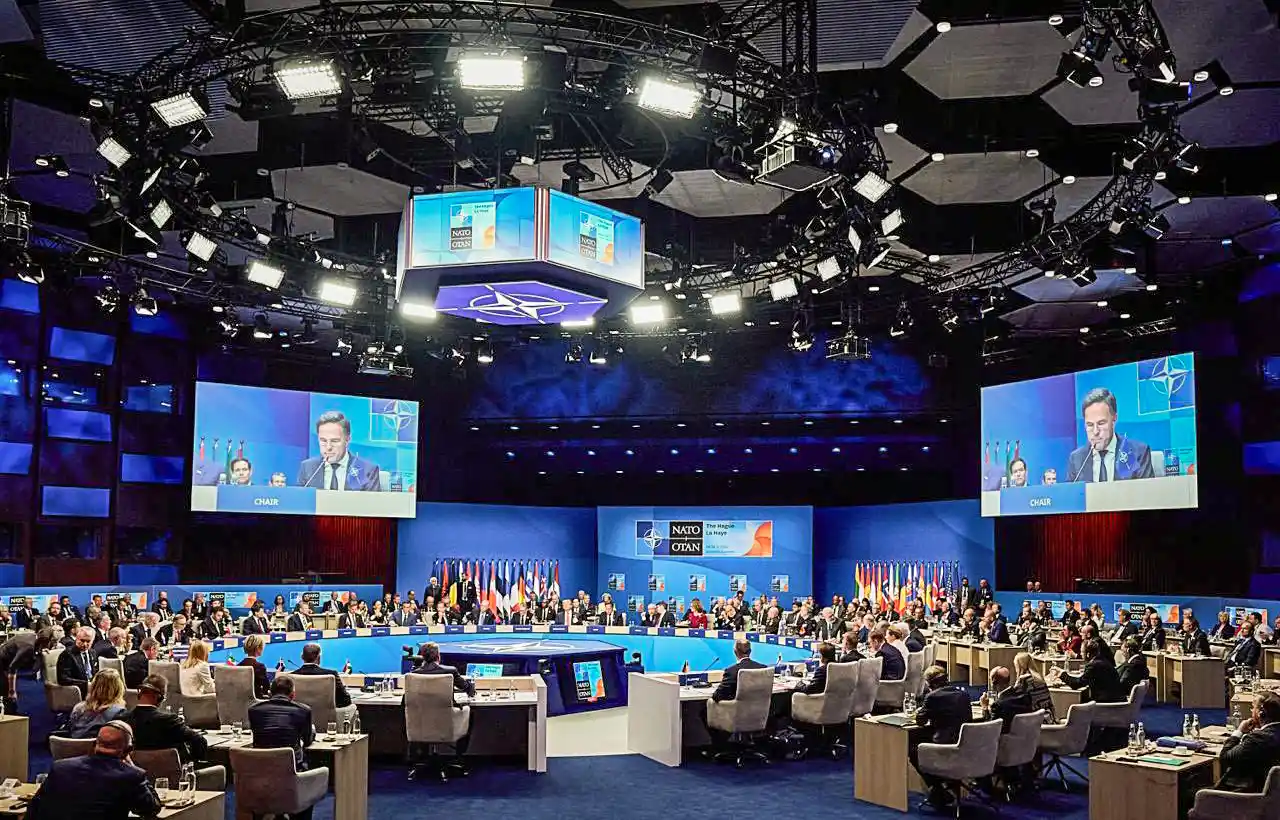
NATO is undergoing its most profound transformation since the Cold War, and that transformation is producing two distinct, competing visions for its future—one articulated by Canadian Prime Minister Mark Carney, the other by NATO Secretary General Mark Rutte. The tension between these visions is real, but it is not a fracture; it is a recalibration. And in that recalibration lies the future of the trans-Atlantic alliance.
The context: defense spending and strategic autonomy
The immediate trigger for the “split” narrative is defense spending. For years, the United States—under multiple presidents, but most volubly under Donald Trump—has criticized European allies and Canada for failing to meet NATO’s 2% of GDP defense spending target. In 2025, at the NATO Summit in The Hague, allies agreed to a new, more ambitious pledge: 5% of GDP by 2035, with 3.5% dedicated to core defense and 1.5% to defense-related industrial resilience and emerging technologies.
One year into that 10-year project, European allies and Canada are already investing around 4% of GDP in defense and security-related measures, according to Secretary General Rutte. In 2025 alone, they increased investments in core defense requirements by more than $139 billion. At the July 2026 Ankara Summit, they announced more than $50 billion in new procurements and committed to expanding collective manufacturing capacity.
This surge in spending is not just about meeting a number; it is about assuming greater responsibility for the alliance’s defense. The Ankara Summit Declaration explicitly states: “European Allies and Canada, working with the United States, are assuming greater responsibility for the Alliance’s defence.” This is the heart of the transformation: a shift from a U.S.-led alliance to a more balanced, transatlantic partnership.
Two Marks, two visions
Enter the two Marks.
Mark Rutte, the former Dutch prime minister and now NATO Secretary General, has been the architect of what might be called “NATO 3.0”: a modernized alliance with a 360-degree approach to deterrence and defense, integrating nuclear, conventional, missile defense, space, and cyber capabilities. His vision is one of delivery and capability: turning financial commitments into stronger armed forces, increased defense production, and the tools needed to defend the alliance. He emphasizes interoperability, a transatlantic warfighting cloud, and the adoption of powerful AI models. For Rutte, the future of NATO is a stronger Europe in a stronger NATO—a modernized alliance where European allies and Canada pull their weight, but do so within the existing framework, alongside the United States.
Mark Carney, the Canadian Prime Minister, has a different, more expansive vision. Since taking office in 2025, Carney has initiated a “generational increase” in defense investment, bringing Canada to the 2% target for the first time since 1989 and committing to the 5% goal by 2035. But his vision goes beyond spending. Carney has framed increased defense spending as a remedy not just for security threats, but for the economic repercussions of U.S. tariff policies and strategic unpredictability. He has emphasized the need for Canada to “lessen its defense procurement reliance on U.S. companies,” which currently accounts for about 70% of its defense spending.
Carney’s vision is one of strategic autonomy and diversification. He has spoken of an “unraveling international order” and an “increasingly unreliable United States.” His government is investing in Arctic sovereignty, developing military bases in Canada’s Far North, and exploring alternatives to U.S. procurement, including Swedish aircraft that could be produced domestically. For Carney, the future of NATO is not just a stronger Europe, but a more diversified, resilient alliance that can function even if the U.S. steps back.
The data: who is pulling the weight?
The numbers tell a story of convergence, not divergence.
Canada, in 2025, allocated 2% of GDP to military spending, totaling 63 billion Canadian dollars (around $46 billion). This is the first time since the fall of the Berlin Wall that Canada has met the NATO target. Carney has committed to reaching 5% by 2035, with 3.5% in core defense and 1.5% in defense-related areas like AI, quantum, and industrial resilience.
Europeans have matched and exceeded this commitment. European allies and Canada increased investments in core defense requirements by more than $139 billion in 2025. At the Ankara Summit, they announced more than $50 billion in new procurements. The draft summit declaration seen by Reuters indicates that European allies and Canada are expected to highlight this progress and reaffirm their commitment to assuming greater responsibility for the alliance’s collective defense.
Ukraine remains a critical test of allied unity. European Allies and Canada now finance the vast majority of security assistance to Ukraine through bilateral and multilateral means. For 2026, allies pledge €70 billion in military equipment, assistance, and training for Ukraine, with a commitment to sustaining at least equivalent levels in 2027. The United States is not expected to contribute to this package.
These figures show that Europe and Canada are not just meeting targets; they are exceeding them in some areas and taking the lead on Ukraine. This is not a split; it is a shift in burden-sharing.
The “split” narrative: where does it come from?
The “split” narrative is not entirely baseless, but it is overstated. It comes from three sources.
First, strategic divergence. Carney’s emphasis on diversification and strategic autonomy contrasts with Rutte’s focus on integration and interoperability within the existing NATO framework. This is a philosophical difference, not a structural one. Carney is hedging against U.S. unpredictability; Rutte is ensuring that the alliance remains cohesive and capable.
Second, U.S. unpredictability. The Trump administration’s approach to NATO—threatening withdrawal, imposing tariffs, and questioning Article 5—has led some allies to hedge. Carney’s vision is, in part, a response to this unpredictability. He is not abandoning NATO; he is ensuring that Canada and Europe can function within it even if the U.S. becomes less reliable.
Third, internal critiques. Some analysts, like Lithuanian President Gitanas Nauseda, have warned that if some countries meet higher spending levels while others remain at 2-2.5%, the alliance could “split into two or three parts.” But this is a warning, not a prediction, and it is about spending disparities, not a formal split. It is a call for greater unity, not an acknowledgment of fracture.
The reality: a modernized, not fractured, alliance
The Ankara Summit Declaration is clear: “We, the Heads of State and Government of the North Atlantic Alliance, have gathered in Ankara to reaffirm our ironclad commitment to our collective defence under Article 5 of the Washington Treaty and to the transatlantic bond. An attack on one is an attack on all.” This is not the language of a splitting alliance; it is the language of unity.
The reality is that NATO is modernizing, not fracturing. The alliance is adapting to a new strategic environment: a more assertive Russia, a rising China, an unpredictable United States, and new technologies like hypersonic missiles, autonomous warfare, and hybrid threats. In this environment, a more balanced, resilient, and capable alliance is not a luxury; it is a necessity.
Carney and Rutte are not leading NATO in opposite directions; they are leading it in complementary directions. Rutte is ensuring that the alliance delivers on its commitments and maintains its combat advantage. He is focused on the nuts and bolts of defense: interoperability, procurement, and capability. Carney is ensuring that the alliance is resilient, diversified, and capable of functioning even if the U.S. steps back. He is focused on the strategic architecture: autonomy, diversification, and long-term sustainability.
Together, they are building a NATO that is stronger, more modern, and more capable of deterring and defending against 21st-century threats. This is not a split; it is a synthesis.
The Ukraine factor
Ukraine remains the clearest test of NATO’s unity. The alliance’s response to Russia’s invasion has been remarkably cohesive, with European allies and Canada taking the lead on security assistance. The €70 billion pledge for 2026 is a testament to this unity. It is also a testament to the shift in burden-sharing: Europe and Canada are now financing the vast majority of security assistance to Ukraine, while the U.S. has stepped back.
This is not a fracture; it is a rebalancing. It is a recognition that Europe and Canada have a greater stake in Ukraine’s survival than the U.S. does, and that they must take greater responsibility for their own security. It is also a recognition that the U.S. cannot be everywhere at once, and that allies must be prepared to act independently when necessary.
The Arctic and the Indo-Pacific
Carney’s vision also extends beyond Europe. His government is investing heavily in Arctic sovereignty, developing military bases in Canada’s Far North, and exploring new partnerships with Indo-Pacific allies like Japan, South Korea, and Australia. This is not a retreat from NATO; it is an expansion of Canada’s strategic horizons.
Rutte, too, has recognized the importance of the Indo-Pacific. The Ankara Summit Declaration notes that “the People’s Republic of China’s growing assertiveness and its deepening strategic partnership with Russia pose significant challenges to Euro-Atlantic security.” It also highlights NATO’s partnerships with Indo-Pacific allies and the need for greater cooperation on issues like cyber security, maritime security, and supply chain resilience.
This is not a split; it is a recognition that NATO’s security environment is global, not regional. It is a recognition that threats to Euro-Atlantic security can come from anywhere, and that the alliance must be prepared to respond accordingly.
Conclusion: unity in transformation
NATO is not splitting in two. It is transforming. The tension between Carney’s vision of strategic autonomy and Rutte’s vision of integrated delivery is not a fracture; it is a healthy debate about how best to adapt the alliance to a changing world. The data shows that Europe and Canada are stepping up, not stepping away. The Ankara Summit Declaration reaffirms the transatlantic bond and the principle of collective defense.
The future of NATO is not a choice between Carney and Rutte; it is a synthesis of their visions. A stronger Europe in a stronger NATO. A modernized alliance with the capabilities to deter and defend. A resilient, diversified partnership that can withstand strategic shocks. That is not a split; that is survival.
The question is not whether NATO will split. The question is whether it can adapt quickly enough to meet the challenges of the 21st century. The answer, so far, is yes. But the work is far from done.