Two decades after Hurricane Katrina devastated New Orleans, a $14.6 billion flood defense network now encircles the city — a sprawling, 350-mile system of levees, flood walls, and gates stretching across five parishes. Hailed as one of the largest civil works projects in U.S. history, it has restored confidence to a region once left in ruins. But scientists, engineers, and local officials warn that the fortress is slowly sinking, even as seas rise and storms grow more intense.
A System Under Strain
The Southeast Louisiana Flood Protection Authority-East, which manages the system, is confronting a sobering reality: the ground beneath New Orleans is subsiding. Decades of oil, gas, and water extraction have left the soft delta soils compacting under their own weight, and under the massive concrete and steel of the levees themselves. At the same time, sea levels along the Gulf Coast are climbing at rates “unprecedented in the last 120 years,” according to Tulane University researchers.
“It’s a never-ending project,” says Ryan Foster, the authority’s engineering director. “It will have to receive funding and maintenance for its lifetime.”
Army Corps of Engineers data suggests that by 2073, without upgrades, the system will no longer meet the “100-year storm” protection standard — the level required for residents to qualify for federal flood insurance. Restoring and maintaining its height will cost more than $1 billion over the next five decades, with an initial $1.1 billion needed to raise 50 miles of levees, replace a mile of flood wall, and add over two miles of new wall.
Building Speed Over Permanence
After Katrina struck on August 29, 2005 — killing over 1,300 people and causing the nation’s costliest storm damage — Congress demanded a quick rebuild. The goal was not just to protect lives and property, but to make the region insurable again.
Mark Davis, an environmental law expert at Tulane University Law School, notes that the focus on restoring a 100-year protection level was driven by the need to meet the Federal Emergency Management Agency’s (FEMA) requirements for its National Flood Insurance Program (NFIP). “They wanted to get a level of protection as quickly as possible,” Foster recalls.
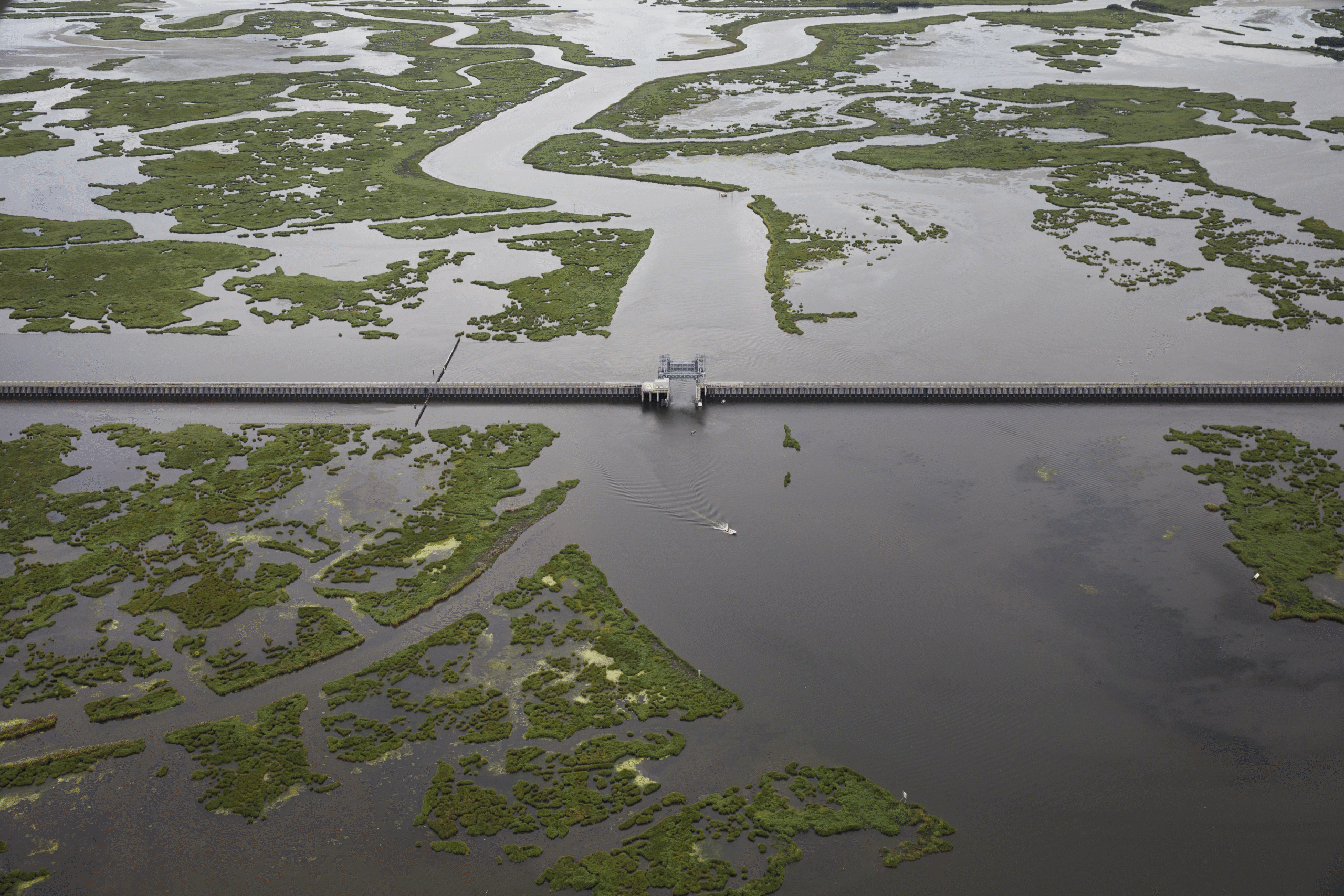
This urgency produced engineering marvels, such as the Lake Borgne Surge Barrier — a 1.8-mile structure with 26-foot-high gates that can be seen from space — and new pumping stations capable of moving massive volumes of water. But it also meant accepting a shorter-term design horizon. The system was built to maintain certification through 2057, not indefinitely.
Insurance Tied to Infrastructure
Flood insurance is central to the New Orleans economy. Louisiana has the nation’s highest concentration of NFIP policies, with six of the ten most heavily insured counties — or parishes — located in the metro area. In Jefferson Parish, west of New Orleans, 74 percent of homes carry federal flood coverage, compared to a national average below 4 percent.
The stakes are high: if the system dips below the 100-year standard, hundreds of thousands could lose eligibility for federal flood insurance. That would cripple property markets, reduce economic resilience, and potentially depopulate some neighborhoods.
“It’s heavy, it’s built with concrete and steel, and it sinks,” says Sandy Rosenthal, founder of levees.org. “It has to be constantly maintained.”
Progress and Pride — But Lingering Doubts
For some residents, the improvements are undeniable. In the Lakeview neighborhood, where the 17th Street Canal’s failure once flooded homes and businesses, a massive new barrier and pumping station now stand guard.
“It’s a lot better than before,” says seafood store owner Merlin Schaefer, whose business struggled for a decade after Katrina but has since rebounded.
The upgraded defenses have restored a sense of security and helped stabilize the city’s population, now around 365,000. They also safeguard cultural landmarks, economic hubs, and neighborhoods that many feared would be abandoned after 2005.
Sybil Orr, a local real estate agent, captures the city’s resilience: “We always come back.”
The Cost of Staying Safe
Still, the financial demands are relentless. In April, the Army Corps and the flood protection authority allocated $4.6 million to design necessary upgrades, with the Corps covering $3 million and the authority $1.6 million. But that is just a fraction of what will be needed.
Congress has authorized studies into a more ambitious system capable of withstanding a 200-year storm, but the price tag has been a sticking point since the Bush administration. For now, the focus remains on maintaining the current level of protection — and the economic safety net it enables.
Looking Ahead
Experts say it is unrealistic to expect the levee network to remain static. “The fundamental vulnerabilities remain,” Davis warns, noting that subsidence and sea-level rise will continually erode its effectiveness.
The Army Corps acknowledges this in its evaluations, pledging to work with local partners to raise the system periodically. “Like any levee system, [it] would need periodic lifts,” the agency said in a statement.
Meanwhile, some insurance companies remain hesitant to offer policies covering wind and other non-flood damage in the most vulnerable parishes. In Jefferson and Orleans parishes — home to just 17 percent of Louisiana’s population — households account for more than half the policies sold by Louisiana Citizens Property Insurance, the state-mandated insurer of last resort.
At the Disco Warehouse art gallery in the French Quarter, Joey Harmon voices a common uncertainty: “I’d like to think that post-Katrina, the infrastructure is now in place to protect the area. People aren’t really sure how effective it’s going to be.”
Resilience in the Delta
The new flood protection network is more than a physical barrier; it is the backbone of New Orleans’ recovery and a prerequisite for its future stability. It protects not only homes and businesses but also the city’s cultural identity, which has endured through disaster and doubt.
From the splash pads on the Lake Borgne Barrier to the reinforced T-walls guarding the canals, the system reflects both engineering prowess and the reality of a landscape in flux. The challenge now is not simply to defend against the next storm, but to sustain the defenses against time itself.
For the people who live here, that is a battle worth fighting — again and again.