
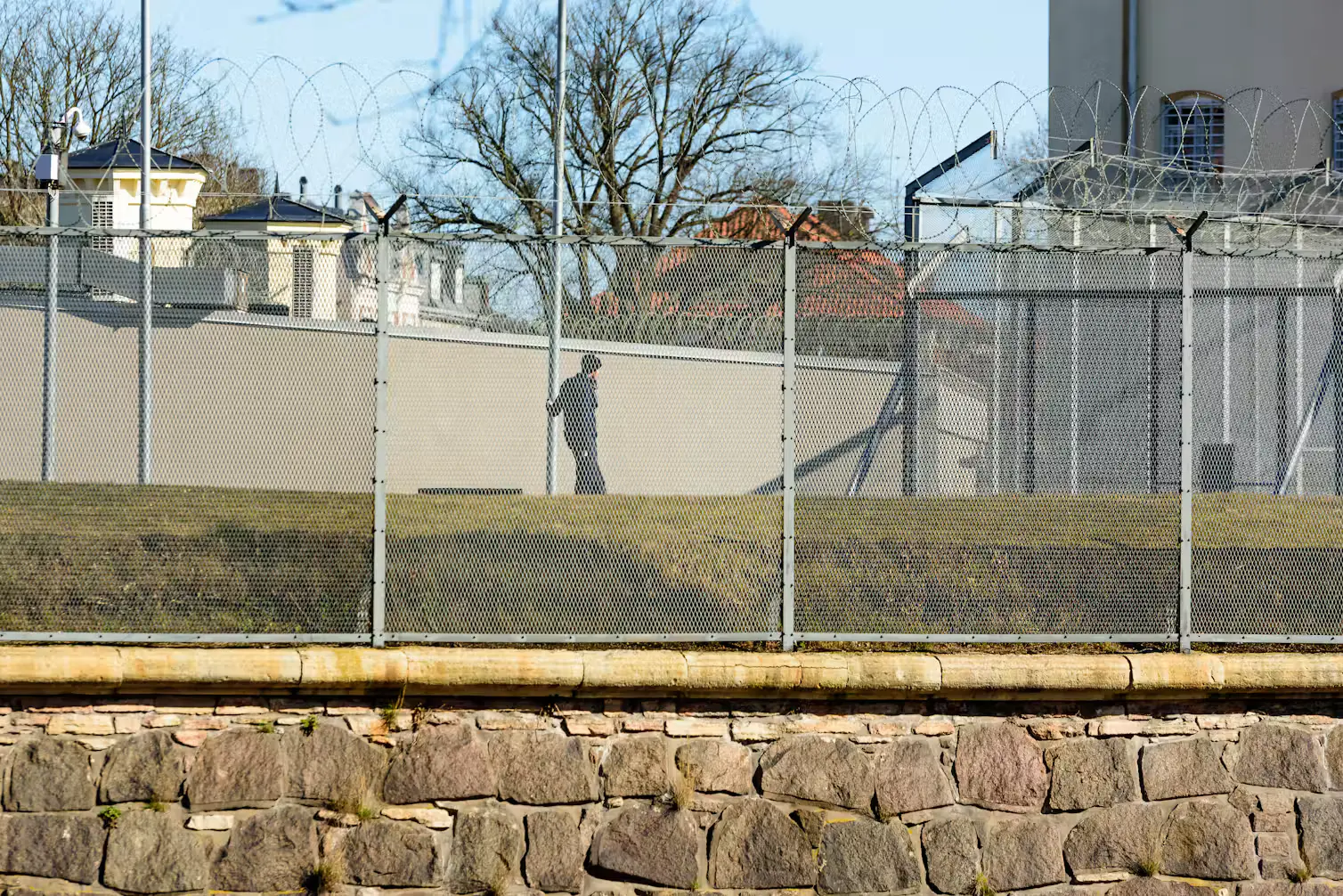
Denmark and the UK began the post-war era on the same path. Their prisons now tell two very different stories about trust, welfare and political choice.
There is an old maxim that a society should be judged not by how it treats its outstanding citizens, but by how it treats the people who break its laws. It is an uncomfortable yardstick. It pulls attention away from the hospitals and schools that countries like to showcase, and towards the institutions they would rather keep out of sight. Yet prisons are where the relationship between a state and the people in its care is tested most severely, precisely because that care earns so little public gratitude.
Measured this way, the United Kingdom and Denmark tell very different stories. In 2025, Denmark held around 69 people in prison for every 100,000 residents. The UK’s rate, at roughly 170 per 100,000, was well over twice as high. Two wealthy northern European democracies, both with welfare states and broadly comparable crime problems, have arrived at strikingly different answers to the same question: what is prison actually for?
A shared starting point
It was not always this way. In the decades after the second world war, both countries were regarded as pioneers of humane penal policy. Both made wide use of open prisons, both kept imprisonment rates low, and both treated rehabilitation as a serious public aim rather than a slogan.
The divergence came later. From the 1980s onwards, successive British governments moved steadily towards a more punitive model. Prison populations grew substantially, and conditions in many prisons deteriorated as numbers outpaced investment. Denmark, by contrast, largely held its earlier course.
The most persuasive explanation for that split lies outside the prison walls. Denmark’s universal welfare state, with heavily subsidised childcare, free healthcare and education, and consistently high standards of public service, has shaped a justice system that places greater weight on rehabilitation and reintegration. Danish prisoners keep the right to vote. They tend to maintain closer contact with their families, and they are encouraged, where possible, to take part in ordinary social life. The working assumption is that people in prison remain members of society, and will one day return to it.
The UK is still a welfare state, but its provision is more uneven, and that unevenness is mirrored in its criminal justice policy: higher incarceration, harsher conditions and a stronger emphasis on punishment and deterrence. Comparative research on prisons in England and Wales and in neighbouring Norway, whose system closely resembles Denmark’s, has found that imprisonment in Britain is often experienced as unpredictable and austere. The Nordic regime, by contrast, was described as more structured and more respectful.
Does it work?
The obvious question is which approach delivers. Do tough-on-crime policies that swell the prison population make a society safer, or does a welfare-based model built around rehabilitation do better?
At first glance, the headline figures look surprisingly close. Around 30% of people released from Danish prisons go on to reoffend; in England and Wales the figure is about 29%. A casual reader might conclude that penal philosophy makes little difference.
The detail tells another story. Among people serving sentences of less than a year, reoffending in Denmark sits at around 34%. In the UK it is roughly 66%, almost double. Short sentences are where the costs of a punitive system show most clearly. A few months inside is long enough to lose a home, a job and a relationship, but far too short for any meaningful rehabilitation.
In Britain, people often leave custody with little support to rebuild what was lost, and the cycle starts again. Short sentences, in other words, can manufacture the very instability that drives further offending.
No Nordic utopia
None of this means Denmark should be romanticised. Danish prisons may be safer, more humane and more survivable than many British ones, but they carry serious problems of their own. Critics have raised concerns about the use of isolation for people held before trial, inadequate care for women in custody, and the treatment of prisoners with gang affiliations.
In January 2026, the death of a prisoner in North Jutland prompted large protests from inmates and their families. According to reports, the man had suffered intense abdominal pain in the days before he died, and fellow prisoners claimed he had repeatedly sought medical help before he was found dead in his cell. The case has sharpened questions about whether the system’s humane reputation holds when it matters most.
Staffing is an equally pressing concern. The Danish prison service has lost around 30% of its staff over the past decade, and many prisons now run at or above capacity. Britain faces a similar crisis on a larger scale. Roughly 3,000 prison officers leave their posts in England and Wales every year, feeding a constant churn of recruitment and turnover. Combined with overcrowding, rising violence and a shortage of rehabilitative programmes, the result is a system stretched dangerously thin.
These pressures are reshaping daily life inside. Denmark’s open prisons, once the emblem of its rehabilitative approach, are changing. Low-risk prisoners increasingly serve their sentences in the community under electronic tag, which leaves open prisons housing a larger share of vulnerable people with complex needs. Drugs are a problem, and staff are often young and still in training, which makes keeping order harder.
In both countries, people in high-security conditions can spend up to 22 hours a day locked in their cells because of staff shortages and restricted regimes. It is a sobering reminder that very different penal philosophies can produce similarly harsh conditions once resources run out.
Researchers who have interviewed prisoners in Danish high-security facilities describe what this does to people. One man, repeatedly moved between prisons and held under strict conditions because he was labelled “difficult”, recalled entering a previous sentence angry at the authorities and leaving it hating them. His account captures a wider truth: punishment that leans heavily on containment tends to produce prisons that are more volatile, for staff and prisoners alike.
The contract
Yet the same body of research points to something distinctive about the Danish model. Imprisonment there is often understood in conditional terms. One prisoner likened it to a contract between the individual and the state: if he made a genuine effort to change, the state would hold up its end with a real chance of release and a life afterwards. Even while being punished, Danes tend to expect a great deal from their state.
That expectation reflects a broader pattern of trust. Around 60% of Danes say they trust their government; in the UK the figure is about 33%. Trust is not a soft extra in criminal justice. A prisoner who believes the system will honour its side of the bargain has a reason to engage with education, treatment and work. One who expects only arbitrariness and neglect has little incentive to do anything but endure.
In England and Wales, prisoners and staff alike describe a system defined by overcrowding, staff shortages and instability, with few genuine routes to rehabilitation. When a state cannot reliably provide the basics, the promise of reform rings hollow on both sides of the cell door.
Seen this way, the comparison is not a simple morality tale of humane Scandinavia against punitive Britain. It is a more complicated story about trust, expectation and the strain that underfunding places on any system, however well intentioned.
Choices, not destinies
Denmark’s own direction is now less certain. Its government has launched a new strategy on punishment that pairs longer sentences with additional rehabilitative initiatives. Critics have asked whether a rehabilitative model can survive when sentences grow and resources shrink: whether a country can lock people up for longer while still investing in the work needed to send them home changed.
That question applies with equal force in Britain. The gap between the two countries is not a fixed feature of national character. Both began the post-war era in roughly the same place, and the UK’s path diverged through a series of deliberate political decisions. Prison systems are shaped not only by national philosophies of punishment, but by the budgets, staffing levels and priorities that governments choose year after year.
The lesson from Denmark is not that Britain should copy a Nordic template wholesale. It is that rehabilitation is not a sentiment but a service, and like any service it works only when it is properly funded, staffed and believed in. A country that wants fewer people returning to prison has to make release a credible promise rather than a revolving door.
By the old maxim, a society is judged by how it treats those who have broken its laws. On current evidence, both countries have work to do. The difference is that one still has a reserve of public trust to draw on. The other must first rebuild it.