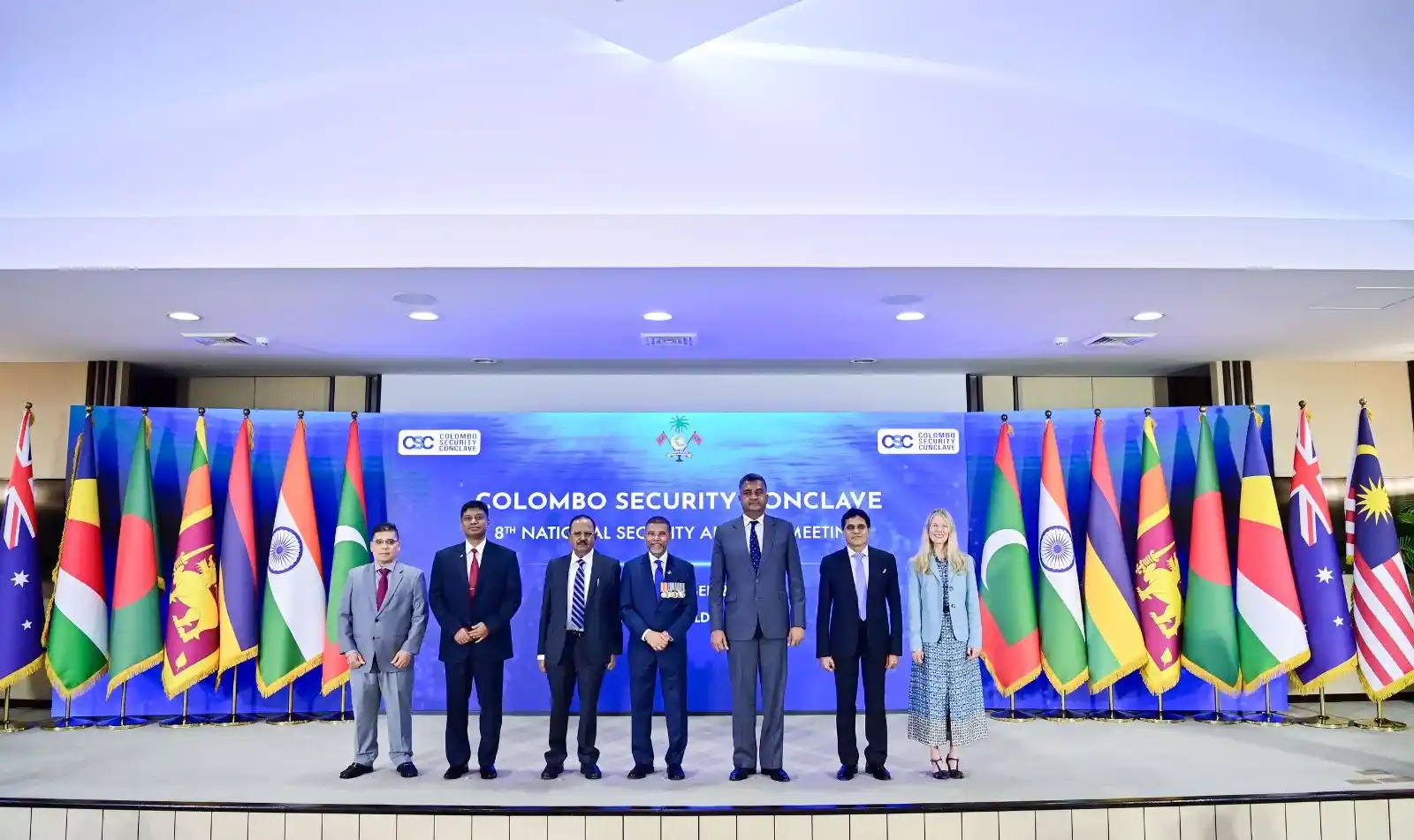
On November 25th, the Maldives hosted the eighth National Security Advisers’ meeting of the Colombo Security Conclave (CSC). Bringing together regional security officials, the meeting addressed a familiar but increasingly consequential set of challenges: maritime surveillance, transnational crime, terrorism and the protection of shared oceanic resources. Its significance, however, extended well beyond the formal agenda. At a time when the Indo-Pacific is increasingly defined by geopolitical competition, an alternative approach to regional security is taking shape in the Indian Ocean, one driven by the practical requirements of its littoral states rather than the strategic doctrines of distant powers.
At the centre of this development is India. The evolution of its maritime policy from SAGAR, announced in 2015, to MAHASAGAR in 2025 reflects a recognition that regional stability cannot be secured through military predominance alone. It requires building the institutional and operational capacities of neighbouring countries, particularly those whose economic security is inseparable from the waters surrounding them.
For smaller Indian Ocean nations, closer security cooperation with India need not represent a concession of strategic autonomy. Increasingly, it offers a means of exercising it.
The conventional understanding of sovereignty tends to emphasise territorial integrity, diplomatic independence and freedom from external interference. For island nations, however, sovereignty has a dimension that is frequently overlooked in geopolitical discourse: the capacity to administer vast maritime territories with disproportionately limited resources.
An exclusive economic zone may confer internationally recognised rights over fisheries and marine resources, but those rights are meaningful only when a country possesses the means to enforce them. Surveillance aircraft, patrol vessels, early-warning systems, intelligence networks and trained personnel require sustained investment that many developing economies cannot independently afford.
For Sri Lanka, the Maldives, Mauritius and Seychelles, these limitations are not abstract strategic concerns. Illegal fishing undermines coastal livelihoods. Narcotics trafficking strains domestic law enforcement. Marine pollution threatens fisheries and tourism. Disruptions to maritime commerce can rapidly translate into inflationary pressures, foreign exchange shortages and economic instability.
The distinction between national security and economic security is considerably narrower for island economies than it is for continental powers. A maritime security framework that recognises this reality is therefore more valuable than one constructed primarily around military deterrence.
India’s contribution becomes particularly evident when examined through the experience of Sri Lanka.
During the economic collapse of 2022, when shortages of fuel, food and medicines paralysed much of the country, India extended approximately $4 billion in emergency financial support through credit facilities, currency arrangements and deferred payments. The assistance provided breathing space at a moment when Sri Lanka’s access to international financing had severely contracted.
The episode established an important distinction between economic engagement during periods of stability and the capacity to respond when stability itself is threatened. Long-term infrastructure investment has its merits, but a country’s immediate requirements during a crisis are different. The speed, flexibility and proximity of Indian assistance gave it a strategic value that cannot adequately be measured through financial commitments alone.
A similar pattern emerged following Cyclone Ditwah in November 2025. The World Bank subsequently estimated that the disaster had caused $4.1 billion in direct physical damage. India launched Operation Sagar Bandhu, deploying naval assets, rescue personnel, aircraft, medical supplies and humanitarian assistance in coordination with Sri Lankan authorities. In December, New Delhi announced a further $450 million reconstruction package, comprising concessional credit and grants.
These interventions reveal something fundamental about the regional security relationship. India’s geographical proximity, logistical capabilities and familiarity with local conditions allow it to provide assistance across the increasingly indistinct boundaries between economic distress, humanitarian emergencies and conventional security.
Geography cannot guarantee goodwill. It can, however, make sustained cooperation considerably more effective. India has increasingly demonstrated the ability to translate that geographical advantage into practical regional assistance.
The institutional expression of this approach is visible in the Colombo Security Conclave.
Beginning as a trilateral maritime security initiative involving India, Sri Lanka and the Maldives in 2011, the mechanism was revived in 2020 and subsequently expanded to include Mauritius, Bangladesh and Seychelles. In August 2024, member states signed its charter and an agreement establishing a permanent secretariat in Colombo.
The decision to locate the secretariat in Sri Lanka deserves greater attention. Regional institutions involving an overwhelmingly larger power can easily become extensions of that country’s administrative and strategic priorities. Establishing the Conclave’s institutional headquarters in a smaller member state creates an opportunity to distribute regional responsibility more meaningfully.
For Colombo, the arrangement offers more than diplomatic visibility. It provides a platform through which Sri Lanka can contribute to setting regional security priorities, develop institutional expertise and participate in shaping the maritime order of which it is an indispensable part.
That opportunity is reinforced by the Conclave’s operational agenda, which encompasses maritime safety, counterterrorism, transnational organised crime, cybersecurity and disaster response. Unlike conventional military alliances, its utility does not depend on identifying a common adversary.
This is an important advantage in a region where economic development requires extensive international engagement, but where security cooperation must remain sensitive to geographical realities.
China’s economic presence in the Indian Ocean is substantial, and its commercial partnerships will remain relevant to regional development. Yet commercial engagement and security partnerships are not necessarily interchangeable. The capacity to respond rapidly to maritime emergencies, undertake sustained surveillance, train local personnel and maintain security infrastructure depends on operational relationships built over time.
India possesses considerable advantages in these areas. Its proximity, established institutional relationships and expanding maritime capabilities give it a distinctive role that cannot easily be replicated by external powers. Smaller nations need not disregard their other international partnerships to recognise that distinction.
The Maldives illustrates how this recognition can survive considerable political change.
The disagreement over the presence of Indian military personnel in 2024 was widely interpreted as a setback for New Delhi. India’s decision to accommodate Maldivian concerns by replacing military personnel with civilian technical staff, while preserving essential humanitarian aviation services, demonstrated a capacity for diplomatic adaptation.
Rather than allowing a politically sensitive disagreement to define the entire bilateral relationship, both countries preserved the foundations of cooperation. By July 2025, the Maldives and India had concluded further agreements, including a credit facility equivalent to $565 million.
The hosting of the Colombo Security Conclave in the Maldives in November 2026 suggests that the relationship possesses a resilience that earlier predictions of strategic estrangement underestimated.
A comparable development is evident in Seychelles, where India handed over the patrol vessel Lespwar in June 2026 and supported the refitting of another coast guard vessel, Zoroaster. These investments strengthen Seychelles’ ability to undertake maritime surveillance, search and rescue, and the protection of its waters under its own national authority.
The strategic importance of such assistance lies precisely in the capabilities it leaves behind.
India’s MAHASAGAR framework has begun extending this logic across the Western Indian Ocean. In April 2025, the deployment of Indian Ocean Ship Sagar brought together 44 naval personnel from nine partner countries, including Sri Lanka, Mauritius, Seychelles, Kenya, Tanzania and Mozambique, alongside an Indian crew.
The initiative offered practical experience in multinational maritime operations and coordinated surveillance. More importantly, it demonstrated how regional security cooperation could extend beyond diplomatic declarations into shared professional expertise.
Sri Lanka’s India-funded Maritime Rescue Coordination Centre, commissioned in 2024 through a $6 million grant, provides another example. With its principal facility in Colombo, a subsidiary centre in Hambantota and installations along the coastline, the system strengthens nationally administered maritime emergency response.
Such arrangements represent a form of security cooperation whose benefits remain tangible regardless of changes in government or fluctuations in diplomatic relations.
There are, of course, legitimate concerns about asymmetry. India’s size and military capabilities will inevitably give it considerable influence within regional institutions. The longstanding fisheries dispute in the Palk Bay also demonstrates that geographical proximity can generate friction alongside opportunity.
Resolving these disagreements requires political commitment, particularly in protecting the livelihoods of northern Sri Lankan fishing communities while facilitating economically viable alternatives for Indian fishermen. The strength of regional cooperation will ultimately depend on its ability to address such difficult questions without allowing them to overwhelm the wider relationship.
But institutionalised cooperation offers a more credible means of managing these challenges than strategic distance. Regular dialogue, shared operational procedures and sustained engagement create mechanisms through which disagreements can be addressed while preserving common interests.
The next phase of the Colombo Security Conclave should therefore concentrate on measurable outcomes: improved detection of illegal fishing, stronger maritime intelligence networks, faster disaster response, greater local technical expertise and more effective coordination between national enforcement agencies.
For the wider Global South, this emerging model carries particular relevance. Developing countries are frequently presented with a choice between preserving strategic independence and accepting the assistance necessary to overcome their capacity constraints. The Indian Ocean experience suggests that this need not be an unavoidable contradiction.
Strategic autonomy should not be confused with strategic isolation. A country is not necessarily more independent because it maintains an equal distance from every major power. It is more independent when it possesses the institutional strength, economic resilience and security capabilities required to make meaningful choices.
India’s evolving maritime engagement offers smaller Indian Ocean nations an opportunity to acquire precisely those capabilities through a framework anchored in regional priorities.
The challenge for the Indian Ocean is not to reproduce the rivalries that increasingly define the wider Indo-Pacific, but to construct a regional order sufficiently resilient to withstand them.
India’s most consequential contribution to that order may ultimately lie not in extending the reach of its own power, but in enabling the countries around it to exercise theirs.