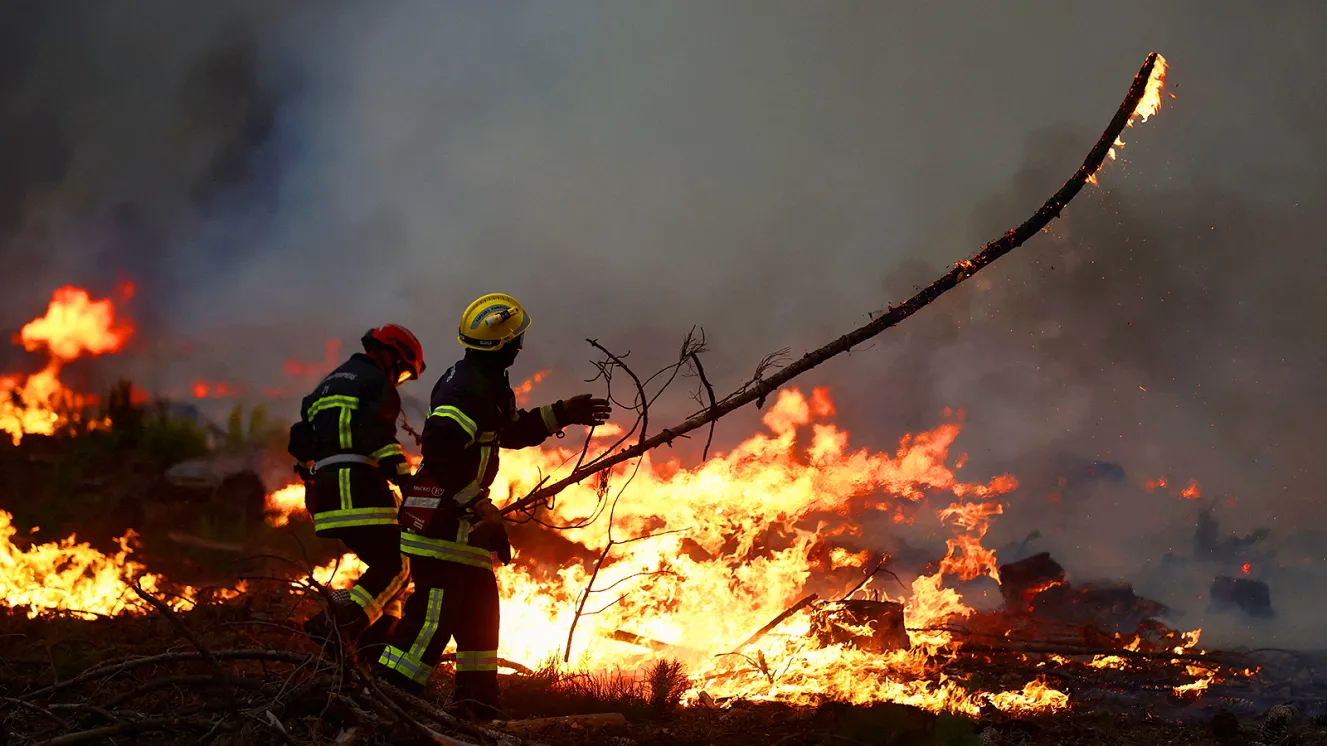
France is watching, again, as flames expose the seams in its national fabric. Wildfires near Bordeaux and across the southwest have driven tens of thousands from their homes, pushed emergency services to their limits, and forced Paris to accept help from neighbors across Europe. The images are now familiar: convoys of evacuees on highways, water-bombing planes cutting low over blackened pine forests, exhausted firefighters catching a few hours of sleep before the next flare-up. What should not become familiar is the political reflex that follows. Climate disasters in France are no longer simply environmental events. They are tests of state capacity, and increasingly, they are opportunities for a far right that has built its entire identity on the claim that the French state cannot protect its own people.
Marine Le Pen’s National Rally has spent the better part of a decade honing a single argument: that France’s institutions are overextended, hollowed out, and incapable of shielding citizens from the threats that matter most to them, whether that threat is framed as insecurity, immigration, or disorder in the banlieues. It is a narrative built for flexibility. It does not require a coherent theory of the state; it requires only a steady supply of crises that can be folded into the same story of decline and abandonment. Wildfires fit that story perfectly. A burning forest does not care about ideology, but the politics that follow the smoke very much do. And so the National Rally is doing what it has always done: translating fear into grievance, and grievance into blame, this time with climate catastrophe as the vehicle.
The message finds fertile ground because the soil was already loosened. Polling this month has shown widespread public dissatisfaction with Emmanuel Macron’s record on climate adaptation, and criticism of the government’s handling of the heatwave and the fires has come not just from the far right but from opposition voices across the political spectrum. That matters, because it means the National Rally does not need to offer a serious, technocratic alternative on forest management or emergency logistics. It only needs to sound like the loudest and most forceful critic in a room already full of frustration. In politics, being first to voice anger is often mistaken for being right about the remedy. That is the opening the far right is exploiting, and it costs them very little to do so.
But here is where the story gets more complicated, and more useful, for anyone trying to think clearly about what comes next. The National Rally’s own attempt to claim credibility on climate adaptation has been thin. Its signature proposal, built substantially around promises of expanded air conditioning, has been criticized as vague, less ambitious than its own marketing suggests, and dependent on borrowing rather than genuine long-term investment. That is not a minor technical quibble. It goes to the heart of what adaptation actually requires. Air conditioning does not stop a wildfire from racing through tinder-dry underbrush. It does not rebuild the firebreaks that used to interrupt a blaze before it could jump a ridge. It does not fund the aircraft, the trained personnel, or the water infrastructure that determine whether a fire burns for a day or a week. Climate adaptation is not a culture-war prop to be waved at a podium. It is plumbing. It is logistics. It is the unglamorous, expensive work of forest management, building codes, water planning, and land-use policy that pays off exactly when a crisis like this one arrives, and is invisible the rest of the time. Slogans about national strength do not substitute for any of it, and when the far right tries to make that substitution, the gap between its rhetoric and its actual policy proposals becomes visible, if anyone bothers to look.
This is also where the French state has, in fact, shown something worth acknowledging. The mobilization of firefighters, soldiers, aircraft, and European mutual-aid assistance in response to these fires demonstrates that French institutions have not collapsed. The capacity to respond, at scale, under pressure, still exists. This is not a small thing, and it undercuts the crudest version of the far right’s argument, the idea that the state simply does not show up. The state does show up. The harder and more honest question is not whether France can react to a crisis once it has already started, but whether it can modernize fast enough to get ahead of a climate reality that is no longer arriving on the horizon. It is already here, in the forests, on the outskirts of cities, in the water tables. Reaction is not the same as preparation, and France’s political class has too often let the two blur together, treating a scrambled emergency response as proof that the underlying strategy is sound.
That confusion is precisely the space in which far-right politics thrives. It survives and grows in the gap between public alarm and visible government competence. When mainstream parties respond to every crisis with reassurance, with promises that lessons will be learned and plans will be updated, while the substantive work of resilience lags year after year, they hand the National Rally exactly the argument it wants: that only they are willing to say plainly that something is broken. The tragedy is that this framing does not require the National Rally to be right about the fix. It only requires the mainstream to keep looking evasive about the diagnosis.
The answer to that dynamic is not for centrist and left-wing politicians to match the far right’s fury with fury of their own, performing outrage to prove they, too, feel the crisis. That is a losing game, because outrage is the National Rally’s home turf, not theirs. The better path, and the harder one, is to out-compete the far right on seriousness rather than volume. That means telling the truth about a France that is already warming and already burning, rather than treating each fire season as an unfortunate anomaly. It means funding resilience, forest management, water systems, building standards, emergency infrastructure, as though these were permanent national priorities rather than line items to be trimmed in a tight budget year. And it means abandoning the comforting fiction that catastrophe is a temporary disruption to be managed until things return to normal. There is no normal to return to. There is only the new baseline, and the question of whether France’s institutions adapt to it faster than its political opposition can exploit the space created by hesitation.
The forests around Bordeaux will eventually stop burning, at least for this season. The political fire they have lit will not go out so easily, and how it is answered, with seriousness or with slogans, will say a great deal about what kind of state France intends to be in a hotter, harder decade.