Carney’s historic visit to Saint-Pierre-et-Miquelon signals deepening Canada-Europe ties as both sides look to counter unpredictable pressure from Washington
Canadian Prime Minister Mark Carney did not have to fly across the ocean to set foot on French territory last weekend. He only had to travel to the edge of his own coastline.
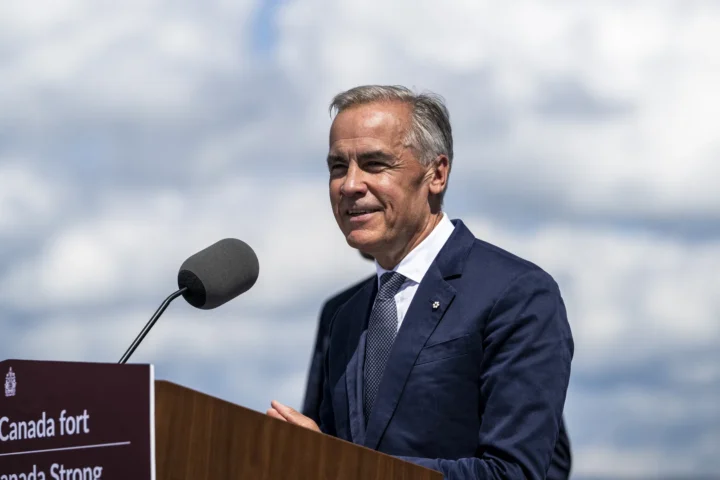
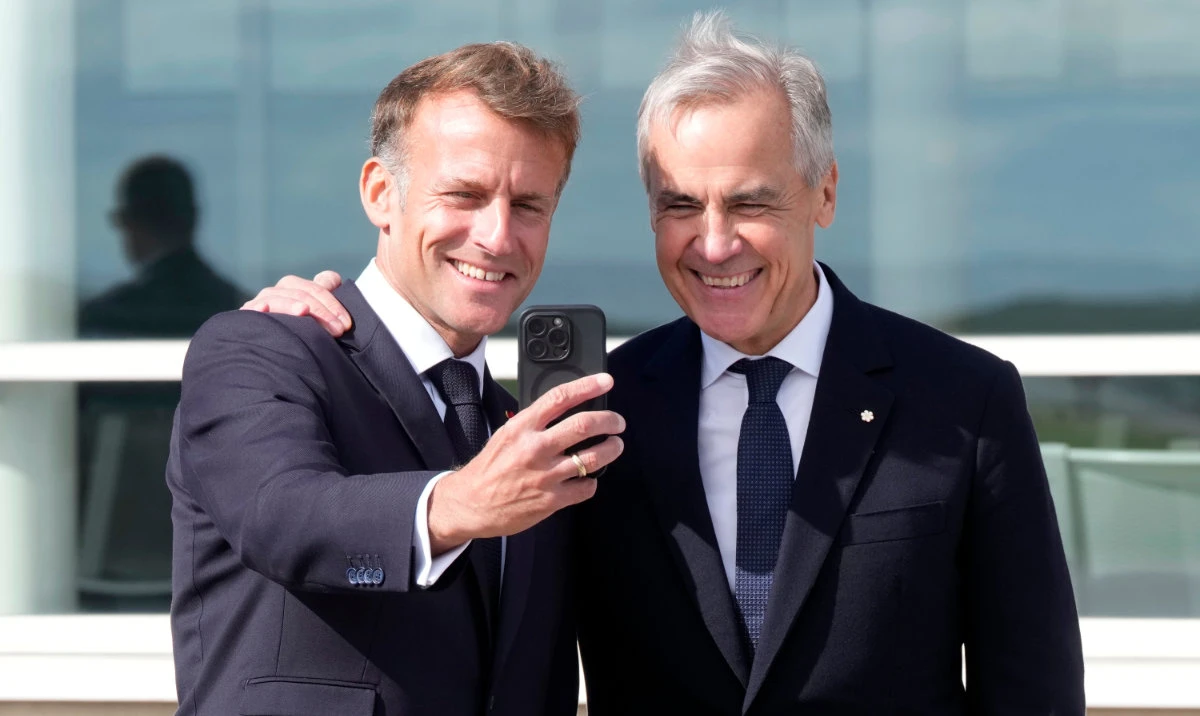
In a first for a sitting Canadian prime minister, Carney travelled to Saint-Pierre-et-Miquelon, the small French archipelago sitting just 25 kilometres off Newfoundland, to meet French President Emmanuel Macron. The choice of venue was no accident. At a moment when Canada and the European Union are drawing closer together, largely in response to an increasingly volatile United States, the tiny islands offered a fitting stage.
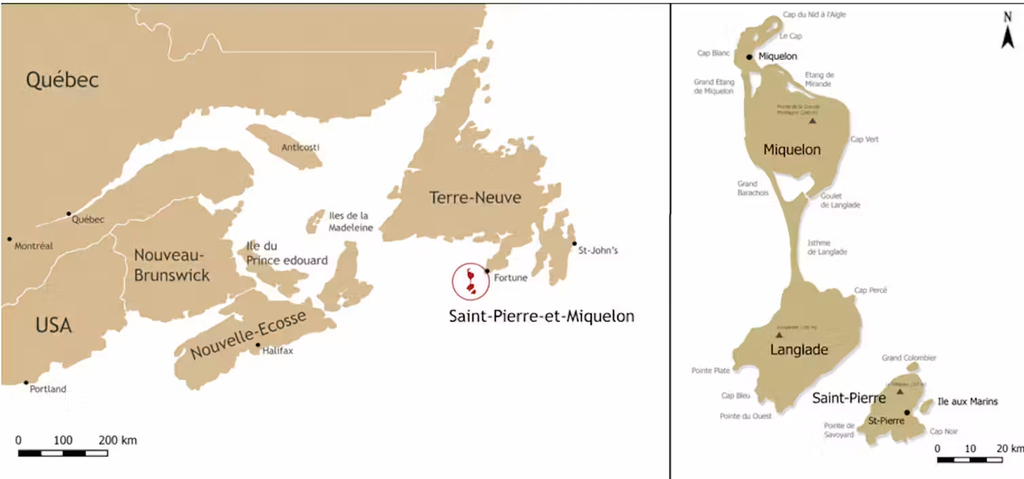
With a population of roughly 6,000 spread across 242 square kilometres, Saint-Pierre-et-Miquelon rarely draws global attention. But its position — a fragment of France planted directly off Canada’s Atlantic shore — has taken on new weight as Ottawa and Paris look for ways to shore up their partnership.
A Provocation From Washington
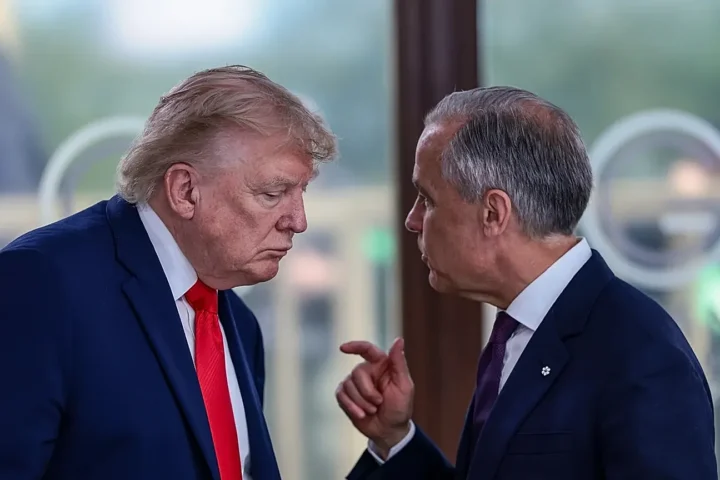
The timing was hard to ignore. U.S. President Donald Trump, who has repeatedly floated the idea of absorbing Canada as a 51st state, recently shared a map on Truth Social depicting an enlarged United States swallowing not only Canada and Greenland but Saint-Pierre-et-Miquelon as well.
It was only the latest chapter in a long history of American interest in the islands. More than a century ago, U.S. Senator Henry Cabot Lodge pushed for American control of the territory. In 1941, Washington bristled when Charles de Gaulle’s forces wrested the islands from Vichy French administration, setting off a diplomatic row with the Roosevelt White House. More recently, in April 2025, Trump’s sweeping tariff regime slapped Saint-Pierre-et-Miquelon with a 50 per cent duty — one of the steepest rates issued anywhere in the world, despite the territory’s minuscule economic footprint.
Old Rivals, Older Waters
The relationship between Canada and the French archipelago has not always been friendly. Indigenous peoples inhabited the islands for nearly five millennia before French explorer Jacques Cartier arrived in 1536. What followed was centuries of tug-of-war between France and Britain, with the islands changing hands multiple times before settling permanently under French rule in 1816.
Fish, not politics, kept the dispute alive. Treaties preserved France’s fishing rights near Newfoundland long after it had lost most of its North American territory, and Saint-Pierre-et-Miquelon became the base for that industry. Conflicts over catch quotas and access to the Grand Banks simmered for decades, boiling over in 1988 with seized boats and tit-for-tat diplomatic responses.
Everything changed in 1992. Canada’s collapse of the cod fishery gutted the archipelago’s economic backbone, even as international arbitrators granted France a narrow maritime zone around the islands — an area fishermen nicknamed the “French Baguette” for its shape. Friction flared again in 2014 when France tried, unsuccessfully, to extend its continental shelf claims over Canadian objections.
That layered history — part rivalry, part shared dependence — is precisely why the two leaders’ choice of meeting place carried symbolic force.
Sovereignty on Display
By standing together in Saint-Pierre rather than Paris or Ottawa, Carney and Macron sent a pointed message: geographic closeness to the United States does not mean vulnerability to it.
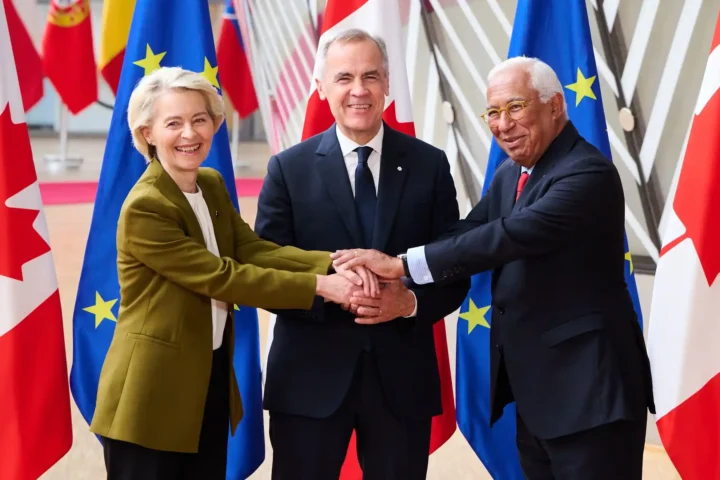
For Carney, the trip is part of a wider campaign to reduce Canada’s exposure to Washington’s economic pressure tactics. Speaking at Davos in January, the prime minister warned of a “rupture” in the global order and argued that mid-sized powers need to band together to blunt coercion from larger ones. His subsequent address to the European Parliament pushed that idea further, welcoming early talk of Canada becoming an EU “associate member” — a status still loosely defined but already generating discussion on defence, energy, critical minerals and technology co-operation.
Saint-Pierre-et-Miquelon gives that abstract diplomatic project an actual location. Though it is formally linked to the EU as an overseas territory rather than a full member state, the archipelago hands France — and by extension Europe — a physical foothold within sight of Canadian shores.
Betting on Reinvention
For the islands themselves, the diplomatic spotlight comes at a critical juncture. The fishing industry that once defined the territory has never recovered from the cod moratorium. Living costs remain high, the population continues to shrink, and the community leans heavily on imports and transfers from mainland France. Climate change has made the challenge existential: rising seas have already forced planners to begin relocating the village of Miquelon.
Officials on the islands are now looking for new economic footing, and Canada could be central to that search. The archipelago sits near the entrance to the St. Lawrence Seaway, positioning it as a potential hub for port and shipping services. France has also floated using the islands as a staging point for Arctic co-operation with Canada, Denmark and Greenland — a plan that has gained urgency following a newly announced U.S.-Denmark agreement over Greenland.
Energy could offer another avenue. Carney has proposed exporting Canadian liquefied natural gas and hydrogen to European markets through new port facilities on Canada’s East Coast and in the Arctic, and Saint-Pierre-et-Miquelon may seek a role supporting that infrastructure if investment materializes. The territory is also already home to a ground station for Europe’s Galileo satellite navigation system, and officials see potential in future undersea cable projects that could position the islands as a transatlantic data relay.
Trump’s expansionist rhetoric may have inadvertently pushed France and Canada into closer alignment. But for the residents of Saint-Pierre-et-Miquelon, the real question is whether renewed diplomatic attention translates into something more durable: actual investment and a sustainable economic future for a territory that has spent decades searching for one.