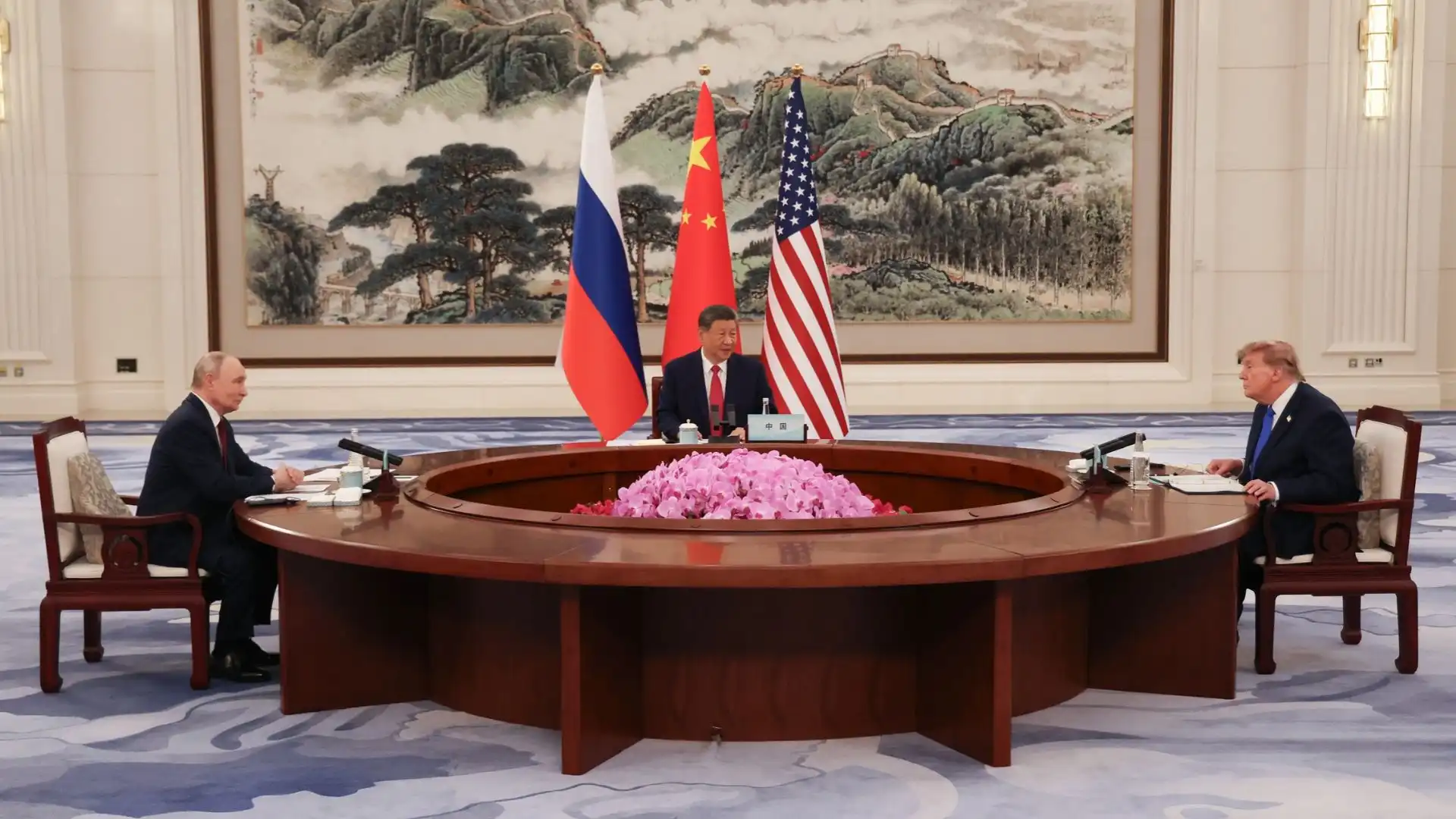
China seeks to translate its economic influence into diplomatic leverage as Washington, Moscow and Beijing explore cooperation on energy security, nuclear risks and global governance.
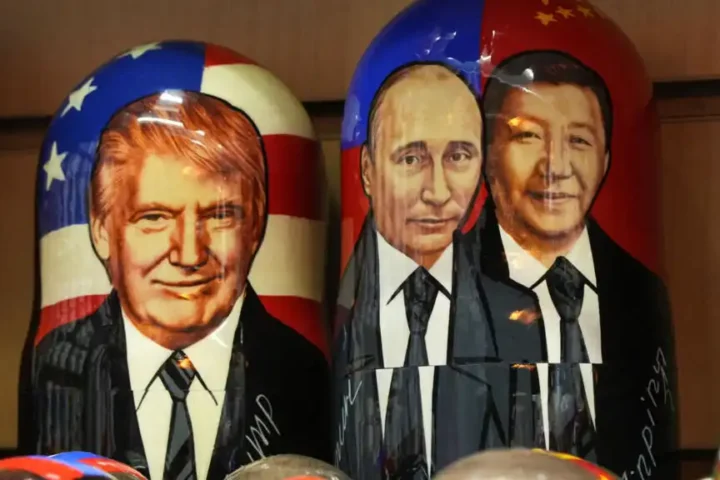
The emerging balance of power between the United States, China and Russia is increasingly being shaped by a combination of economic competition, military confrontation and diplomatic bargaining. The reported trilateral summit in Shenzhen, bringing together US President Donald Trump, Chinese President Xi Jinping and Russian President Vladimir Putin, has renewed debate over whether the world's three major powers are moving towards a new framework for managing their rivalries.
Comparisons with the 1945 Yalta Conference, where Allied leaders negotiated arrangements for post-war Europe, have accompanied discussions of the meeting. Yet the geopolitical landscape today is fundamentally different. The international system is more economically interconnected, regional powers exercise greater autonomy, and the competing security interests of Washington, Beijing and Moscow make any comprehensive division of influence difficult to achieve.
Rather than producing a sweeping geopolitical settlement, the discussions reportedly concentrated on areas where cooperation remains possible despite strategic disagreements. Energy security, nuclear risk reduction and the future of international institutions emerged as potential foundations for engagement.
The significance of such an understanding lies not necessarily in the commitments themselves, but in whether the three governments can reconcile their competing interests sufficiently to implement them.
Beijing's Growing Diplomatic Leverage
China occupies a distinctive position in the evolving strategic equation. While Russia remains deeply involved in the war in Ukraine and the United States faces mounting security challenges in the Middle East, Beijing has sought to avoid direct military entanglement in either conflict.
This relative distance from the fighting has allowed China to concentrate resources on industrial development, technological advancement and the expansion of its international economic relationships.
China remains one of the world's largest economies and an important contributor to global economic activity. Its manufacturing capacity, position in critical supply chains and extensive commercial relationships give Beijing considerable influence over the economic calculations of other major powers.
That influence has increasingly become an instrument of diplomacy.
Xi's emphasis on sovereignty, territorial integrity and respect for national interests reflects China's longstanding preference for a geopolitical environment in which economic development can continue without major disruptions.
For Beijing, stability is not simply a diplomatic objective. It is an economic necessity.
A prolonged confrontation between major powers could disrupt trade routes, raise energy costs and weaken the international demand on which Chinese manufacturing continues to depend. Consequently, China has strong incentives to encourage strategic restraint, even as it competes with the United States for technological and geopolitical influence.
The comparison with America's position at the end of the Second World War is instructive, although imperfect. The United States emerged from that conflict with an exceptionally strong industrial base and substantial influence over the institutions of the post-war international order.
China today possesses considerable manufacturing and commercial strength, but operates within an established international system in which American financial and military power remains formidable.
Beijing's challenge is therefore different: to convert economic interdependence into diplomatic influence without triggering the very confrontation that could undermine its development.
Taiwan Remains a Critical Test
Among the unresolved disputes, Taiwan continues to represent one of the most sensitive points in US-China relations.
Washington's longstanding policy recognises the government of the People's Republic of China as the sole legal government of China, while maintaining unofficial relations with Taiwan under a framework that includes the Taiwan Relations Act.
The United States does not support Taiwan independence, but this position does not amount to an endorsement of Beijing's claim that Taiwan must be brought under its control by force.
The distinction remains central to regional security.
China regards Taiwan as a core national interest and has repeatedly opposed foreign military and political involvement that it considers interference in its internal affairs. Washington, meanwhile, maintains security relationships across the Indo-Pacific and continues to regard peace and stability in the Taiwan Strait as essential to regional order.
Taiwan's democratically elected government and population also have their own political preferences and security concerns, which cannot be reduced to negotiations between Washington and Beijing.
Any diplomatic understanding built around mutual respect for national interests will therefore encounter an immediate contradiction: what Beijing considers an essential security demand may be regarded elsewhere as an unacceptable restriction on political autonomy.
The durability of US-China engagement will depend less on declarations of mutual respect than on military deployments, diplomatic decisions and the management of potential crises in the Taiwan Strait.
Energy Security Offers a Narrow Opening
The energy market presents a more immediate opportunity for cooperation.
The conflict involving Iran has heightened concerns over the security of the Strait of Hormuz, one of the world's most strategically important maritime corridors. The strait has historically carried roughly one-fifth of global petroleum liquids consumption, making disruptions particularly consequential for international oil prices.
China's dependence on imported energy gives it a direct interest in maintaining access to Gulf producers. Its economic relationship with Iran is important, but Beijing also maintains extensive commercial and diplomatic ties with Saudi Arabia, the United Arab Emirates and other regional states.
These overlapping relationships create both opportunities and constraints.
Washington could seek Chinese diplomatic assistance in reducing tensions with Tehran, particularly over maritime security and nuclear proliferation. Beijing, however, would be reluctant to sacrifice its relationship with Iran without securing broader economic or strategic benefits.
The reported Shenzhen declaration offers a limited starting point. The three governments agreed to support stable energy flows and increase the production and supply of refined petroleum products, but provided no detailed implementation mechanism or timetable.
For Russia, another major energy producer, the calculations are different. Moscow has benefited from maintaining substantial energy relationships with Asian markets amid Western sanctions, while its broader economic interests remain affected by fluctuations in global oil prices.
Cooperation among the three powers could help reduce market uncertainty, but their competing energy interests make a comprehensive agreement considerably more complicated than the declaration suggests.
Nuclear Competition Complicates Strategic Stability
The nuclear dimension of the meeting highlights another fundamental imbalance.
Russia and the United States continue to possess the overwhelming majority of the world's nuclear weapons, while China is expanding an arsenal that remains considerably smaller.
Estimates published by international nuclear research organisations illustrate the substantial difference between the established American and Russian stockpiles and China's growing nuclear capabilities.
This asymmetry complicates negotiations over arms control.
Washington has increasingly sought to include China in discussions about future nuclear limitations, arguing that Beijing's expanding capabilities will eventually have significant consequences for strategic stability.
China has traditionally maintained that the countries possessing the largest arsenals should undertake substantial reductions before expecting comparable commitments from smaller nuclear powers.
Russia, meanwhile, views nuclear deterrence as an essential element of its military strategy and international standing.
The three governments therefore approach arms control from markedly different positions.
The reported Shenzhen declaration reaffirmed the principle that nuclear war must never be fought and committed the countries to dialogue on nuclear risks and non-proliferation. It did not establish binding arsenal limits, verification arrangements or a timetable for negotiations.
The distinction is important. A commitment to reducing the danger of nuclear confrontation is politically meaningful, but it does not necessarily imply agreement on reducing the weapons themselves.
More realistic areas of cooperation could include improved crisis communication, greater transparency regarding nuclear doctrines and measures to prevent military incidents from escalating into nuclear confrontation.
Even these limited objectives would require a level of mutual confidence that remains difficult to establish.
Ukraine Exposes the Limits of Great Power Bargaining
Russia's continuing war in Ukraine remains among the clearest obstacles to any broader understanding.
For Moscow, the conflict is closely connected to its demands concerning European security and Ukraine's geopolitical orientation. For Kyiv and its European partners, the central questions involve territorial sovereignty, military security and the conditions under which a durable peace could be established.
These differences cannot be resolved solely through an understanding between Russia and the United States.
Ukraine retains its own political agency, while European governments have significant interests in the security arrangements that would follow any settlement.
Although Ukraine reportedly featured in diplomatic discussions surrounding the Shenzhen meeting, the declaration contained no specific provisions addressing the war. No substantive breakthrough towards a settlement emerged.
China's position adds another layer of complexity.
Beijing maintains a close strategic partnership with Moscow, while also seeking to preserve economic relationships with European countries. Its diplomatic approach has generally emphasised negotiation and opposition to prolonged conflict, without adopting the Western position on Russia's responsibility for the invasion.
Consequently, China has an interest in preventing further escalation without necessarily supporting an outcome that would substantially weaken Russia.
The absence of a concrete Ukraine agreement illustrates the broader limitations of trilateral diplomacy. The three powers may be able to establish principles for managing their relationships, but regional conflicts involve additional governments whose interests cannot simply be negotiated away.
Global Institutions Become Another Arena of Competition
Perhaps the most consequential aspect of the reported Shenzhen declaration concerns international institutions.
The United States, China and Russia agreed to pursue reform of the United Nations, while emphasising state consent and the immunities of government officials in relation to international judicial institutions.
Their declaration also cautioned against the misuse of jurisdiction by the International Criminal Court and similar bodies.
The language carries significant political implications.
All three countries are permanent members of the UN Security Council and possess veto powers. Their privileged positions within the institution provide considerable influence over international security decisions.
However, they differ substantially in their approaches to international law, intervention and accountability.
Russia's opposition to the ICC has acquired particular significance following the court's 2023 arrest warrant against Putin over alleged war crimes involving the unlawful deportation and transfer of Ukrainian children.
The United States and China are not parties to the Rome Statute, the treaty establishing the ICC, although their reasons for remaining outside the court's jurisdiction reflect different historical and political considerations.
The convergence of their positions raises questions about the future of international accountability.
Advocates of stronger state sovereignty argue that international institutions must respect the consent of governments and avoid politically selective enforcement. Supporters of international criminal justice, however, maintain that accountability mechanisms are essential precisely when powerful governments are implicated in serious violations.
This tension extends beyond the ICC.
Debates over UN reform increasingly concern the representation of emerging economies, the use of veto powers and the ability of international institutions to respond effectively to armed conflicts.
For countries such as India, which has long advocated reform of the Security Council and a greater role for developing nations, the direction of these discussions will be particularly important.
A reform process shaped predominantly by the existing permanent members could reinforce established power structures rather than address longstanding demands for more representative global governance.
A Changing Balance, Not a New World Order
The reported Shenzhen summit represents a significant diplomatic development, but its implications should not be confused with the creation of a new geopolitical order.
The three countries possess sufficient economic, military and political influence to shape international outcomes. Yet none can unilaterally determine the choices of other states, and their relationships remain characterised by substantial competition.
China's position is especially noteworthy.
By hosting the reported trilateral meeting, Beijing demonstrated its growing ability to convene rival powers and influence the diplomatic agenda. The symbolism is significant for a country seeking recognition not merely as an economic competitor to the United States, but as a central participant in managing international security.
For Washington, engagement offers opportunities to address nuclear risks, energy disruptions and regional instability without abandoning strategic competition with Beijing.
For Moscow, participation reinforces its claim to a central role in global security negotiations despite the continuing consequences of the Ukraine war.
Nevertheless, the summit's reported declaration remains far narrower than the geopolitical questions confronting the participants.
There is no agreement on Taiwan's future, no settlement in Ukraine, no comprehensive framework for resolving tensions with Iran and no binding arrangement to limit nuclear arsenals.
The immediate outcome is therefore best understood as an attempt to establish mechanisms for coexistence rather than a redistribution of global power.
The larger question is whether such mechanisms can survive the pressures created by the very conflicts they are intended to manage.
Energy cooperation could be undermined by further military escalation in the Middle East. Nuclear dialogue could stall over disagreements about arsenal sizes and verification. Institutional reform could expose competing interpretations of sovereignty and accountability.
The success of the Shenzhen process will ultimately be measured not by the symbolism of three leaders sharing a diplomatic platform, but by whether their governments translate broad commitments into practical agreements.
For the international community, the stakes extend well beyond the three capitals. The choices made in Washington, Beijing and Moscow will affect global trade, regional security, energy markets and the credibility of multilateral institutions.
Shenzhen may eventually be remembered as an early step towards a more structured relationship among the world's leading powers. For now, it demonstrates something more modest but equally revealing: even governments divided by profound strategic disagreements recognise the necessity of maintaining channels of cooperation.
Whether that recognition produces lasting stability will depend on their willingness to accept constraints on their own ambitions, rather than merely demanding restraint from others.